
Polo Shirt vs T-Shirt for Company Uniforms: Which Is Better?
Compare polo shirts and crew-neck T-shirts for Malaysian company uniforms by staff role, comfort, branding, fit, care, cost and reorder control.
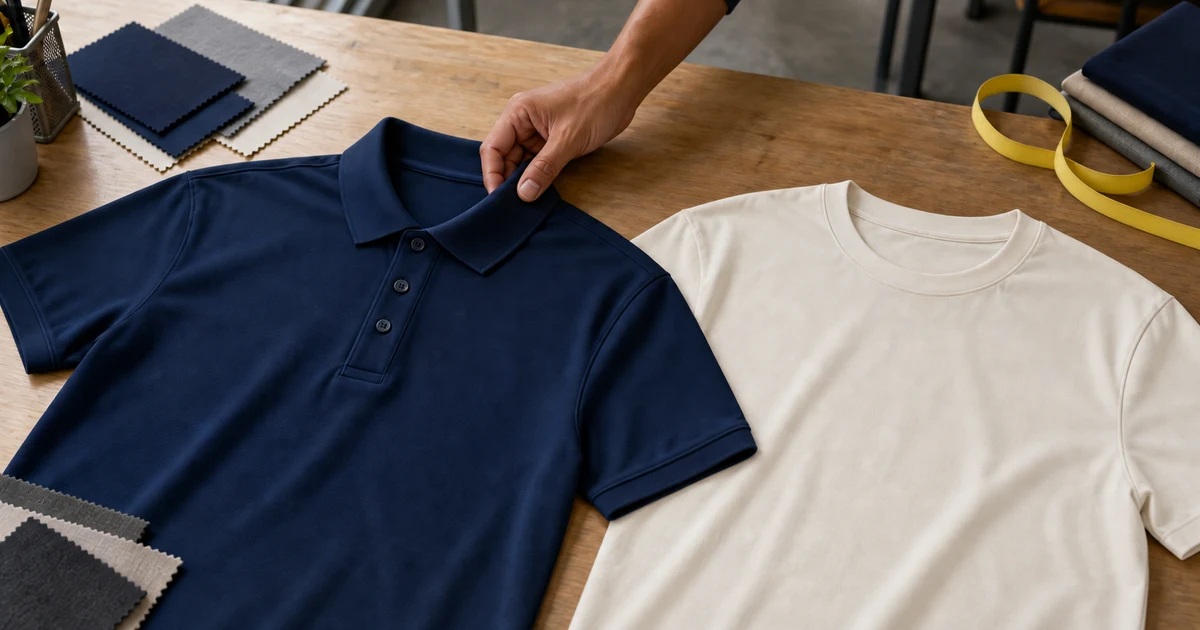
The short answer: choose a polo shirt when customer-facing staff need a structured smart-casual uniform; choose a crew-neck T-shirt when movement, casual presentation, event use or a larger printed graphic matters more. If departments work differently, use both under one controlled uniform system instead of forcing one shirt onto every role.
The collar is only the visible difference. Fabric, cut, decoration, washing frequency, stock availability and the actual workplace decide whether a shirt succeeds as a uniform.
Polo shirt vs T-shirt at a glance
| Decision point | Polo shirt | Crew-neck T-shirt |
|---|---|---|
| Visual tone | Structured and smart-casual | Relaxed, simple and approachable |
| Typical starting roles | Reception, showroom, sales, service counter and office events | Event crew, promotions, warehouse support, casual retail and active teams |
| Logo layout | Often a compact chest logo; sleeve or back can be added | Works with a chest logo or larger front and back graphics |
| Fabric range | Pique, interlock, microfiber and blends with a collar and placket | Jersey, interlock, microfiber and other knits without a placket |
| Fit checks | Collar, placket, shoulder, sleeve and body length | Neck opening, shoulder, sleeve, chest and body length |
| Decoration risk | Texture and placket can restrict fine detail or placement | Thin or stretchy fabric can distort, show through or react to heat |
| Reorder control | Collar shape and trim make exact product matching important | Product code, knit, fit and dye lot still need control |
These are starting directions, not rules. A poorly fitting polo will not look professional, and a well-specified T-shirt can be entirely appropriate for a customer-facing casual brand.
When should a company choose polo shirts?
A polo is a useful default when the organisation wants a recognisable uniform that sits between a formal shirt and a casual tee. The collar and placket create more structure without requiring a woven business shirt.
Shortlist polos for teams that:
- receive visitors or work at a service counter;
- attend exhibitions, sales meetings or company events;
- need a consistent smart-casual dress standard;
- use a compact chest logo; and
- can work comfortably in the selected knit and weight.
Do not order from the word “polo” alone. Compare the exact material, fibre percentages, GSM, collar construction, cut and size chart. A lightweight microfiber polo and a heavy cotton-rich pique polo can feel and behave very differently in Malaysia’s indoor and outdoor conditions. The corporate polo material guide explains what to ask beyond labels such as “Lacoste” or “quick dry”.
When is a crew-neck T-shirt the better uniform?
A T-shirt removes the placket and collar, which can suit active, informal or short-duration uniform use. It also provides a cleaner uninterrupted area for prominent campaign, event or back graphics.
Consider T-shirts when:
- the brand is intentionally casual;
- staff bend, lift or move frequently and prefer a simpler neckline;
- the uniform is for roadshows, volunteer days or temporary crews;
- the design needs a large front or back print;
- lower garment complexity helps the available budget; or
- the shirt will also be distributed as merchandise.
“T-shirt” is not a comfort specification. A heavy cotton tee, lightweight cotton blend and quick-dry polyester tee serve different conditions. Compare the actual sample using the cotton vs dry-fit guide for Malaysia instead of choosing only by garment category.
Choose for each staff role, not for the whole company name
One organisation can use more than one approved garment while keeping a coherent identity. A practical system might assign:
- a structured polo to reception and sales;
- a quick-dry polo or T-shirt to field and event staff;
- a crew-neck tee to warehouse support or campaign crews; and
- a long-sleeve or Muslimah option where coverage and fit require it.
Keep the logo colour, approved dimensions and placement logic consistent, but do not pretend two fabrics will produce an identical garment colour or decoration surface. Approve the range together under normal lighting.
Give each garment a separate product code and size chart. Do not convert an employee’s polo size directly into a T-shirt size; chest width, shoulder, body length and cut can differ even when both labels say M. Use the Malaysia uniform size guide and keep separate wearer records for every cut.
How should branding change between polos and T-shirts?
The same logo file may need a different production treatment on each garment.
On a polo, the placket and collar divide the front area. A small left-chest logo is common because it stays clear of those structures, but its exact position must be measured on the garment. Textured pique can reduce the clarity of fine printed detail, while dense embroidery can pucker a light performance polo.
On a crew-neck T-shirt, a centre-front or back design has more uninterrupted space. That does not mean every logo should be enlarged. Large ink or film coverage can change the feel and airflow of the decorated area.
Before pricing, define:
- logo dimensions in millimetres;
- position from fixed seams or centre lines;
- print, embroidery or another approved method;
- colour references for each garment colour;
- backing or inside finish where relevant; and
- whether sleeve or back branding is necessary for the role.
Use the company logo placement guide for measurable positions, then compare embroidery and printing for uniforms on the exact garments.
Test comfort in the real Malaysian working condition
Do not judge comfort from fibre content or a showroom touch alone. Give representative staff the decorated sample and test the conditions they actually face: air conditioning, walking outdoors, vehicle travel, lifting, reaching and repeated sitting.
Check:
- collar or neck comfort after several hours;
- heat and moisture around the upper body;
- sleeve and shoulder movement;
- opacity and cling when the fabric is damp;
- body length during bending or reaching;
- embroidery backing or print feel against the skin; and
- appearance after the agreed wash routine.
Include the smallest and largest required sizes in the assessment. Proportions can change across a size range, and a logo position that works on XL may crowd the collar or sleeve on XS.
For teams that require more coverage, compare an actual long-sleeve or Muslimah sample rather than simply increasing the size of a unisex shirt. The Muslimah and long-sleeve team-shirt guide covers measurable coverage and movement checks.
Compare full cost, not only the blank shirt price
There is no universal rule that polos always cost more than T-shirts. A quotation depends on the selected product, quantity, size range, material, decoration, number of positions, personalisation, packing and delivery.
Ask every supplier to separate:
- garment code and price by size band;
- decoration setup and unit charges;
- each logo position;
- sample or size-set costs;
- individual packing or branch sorting;
- delivery to the final Malaysian postcode; and
- any approved alternatives if stock runs out.
If the programme uses both polos and T-shirts, ask which quantities share a decoration tier and which are separate garment or production groups. Do not assume 50 polos plus 50 tees will automatically receive the same rate as 100 identical pieces.
Plan washing, allocation and reorders before approval
A uniform is repeated wear, not a one-day mock-up. Confirm how often each employee will wear it, how garments will be washed and how long clean shirts take to return to the wearer. That determines quantity per person more reliably than the job title alone.
Use the uniform allocation guide to calculate rotation. Save the supplier, product code, colour, cut, size chart, artwork, dimensions and approved physical sample for future orders.
If two garment types are approved, name them clearly in every record—for example, “front-desk polo A” and “event tee B”. The uniform reorder guide explains how to manage later batches without quietly accepting a different shirt or logo result.
Keep ordinary uniforms separate from PPE
A logo does not make a polo or T-shirt protective clothing. If a role involves traffic, chemicals, heat, machinery or another workplace hazard, the safety requirement comes before the brand-uniform choice.
Malaysia’s current Occupational Safety and Health Act 1994 reprint includes employers’ general duties in section 15 and a duty to conduct and implement risk assessment in section 18B. DOSH also treats approved personal protective equipment as a specific compliance category supported by testing and certification documents.
Ask the organisation’s safety owner to select any required protective garment first. Add branding only where the product instructions and safety approval permit it. An ordinary catalogue polo should not be presented as PPE without the required basis.
Send one role-based uniform brief
List each staff group, working condition, approved garment option, product code, colour, cut, size quantities, logo method, positions, packing requirement, receipt date and delivery postcode. Ask suppliers to quote the same specification and identify every substitute.
Request company-uniform quotations through Baju Printz when the role-by-role choice and size breakdown are ready. The best answer may be one shirt for everyone—or a controlled polo-and-tee system that fits the work better.
Frequently asked questions
Is a polo shirt or T-shirt better for a company uniform?
A polo is usually the stronger starting point for customer-facing roles that need a structured smart-casual look. A crew-neck T-shirt is often more practical for active teams, event crews or large printed graphics, but the actual fabric, fit and working conditions matter more than the collar alone.
Can one company use polos and T-shirts in the same uniform programme?
Yes. Use a role-based system with approved garment codes, colours and logo rules so each team gets a suitable shirt without losing brand consistency. Keep every garment on its own size chart and quotation line.
Which costs more: a custom polo or a printed T-shirt?
There is no universal price rule. The garment model, fabric, quantity, decoration method, logo size, number of positions, extended sizes and delivery all affect the total, so compare itemised quotations for equivalent specifications.
Is embroidery always better on a company polo?
No. Embroidery suits many small chest logos, but fine detail, large coverage, lightweight fabric or a tight budget may favour printing. Approve the chosen decoration on the exact polo or T-shirt because fabric structure changes the result.
Can an ordinary company polo replace PPE?
No. A branded polo or T-shirt is an ordinary uniform unless it is a protective product selected for the identified workplace risk. Safety clothing and PPE must follow the employer's risk assessment and applicable product requirements.
Ready to compare suitable printers?
Get 5 Free Quotes