
Embroidery vs Printing for Company Uniforms: Which Is Better?
Compare embroidery and garment printing by uniform type, logo detail, comfort, fabric and reorder needs before approving company apparel.
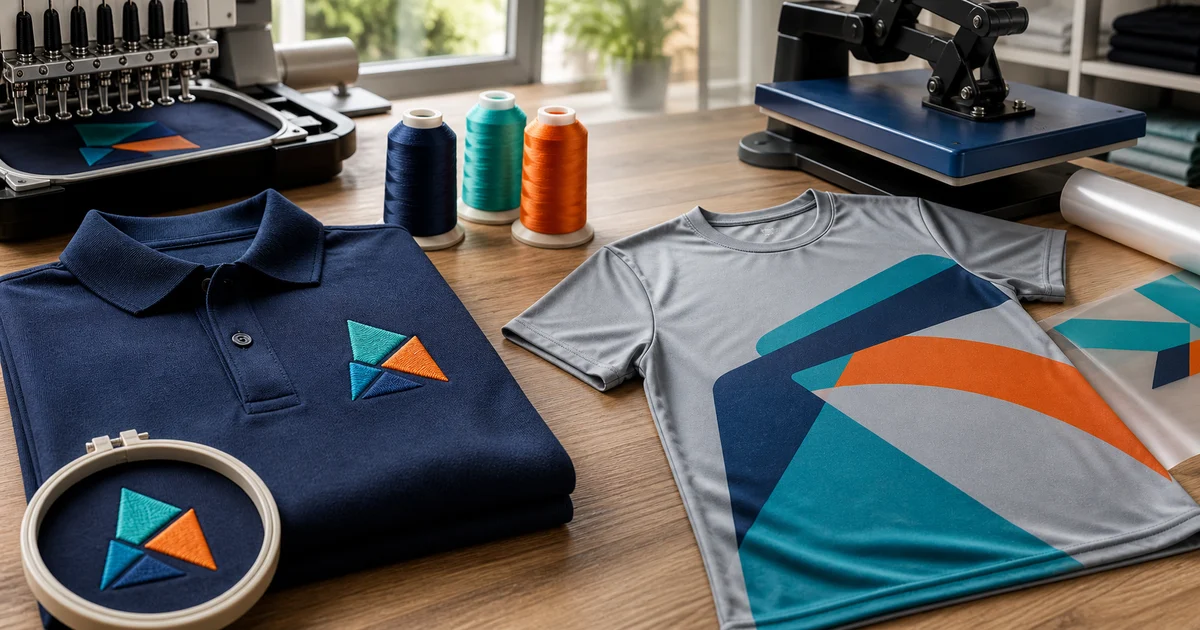
The short answer: choose embroidery for a small, premium-looking logo on suitable polos, woven shirts, jackets and caps. Choose printing when the artwork is large, highly detailed, uses gradients or needs a lighter feel across a T-shirt or performance garment. A company uniform programme can use both methods for different garment roles.
Do not choose from the logo file alone. The same chest mark can behave differently on lacoste pique, thin microfiber, cotton jersey and a structured cap. Match the decoration to the garment, final size, placement, staff activity and washing routine, then approve a physical sample.
Embroidery vs printing at a glance
| Decision point | Embroidery | Garment printing |
|---|---|---|
| Best visual role | Small, dimensional corporate mark | Small to large flat graphic |
| Artwork | Solid shapes and readable details at stitchable size | Fine detail, gradients and many colours are possible with a suitable process |
| Typical garments | Polo, woven shirt, jacket, cap and apron | T-shirt, jersey, event shirt and many compatible uniforms |
| Feel | Raised thread with concentrated weight | Varies by method, ink or transfer coverage |
| Large coverage | Can become heavy, stiff and costly | Usually the more practical route |
| Fabric risk | Needle penetration, puckering or sinking stitches | Heat, pressure, dye migration or adhesion compatibility |
| Setup | Digitised stitch file and sew-out | Artwork separation, transfer or screen setup depending on method |
| Approval | Sew-out on the intended garment | Printed sample on the intended garment |
“Printing” is not one process. DTF, silk screen, sublimation and other systems have different strengths and limitations. Use the table to choose a direction, then compare the actual method your supplier proposes.
Choose by garment role, not prestige alone
Embroidery often suits customer-facing office polos, management shirts, outerwear and caps because a compact thread logo looks structured and does not rely on a large print area. It is not automatically right for every uniform.
A broad embroidered back logo can add weight and stiffness. Dense stitching on a thin, stretchy performance shirt may distort the fabric or feel uncomfortable against the body. Printing is often more practical for large sponsor layouts, event messages, safety graphics and jersey artwork.
For a mixed team, assign a decoration method by use:
- Office and retail polo: small embroidered left-chest logo;
- Roadshow T-shirt: printed front or back campaign graphic;
- Sports or operations jersey: compatible print or sublimation according to fabric;
- Jacket or cap: test embroidery on the actual panel construction; and
- High-visibility or technical wear: confirm that decoration does not compromise the garment specification.
Use the corporate polo material comparison before selecting the base garment.
Choose by logo construction and final size
Embroidery rebuilds artwork as physical stitches. Very small text, hairlines, tight gaps, gradients and photographic detail may need simplification. The minimum embroidery detail guide explains why a print logo should not simply be shrunk into a chest position.
Printing can reproduce broader colour areas and, with an appropriate method, fine detail or gradients. Roland describes DTF as printing onto film, applying hot-melt powder and heat-pressing the transfer to a compatible garment. This makes DTF useful across varied artwork and fabrics, but the supplier still has to control film, adhesive, temperature, pressure and time. See the common DTF problems guide for approval checks.
Silk screen printing is often considered for repeat quantities and solid-colour artwork, but each design and colour plan affects setup. Ask the supplier to explain the separation and colour count rather than assuming “simple logo” means one screen. The silk-screen colour guide gives buyers the right questions.
Compare comfort, weight and coverage
Decoration changes how a uniform moves and feels.
Embroidery concentrates thread and backing in one area. On a stable chest panel this can be acceptable; across a large area it can feel heavy and may affect drape. Printing ranges from a light ink layer to a noticeable transfer, depending on process, coverage and production settings.
Ask staff how the garment will be used:
- Is it worn all day in Malaysian heat and humidity?
- Will a backpack, safety vest or apron rub the decoration?
- Is the logo against bare skin or over another layer?
- Does the role require frequent industrial or high-temperature washing?
- Will the uniform stretch during physical work?
There is no useful universal answer such as “embroidery is always more durable” or “printing is always cooler.” The exact construction and application matter more than the label.
Check fabric compatibility before comparing price
Wilcom’s fabric-setting guidance shows that embroidery density, underlay, pull compensation and stitch length may need to change between pique knit, stretch knit and stable woven fabric. A file that worked on one polo is not proof it will work unchanged on another.
Printing also needs a fabric check. Epson’s DTFilm process guidance describes film printing, adhesive powder and heat transfer. That combination means garment heat tolerance, surface treatments and colour behaviour must be tested by the producer.
Ask for the proposed garment code and fabric composition in the quotation. Do not approve a decoration sample on generic fabric if production will use another model.
Do not decide from unit price alone
Compare the complete job:
- garment and size mix;
- finished decoration dimensions and positions;
- embroidery digitising or print setup;
- number of locations;
- sampling and revision terms;
- individual names or departments;
- delivery schedule and split destinations; and
- repeat-order file and colour controls.
Embroidery commonly separates a one-time digitising step from per-piece stitching. Printing setup depends on the selected process. A low first quotation can become expensive if it omits the back logo, difficult sizes, sample, delivery or setup.
A mixed decoration programme can be the best answer
Consistency does not require every garment to use the same process. It requires a controlled brand system.
For example, approve one simplified embroidered logo for polos and caps, plus one print master for T-shirts and jerseys. Record the finished width, placement, thread or print colour reference, garment model and approved sample for each use. The company logo placement guide helps set repeatable positions.
Do not force the detailed print artwork into a tiny embroidery size. Do not enlarge a dense embroidery file into a broad back mark. Each approved master should suit its production method.
Approve the result on the actual uniform
For embroidery, inspect lettering, registration, thread coverage, puckering, backing and comfort. For printing, inspect colour, edges, opacity, stretch, surface feel, adhesion and any press marks. For both, confirm location and dimensions while the garment is worn.
Keep the signed sample or clear approval photographs with:
- garment brand, code, colour and fabric;
- logo file version;
- finished width and position;
- method and production settings the supplier agrees to retain;
- thread or print colour references; and
- care instructions.
This record is more useful for reorders than a message saying “same as last time.”
Send one comparison brief to suppliers
Send the vector logo, garment role, wearer environment, quantity and size mix, required positions, target date and delivery locations. Ask each supplier to recommend embroidery or a named printing process and explain the trade-off for your exact garment.
You can request comparable company-uniform quotations or browse Malaysian printing and embroidery suppliers by state. Approve production only after the proposed method has been sampled on the selected uniform.
Frequently asked questions
Is embroidery or printing better for a company logo?
Embroidery is usually better for a small, premium-looking mark on a suitable polo, woven shirt, jacket or cap. Printing is usually better for large artwork, gradients, fine detail or a lighter decoration on T-shirts and performance garments. The right answer depends on the logo, garment and intended use.
Can one company uniform programme use both embroidery and printing?
Yes. A team can embroider a small chest logo on office polos and print a larger back graphic on event T-shirts, provided the colours, placement rules and approved logo versions are recorded consistently.
Does embroidery always last longer than printing?
No method has a universal lifetime. Embroidery can be robust on a suitable, well-stabilised garment, while a correctly produced print can also perform well. Construction, fabric, process control, use and washing all affect the result.
Should I approve a sample before ordering uniforms?
Yes, especially for a new garment, fabric, logo or supplier. Approve the decoration on the actual garment model and check appearance, comfort, position, colour, puckering, adhesion and care instructions before mass production.
Ready to compare suitable printers?
Get 5 Free Quotes