
Malaysia T-Shirt Size Guide for Bulk Orders
Build an accurate Malaysian bulk T-shirt size list using the exact product chart, fitting samples, named responses and separate garment subtotals.
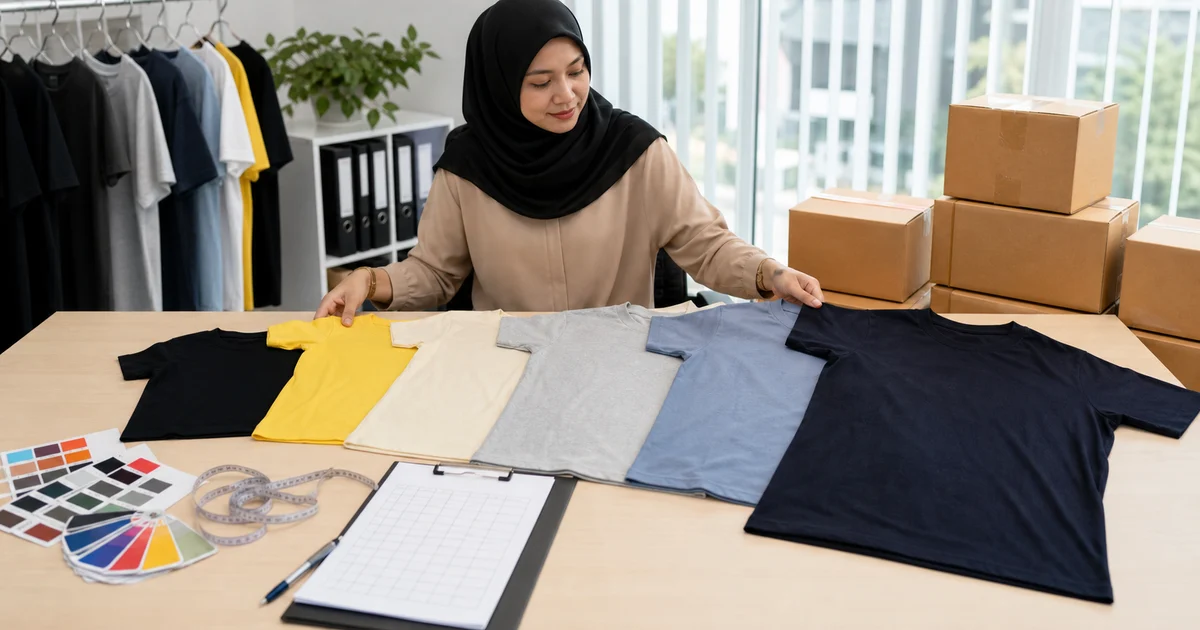
The short answer: there is no universal Malaysia T-shirt size chart. For a bulk order, first lock the exact garment code and cut, then collect one confirmed size per wearer using that product’s chart. An M from another brand—or even another model from the same supplier—may measure differently.
The goal is not to predict which label Malaysians “usually” wear. It is to produce a size list that matches the actual shirts the printer will supply.
Bulk sizing workflow at a glance
| Stage | What the organiser records | Error it prevents |
|---|---|---|
| Lock the garment | Supplier, product code, cut, fabric and colour | Collecting sizes for the wrong shirt |
| Confirm the chart | Measurement basis, units and stated tolerance | Mixing body and garment measurements |
| Let people check fit | Chart, sample set or both | Guessing from a usual size label |
| Collect named choices | Name, product, size and personalisation | Missing or duplicated wearers |
| Separate subtotals | Quantity by product, colour and size | Combining incompatible size scales |
| Reconcile once | Named total, spares and purchase total | Paying for an incorrect breakdown |
Why do Malaysian T-shirt sizes differ?
Size labels are categories created for a particular product, not fixed physical dimensions. Cut, fabric, target wearer and intended ease all affect the finished measurements.
Current Malaysian supplier information illustrates this clearly. CUSTA states that an M in one product will not measure the same as an M in another and tells buyers to use the exact product chart. Oren Sport’s 2025–2026 catalogue says sizes may vary by plus or minus 5% from the actual product and can vary within the same product series. Review the current CUSTA size guidance and Oren Sport catalogue before relying on a listed garment.
These are supplier-specific statements, not a national tolerance. Your final quotation, product chart and approved sample are the order reference.
Choose the exact garment before asking for sizes
Record these details at the top of the size form:
- supplier and product code;
- unisex, fitted, kids, oversized, long-sleeve or Muslimah cut;
- fabric and GSM;
- colour;
- chart version or date; and
- whether the values are body or finished-garment measurements.
Do not send a generic chart while comparing several garments. If the committee changes the shirt after collecting responses, reopen the size decision rather than copying the old labels.
Do not mix body and garment measurements
Body measurements describe the person. Garment measurements describe the finished item and include the designer’s intended allowance for movement and style.
ISO 8559-1 provides definitions for body measurements used in clothing sizing and was reconfirmed in 2026. It does not turn S, M or L into universal garment dimensions. See the ISO 8559-1 overview for the distinction.
If the supplier chart uses flat garment width and length, compare it with a shirt that already fits. Follow the step-by-step T-shirt measurement guide and use the same measurement points as the selected chart.
Use fitting samples for uncertain wearers
A try-on set is the clearest sizing tool for a large team, particularly when the order includes:
- a new brand or product;
- fitted, oversized or Muslimah cuts;
- children and adults;
- staff between two sizes;
- non-returnable personalisation; or
- a large quantity that is expensive to remake.
Label every sample with its product code and size. Do not mix samples from a similar-looking product. If a full sample run is unavailable, obtain at least the most common middle sizes and use the chart for the remaining range.
Keep every garment model separate
One person may choose a unisex tee while another chooses a Muslimah top. Record them as different products even when the colour and artwork match.
Use a summary like this:
| Product | Colour | Size breakdown | Quantity |
|---|---|---|---|
| Unisex tee A | Black | XS 4, S 12, M 18, L 9, XL 3 | 46 |
| Fitted tee B | Black | S 3, M 5, L 2 | 10 |
| Muslimah top C | Black | S 2, M 6, L 4, XL 2 | 14 |
| Total | 70 |
The product names and quantities are examples, not a recommended Malaysian size ratio.
Collect one named response per wearer
Your form needs only the fields that control production:
- full name or staff ID;
- branch, class or team;
- garment product and cut;
- confirmed size;
- printed name or number, if any; and
- response status.
Give everyone the same chart link and deadline. Follow up with missing people instead of assigning a default M or L. For privacy, do not ask for body measurements when a chosen garment size is enough.
The class size breakdown guide shows how to count named units and deliberate spares without inventing a generic size ratio.
Reconcile the order before payment
Run one final check:
- every named wearer appears once;
- every size exists for the chosen product;
- garment models and colours have separate subtotals;
- personalisation matches the same row;
- approved spare shirts are labelled separately;
- all size quantities equal the product subtotal; and
- all product subtotals equal the purchase total.
Send the final sheet to the printer as a locked version and ask for written acknowledgement. Any later change must update both the named row and the quantity summary.
When the size list and garment codes are ready, browse Malaysian printers by location or request comparable quotations through Baju Printz.
Frequently asked questions
Is there one standard T-shirt size chart for Malaysia?
No single S-to-XL chart applies to every Malaysian supplier or garment. Use the chart for the exact product code, cut and fabric being ordered.
Should a bulk order use body measurements or garment measurements?
Use whichever measurement basis the chosen chart defines and do not mix them. For garment measurements, compare a well-fitting shirt laid flat against the supplier's stated measurement points.
Can unisex, women’s, kids and Muslimah sizes share one size list?
They should be recorded as separate products because each cut can have its own chart, stock range and price. Combine only the final purchase total after each product subtotal is correct.
What should an organiser do when someone is between two sizes?
Arrange a fitting sample where possible and choose according to the wearer’s preferred ease. Do not invent a conversion from another brand’s size label.
Ready to compare suitable printers?
Get 5 Free Quotes