
How Many Uniform Shirts Should Each Employee Receive?
Calculate uniform shirts per employee from wear days, laundry turnaround, spare cover and replacement risk instead of using one arbitrary quantity.
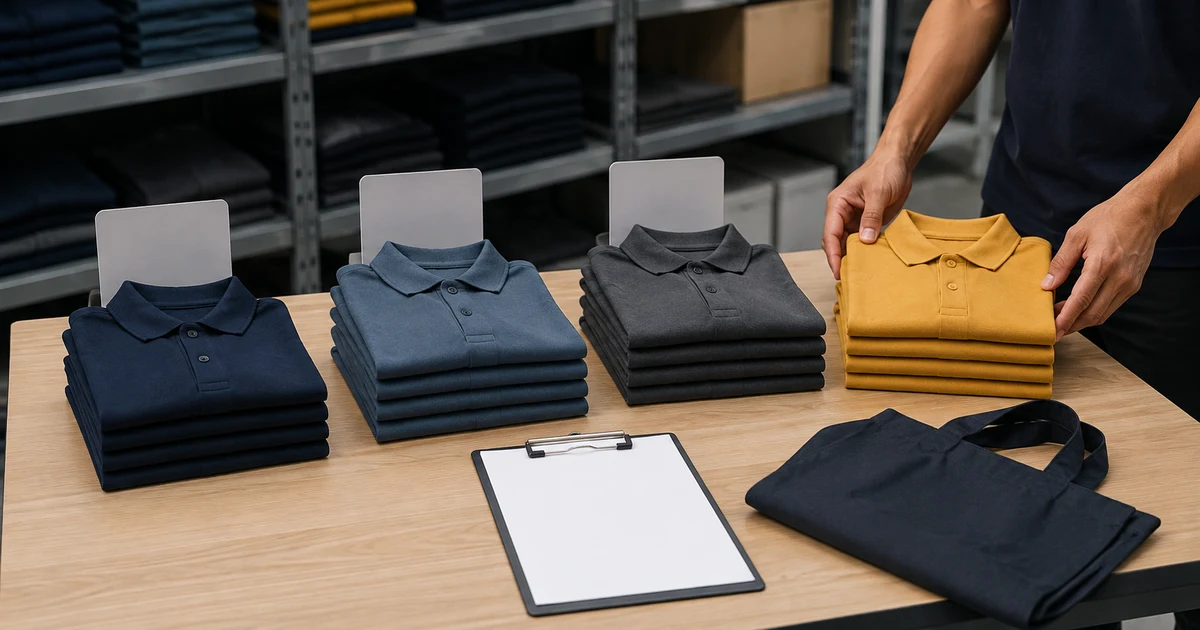
The short answer: do not issue one arbitrary number to every employee. Calculate the shirts needed to cover each role’s uniform-wear days and laundry turnaround, then add only the spare cover you can justify. For daily wear, the correct allocation may be three, four, five or more; the shift and washing cycle must prove the number.
This decision affects comfort, appearance, staff compliance and your reorder budget. Too few shirts create a laundry bottleneck. Too many in the first issue can lock cash into the wrong sizes, cuts or staff turnover.
Use a rotation formula, not a company-wide guess
Start with this planning formula:
Shirts per employee = maximum shirts in use or awaiting laundry at one time + ready spare needed before the next clean shirt is available.
Work through five inputs for each role:
| Input | Question to answer |
|---|---|
| Wear frequency | On how many shifts per week is this exact shirt compulsory? |
| Change frequency | Is one shirt expected to last a full shift, or can the role need a fresh change? |
| Laundry owner | Does the employee wash it, or does the company collect it? |
| Turnaround | How many days pass before a worn shirt is clean, dry and back with the employee? |
| Spare purpose | Is the extra for a missed wash, unexpected shift, damage or stock replacement? |
Do not hide these different needs inside a rule such as “three shirts for everyone”. A staff member wearing the polo once a week and a field employee wearing it on six consecutive days do not have the same rotation.
Calculate from the longest gap between clean-shirt returns
Map a real week. Mark each compulsory wear day, the earliest wash opportunity and when the shirt becomes wearable again. The highest number of pieces tied up before a clean one returns is the base rotation.
For example, an employee wears uniform on five weekday shifts and washes after the third shift. If the first three shirts are clean again before the fourth is needed, the base rotation is three. Adding one ready spare gives an issue of four. This is a worked planning example, not a universal four-shirt standard.
For central laundry, include the whole pipeline:
- one shirt being worn;
- shirts waiting for collection;
- shirts being washed or dried;
- shirts in return transit; and
- any approved ready spare.
If the laundry service returns items two days later, do not calculate as though every worn shirt is available the next morning. Confirm actual collection days, public-holiday handling and what happens when a batch is rejected for stain treatment or repair.
Increase rotation only where the role needs it
Malaysia’s climate makes role-specific checks important. METMalaysia describes Malaysia’s climate as having generally uniform temperatures, high humidity and substantial rainfall. An outdoor, kitchen, warehouse or physically active role may therefore have a different change and drying pattern from an air-conditioned reception role.
The Department of Occupational Safety and Health’s workplace heat-stress guidance also treats clothing as one factor affecting heat exchange and notes the importance of moisture transmission. Use that as a prompt for a proper workplace assessment, not as proof that one fabric or issue quantity suits every job.
Consider a higher rotation when evidence shows:
- consecutive shifts leave no practical washing window;
- the role commonly requires a fresh shirt within one day;
- drying is slow during the employee’s normal laundry arrangement;
- the company laundry has a multi-day return cycle; or
- a missed shirt would prevent the employee from reporting in the required uniform.
First fix an unsuitable garment specification. Issuing more pieces does not make a hot, restrictive or poorly fitting shirt appropriate. Compare role needs with the cotton and dry-fit guide for Malaysia before freezing the product.
Keep personal rotation separate from company spare stock
There are two different quantities:
- Named allocation — shirts issued to a particular employee for normal rotation.
- Unassigned stock — shirts held by the branch or company for new hires, size exchanges, damage or urgent replacement.
Do not add a blanket spare percentage to both. Build unassigned stock from hiring plans, past replacement records, supplier lead time and storage limits. Label it by product code, cut, colour and size.
For a company with several sites, assign ownership of each spare pool and reconcile it separately. The multi-branch uniform size workflow explains how to keep branch subtotals and named wearers aligned.
Calculate the order quantity in layers
Use this order structure:
Total order = named employee allocations + approved unassigned stock + separately identified fitting or production samples.
A simple example:
| Group | Calculation | Quantity |
|---|---|---|
| 18 daily-wear staff | 18 × 4 approved pieces | 72 |
| 7 twice-weekly staff | 7 × 2 approved pieces | 14 |
| Branch replacement stock | Approved by exact sizes | 6 |
| Production sample | Separate approval piece | 1 |
| Total | 72 + 14 + 6 + 1 | 93 |
The numbers demonstrate the calculation only. Your allocation can differ after mapping the actual roster and laundry cycle.
Keep different cuts as different products. A unisex M, fitted M and Muslimah M may not share dimensions or stock risk. Use the Malaysia bulk size guide and approve the Muslimah or long-sleeve option separately where offered.
Decide when each shirt will be replaced
Issue quantity and replacement policy are different decisions. Before ordering, define:
- the normal issue date and acknowledgement record;
- whether shirts remain company property;
- how wear, staining, accidental damage and size changes are handled;
- who approves a replacement;
- whether leavers return reusable items; and
- when the organisation reviews the product for a reorder.
Do not promise a fixed garment lifespan without testing the actual shirt, decoration, care and working conditions. Give employees the approved care instructions; the printed-shirt washing guide provides a practical starting checklist.
For repeat orders, keep the supplier, garment code, colour, cut, size chart, artwork, print dimensions and approved sample reference together. The uniform reorder consistency guide shows what to retain when matching the next batch.
Treat PPE and hazard-control clothing separately
An ordinary logo polo is not automatically personal protective equipment. Where a role requires high-visibility wear, chemical protection, heat protection or another safety garment, the allocation must follow the employer’s safety assessment and the selected protective product’s inspection, cleaning and replacement requirements.
Do not reduce a safety allocation because an ordinary uniform formula produced a smaller number. Ask the organisation’s safety owner to approve the garment and replacement process before requesting decoration.
Send an allocation-ready quotation brief
Give the printer a table showing each garment product, cut, colour, size and quantity. State which pieces are named allocations, unassigned stock and samples, plus the decoration positions, packing by employee or branch, delivery locations and required receipt date.
You can request uniform quotations through Baju Printz once the role-by-role allocation and size breakdown are approved.
Frequently asked questions
How many uniform shirts should an employee receive?
There is no universal number. Calculate the longest gap between laundry opportunities, add the shirts still being worn or washed, then include one clearly justified ready spare where the role needs continuous uniform use.
Are three uniform shirts enough for full-time staff?
Three may work only when the employee can wash and dry them often enough and has cover for delays. Test the real shift and laundry cycle; daily wear with slow laundry return may require more than three.
Should part-time employees receive fewer uniform shirts?
Base the allocation on actual uniform-wear days and the laundry cycle, not employment label alone. A part-time worker with consecutive outdoor shifts may need more rotation than an office employee who wears uniform once a week.
Should spare uniforms be assigned to employees or kept as stock?
Separate personal rotation pieces from unassigned replacement stock. Record central or branch spares by product, cut, colour and size so they are not mistaken for shirts already promised to employees.
Do safety garments count as ordinary company uniforms?
Not automatically. If a garment is required as personal protective equipment or for a specific hazard, follow the workplace risk assessment, safety specification, inspection and replacement rules rather than using an ordinary branded-shirt formula.
Ready to compare suitable printers?
Get 5 Free Quotes