
Cotton vs Dry-Fit for Malaysia’s Weather: Which Is Better?
Choose cotton or quick-dry polyester for Malaysian events, uniforms and sports by comparing sweat, drying, feel, printing and sample checks.
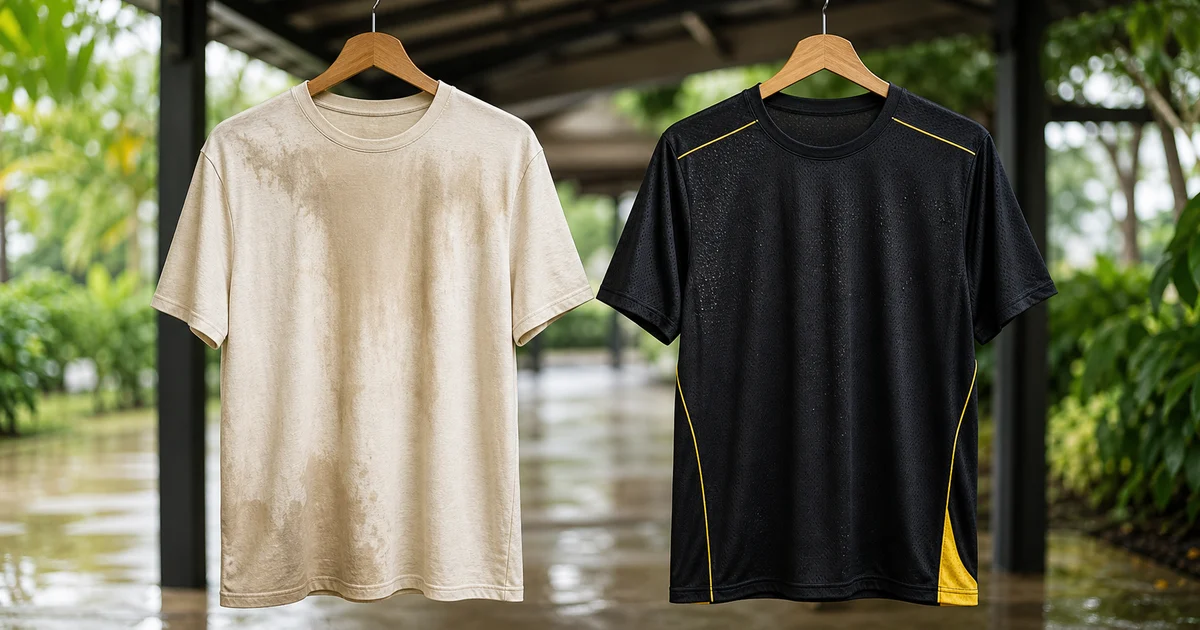
The short answer: choose cotton for relaxed, low-sweat wear and quick-dry polyester for active, sweaty or outdoor use. For Malaysia’s weather, the best choice is not the fabric name alone: weight, knit, airflow, colour and finishing can change how either shirt feels.
Many local suppliers use “dry-fit” as a broad label for sports-style synthetic fabric. Treat it as a product category, not a complete specification. Ask for the fibre composition, GSM, knit name and a physical sample before approving a bulk order.
Cotton vs dry-fit at a glance
| Buyer question | Cotton | Quick-dry polyester |
|---|---|---|
| Best starting use | Office events, casual uniforms, merchandise | Running events, field crews, school sports |
| Sweat behaviour | Absorbs moisture and can stay damp longer | Designed to move or spread moisture and dry faster |
| Typical feel | Soft, familiar and less sporty | Smooth, mesh or textured depending on the knit |
| Printing decision | Often works with silk screen, DTF or DTG | Method must suit the surface and heat sensitivity |
| Main sample check | Shrinkage, opacity and wet feel | Airflow, cling, shine and press marks |
These are selection tendencies, not guarantees. A well-built lightweight cotton shirt can feel better than a dense polyester shirt, and two “dry-fit” samples can perform differently.
Why does Malaysia’s weather change the choice?
MET Malaysia describes the country’s climate as having relatively uniform temperatures, high humidity and abundant rainfall. In those conditions, sweat and drying behaviour matter throughout the year, especially for outdoor programmes and physical work. See MET Malaysia’s climate overview for the official context.
Humidity does not make one fibre universally superior. It makes the complete fabric construction more important: a shirt needs enough airflow, manageable weight and a surface that does not become uncomfortable when wet.
When is cotton the better option?
Cotton is a sensible default when wearers spend most of the day indoors or the programme is not physically demanding. It works well for:
- seminar and conference crews;
- casual office uniforms;
- merchandise where a familiar hand-feel matters;
- class or club shirts worn socially; and
- artwork that benefits from a smooth cotton surface.
The trade-off is moisture retention. Cotton absorbs sweat readily, but a wet shirt can feel heavier and take longer to dry. Ask whether the garment is pre-shrunk, then wash one sample using the intended care method to check dimensional change and collar shape.
When is quick-dry polyester the better option?
Start with quick-dry polyester when people will run, exercise, work outdoors or wear the shirt for a long active shift. Its practical advantage is usually moisture transport and faster drying rather than softness.
Fabric research also shows why buyers should avoid judging by fibre name alone. Wear trials and laboratory studies find that garment construction, thickness, air permeability and finishes influence thermal and moisture comfort alongside fibre content. Review the published wear-trial study for the experimental context.
For an actual order, inspect whether the sample:
- allows air to pass through without becoming too transparent;
- feels clingy after being lightly dampened;
- develops odour quickly during a wear test;
- shows shine or flattening under heat; and
- keeps its shape after washing.
Does the printing method affect the fabric choice?
Yes. Choose the garment and printing method together. A smooth cotton surface, open sports mesh and tightly knitted polyester do not accept ink or heat in the same way.
Send the printer the exact garment code, colour and composition. Ask for a production sample when the artwork has fine detail, a large solid print, a heat-sensitive fabric or an important brand colour. The silk screen, DTF and DTG comparison explains the main method trade-offs.
Use this sample test before ordering
Do not compare folded samples only. Put each shortlisted shirt through the same short check:
- Wear it indoors and outdoors for at least 20 minutes.
- Dampen a small hidden area and compare drying and cling.
- Hold a light colour against daylight to judge opacity.
- Stretch the print area gently to see how the surface behaves.
- Wash and dry it once according to the care label.
- Compare the final fit, collar, colour and hand-feel.
Record the supplier’s garment code, composition, GSM, colour and size chart. That prevents a good sample from being replaced accidentally by a different “equivalent” fabric during quotation or production.
Choose for the wearer, not the label
Use the broader Malaysia T-shirt fabric guide if you are also comparing blends, microfiber and jersey materials. Once the activity and sample are clear, request matched quotations using the same fabric specification for every printer.
Frequently asked questions
Is cotton or dry-fit cooler in Malaysia?
Neither is automatically cooler. Lightweight, breathable construction matters, while quick-dry polyester is usually more practical for heavy sweating and cotton often feels more familiar for low-activity wear.
Is dry-fit always made from polyester?
In Malaysian quotations, dry-fit commonly describes synthetic sports fabric, but the name alone does not confirm fibre content, knit or finish. Ask for the composition and approve the actual sample.
Which fabric is better for an outdoor company event?
Quick-dry polyester is usually the safer starting point when participants will be active or exposed to heat and sweat. Cotton can still suit a relaxed, shaded event when softness and casual appearance matter more.
Can cotton and dry-fit use the same printing method?
Not always. The suitable method depends on fibre content, colour, surface and artwork, so ask the printer to confirm the method and test the exact garment before bulk production.
Ready to compare suitable printers?
Get 5 Free Quotes