
Muslimah and Long-Sleeve Team Shirts: What to Specify
Specify Muslimah and long-sleeve team shirts by coverage, measurements, fabric, movement, artwork, size grading and coordinated colour.
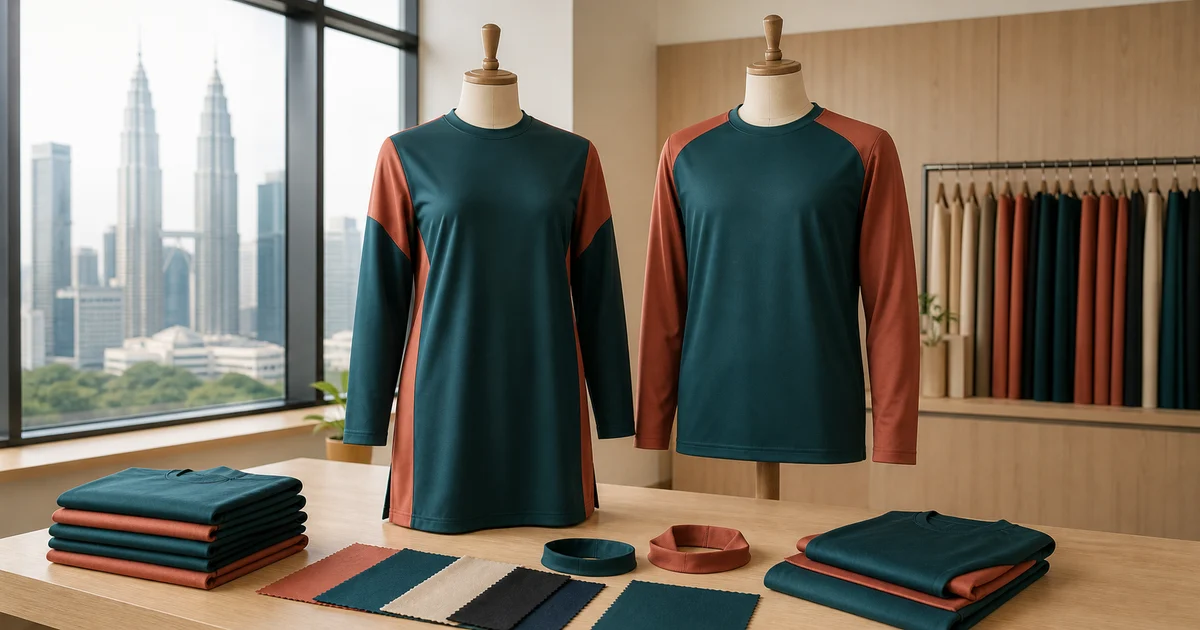
The short answer: specify a Muslimah or long-sleeve team shirt by writing down the required coverage, finished garment measurements, fabric, movement allowance, artwork position and size range. Do not approve it from the words “Muslimah”, “modest” or “long sleeve” alone because suppliers use different cuts.
The right coverage is a wearer and organisation decision. Ask the intended wearers what they need, document it in centimetres and approve a physical sample during normal movement.
Muslimah cut vs standard long sleeve
| Specification point | Standard long-sleeve tee | Muslimah or longline team cut |
|---|---|---|
| Body length | Often follows the brand’s regular unisex body | Commonly longer, but the amount varies |
| Body shape | Regular, fitted or unisex | Often straighter or looser through chest and hip |
| Sleeves | Wrist-length based on the standard pattern | Wrist coverage and opening may be more deliberate |
| Neckline | Standard round or V-neck | Shape and opening may be adjusted for the intended coverage |
| Hem | Usually regular T-shirt hem | May be wider, curved, dropped or include side slits |
| Size chart | Uses that product’s standard chart | Needs its own chart and fitting sample |
| Main use | General team or uniform wear | Teams wanting a specifically agreed longer, looser option |
These are common design tendencies, not a universal definition. Current Malaysian catalogues reinforce the distinction: CUSTA lists Muslimah clothing separately from general long-sleeve tees, while Oren Sport’s current Muslimah range contains several different neck, sleeve and fabric constructions.
Define coverage with measurable points
Ask wearers or the authorised uniform committee to approve a reference garment. Measure it flat and state whether it has been washed. Record:
- shoulder width;
- half-chest width;
- body width at the hem or hip area;
- front and back body length;
- bicep width;
- sleeve length;
- sleeve opening or cuff circumference;
- neck opening and neckline depth; and
- side-slit height, when present.
Also record whether the hem must cover a stated point while standing, sitting and reaching. A long shirt can rise during movement, and a narrow hem can restrict a wearer even when the chest measurement looks adequate.
ISO 18890:2018 defines main garment measurement points and allows additional points to be agreed between interested parties. Use one annotated diagram for the quotation, sample and final inspection. The T-shirt measurement guide explains how to keep the method consistent.
Test movement in normal layers
A sample should be tried with the clothing and head covering the wearer normally uses, where relevant. This is a fit test, not a styling rule.
Ask the wearer to:
- raise both arms;
- reach forward;
- sit and stand;
- bend the elbows fully; and
- walk or perform the team’s normal task.
Check whether the shoulder pulls, the bicep becomes tight, the cuff rides up, the hem rises beyond the agreed coverage or a side slit opens too high. Record the required correction instead of merely asking for “a looser size”.
For active teams, confirm that extra looseness does not create an operational snag risk. Where the role involves machinery, laboratories, food handling or safety equipment, follow the organisation’s occupational clothing rules rather than a general promotional-shirt guide.
Choose fabric for coverage and Malaysia’s climate
Long sleeves and a longer body add covered area, so fabric construction matters. MET Malaysia describes the country’s climate as having uniform temperatures, high humidity and abundant rainfall. In this environment, compare airflow, sweat behaviour and drying together with opacity.
Use cotton or a cotton-rich blend as a starting point for lower-activity indoor teams that value a familiar, softer hand. Test shrinkage, damp feel and whether the fabric becomes heavy during wear.
Use quick-dry polyester or microfibre as a starting point for sports, field events and active outdoor roles. Inspect airflow, cling, odour after wear, surface shine and heat sensitivity during decoration.
Do not select by “cool”, “breathable” or GSM alone. Hold the sample against daylight, wear it over the intended underlayer and compare it after washing. The cotton versus dry-fit Malaysia guide provides a more detailed fabric test.
Keep every cut on its own size chart
Do not convert a wearer’s unisex M automatically into a Muslimah M. Even two Muslimah products can differ in chest, hip, sleeve and body length.
For a mixed team:
- issue the chart for each exact product code;
- label every fitting sample with product and size;
- collect product choice and size in separate fields;
- keep unisex, long-sleeve and Muslimah subtotals separate; and
- reconcile the combined purchase only after each product total is correct.
Use the Malaysia bulk-size workflow to avoid mixing incompatible charts. If the range is custom cut-and-sew, approve the grading across a smaller, middle and larger size rather than checking one sample only.
Approve artwork on every garment cut
A logo placed on a standard tee may sit differently on a longer or looser shirt. A hijab may cover some upper-chest or upper-back positions, while a side panel or raglan seam may reduce the printable area. Ask wearers to check the dressed sample if visibility matters.
Approve for each product:
- artwork width and height;
- distance from collar, centre line or seam;
- front, back and sleeve positions;
- the smallest and largest sizes in the order;
- whether one print size will be shared; and
- any embroidery backing against the skin.
For large prints, assess flexibility and warmth on the actual fabric. The logo placement guide and print-size guide provide a structured approval method.
Coordinate colour without pretending the garments are identical
Teams often want a unisex short sleeve, a regular long sleeve and a Muslimah option in one visual identity. That can work, but different fabrics, suppliers and dye lots may not match exactly.
Approve the garments side by side under daylight and indoor light. Decide whether a small shade or texture difference is acceptable. Save the product codes, colour names, physical samples, artwork files and decoration references for reorders.
If exact panel shapes, custom length or proprietary colours are non-negotiable, a custom programme may be needed. Compare the development implications in the ready-made blank versus cut-and-sew guide.
Wash-test the full uniform option
Wash one decorated sample from each garment model using the intended care method. Check:
- body and sleeve dimensional change;
- twisting and seam shape;
- cuff and neckline recovery;
- opacity and surface after washing;
- decoration adhesion or embroidery distortion; and
- colour difference between coordinated products.
Do not assume a successful test on the short-sleeve option proves the Muslimah product will behave the same. State clear care information for every model; ISO 3758:2023 establishes the international system of textile-care symbols.
Send one brief with separate garment options
Your quotation brief should state the wearer group, use, garment codes or custom dimensions, coverage points, size breakdown by product, fabric, colour, artwork, sample and wash-test requirements, packing, delivery postcode and required date.
When the choices are documented, request Muslimah and long-sleeve team-shirt quotations through Baju Printz. Suppliers can price each option separately while keeping one coordinated team design.
Frequently asked questions
What is the difference between a Muslimah shirt and a regular long-sleeve T-shirt?
A regular long-sleeve tee mainly extends the sleeves, while a Muslimah-labelled cut commonly changes body length, looseness, neckline, hem or side coverage as well. Product names are not standard, so approve the actual measurements and sample.
Which measurements should a Muslimah team shirt include?
Record shoulder width, half chest, bicep, sleeve length and opening, front and back body length, hem or hip width, neckline and any side-slit height. Add other points needed by the wearer or organisation.
Which fabric is best for a long-sleeve team shirt in Malaysia?
There is no universal best fabric. Cotton can suit lower-activity indoor wear, while lightweight quick-dry polyester or microfibre often suits active and outdoor use; compare airflow, opacity, cling, print compatibility and wash performance on a sample.
Can Muslimah and unisex shirts use the same team design?
Yes, but treat them as separate garment products. Approve the artwork position and size on each cut, check colour side by side, maintain separate size subtotals and confirm whether different production setups are required.
Ready to compare suitable printers?
Get 5 Free Quotes