
Uniform Reorders: Keep Colours and Logos Consistent
Keep repeat uniform orders consistent with a controlled product record, physical colour references, approved samples and documented changes.
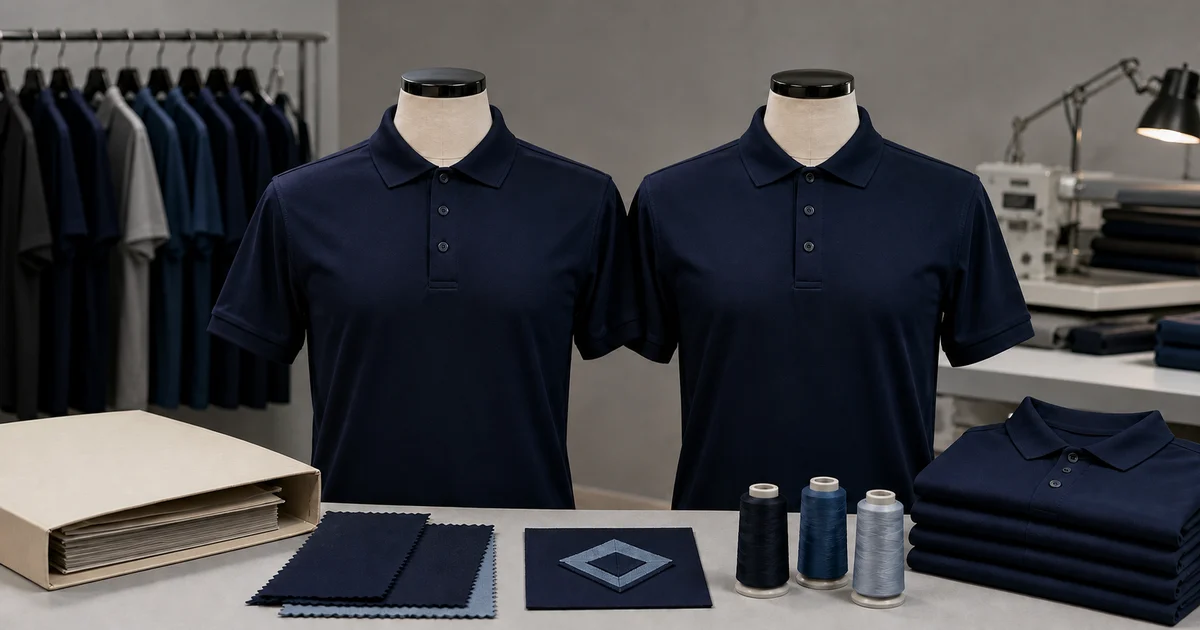
The short answer: treat every uniform reorder as a controlled new production run, not a request to “make the same one again”. Keep the exact garment code, artwork, dimensions, colour references and approved physical sample, then approve one new sample from the reorder before bulk production.
That record gives a growing team a repeatable target. Without it, the supplier may have only an old chat image, a screen colour and a vague description of the previous shirt.
Build one reorder reference pack
| Control | Record this | Why it matters |
|---|---|---|
| Garment | Manufacturer, product code, colour name, cut, fabric, GSM and size chart version | Similar-looking shirts may differ in shade, texture and fit |
| Artwork | Editable master, production file and approved version date | Prevents an old or low-resolution logo from returning |
| Dimensions | Finished width and height plus fixed placement points | “Same size” and “left chest” are open to interpretation |
| Decoration | Method, colour layers, ink or thread product and digitising file where relevant | A logo can change when its production recipe changes |
| Approval | Digital proof, physical sample, order number and approver | Establishes which version was accepted |
| Change log | Date, reason and approved deviation | Makes later reorders auditable |
Store the pack under one stable uniform reference, not in one employee’s message history. If the supplier has a job number, record it, but keep your own source files and approvals too.
Freeze the garment before matching the logo
Confirm that the original product code is still available in every required size. A replacement polo with the same colour name is not automatically equivalent: its fibre blend, knit, collar, cut and surface can affect both appearance and decoration.
For a product change, compare the proposed replacement with the approved shirt side by side. Reopen sizing if the cut or chart has changed; the Malaysia bulk-order size guide explains why labels such as M and XL should not be copied between products.
Record the replacement as a new version rather than silently overwriting the old specification. That preserves a clear history for branches still wearing the earlier uniform.
Separate fabric colour from logo colour
A navy garment and a navy printed logo are not controlled through the same production system. State which colour each reference controls:
- garment fabric: supplier colour name, product code, current swatch or approved shirt;
- printed logo: spot-colour or process-colour target agreed with the printer; and
- embroidered logo: thread manufacturer, range and exact thread code.
Pantone’s current guidance places TCX references with soft textile and apparel surfaces, while its Graphics system uses references such as C and U for ink on coated and uncoated paper. See the official Pantone Fashion, Home + Interiors system and Pantone Graphics system.
This does not mean one Pantone suffix automatically controls every textile-printing process. Tell the printer the exact reference system and final substrate, then agree how the produced logo will be judged. The Pantone, CMYK and RGB artwork guide gives the wider file-colour context.
Record logo size and placement as measurements
Do not rely on a mockup alone. Record:
- artwork version and filename;
- finished decoration width and height in millimetres or centimetres;
- position measured from stable points such as the centre front, shoulder seam, placket or sleeve seam;
- orientation and number of positions; and
- whether one decoration size applies to all garment sizes.
Use the previous order’s annotated proof as a starting point, then check the smallest and largest reordered sizes. Review the company logo placement guide and print-size approval guide before locking the measurements.
For embroidery, retain the approved digitising file and sew-out where your agreement permits. Also record the thread codes, backing and any deliberate logo simplification. For printing, retain the production artwork and the agreed colour-layer or underbase instructions where applicable.
Approve a fresh sample under consistent conditions
Ask for a pre-production sample made on the actual reordered garment, using the intended decoration method and production files. Compare it with the retained reference under the same neutral lighting, at the same time, rather than comparing two phone photos.
Check at least:
- garment product, cut, construction and shade;
- logo colour, dimensions and placement;
- embroidery density or print coverage and feel;
- spelling, fine details and alignment; and
- the approved care instructions.
An old shirt that has been washed and worn is useful for checking real-life ageing, but it should not be the only colour target. Keep one clean, unwashed approved sample protected from prolonged light where practical.
Define what happens when an exact component is unavailable
“Exact match” is not a useful acceptance rule unless both sides define how it will be assessed. Before production, agree whether a proposed difference is acceptable, requires a new company-wide version, or means the reorder should wait.
For each approved change, update the version record with:
- the discontinued or unavailable item;
- the proposed replacement;
- side-by-side sample photographs for reference, not colour approval by themselves;
- the person who approved the change; and
- the date from which the new version applies.
Do not buy an arbitrary spare ratio merely to avoid future changes. Base any controlled buffer on staff turnover, storage conditions, product availability and the cost of holding unused sizes.
Send a reorder brief that can be checked
Your quotation request should name the previous order reference, attach the current specification pack, list quantities by exact product and size, and state that bulk production begins only after written sample approval. Ask the supplier to identify any material, stock, artwork or process change before quoting it as a repeat order.
When the pack is ready, request comparable uniform quotations through Baju Printz and attach the same controlled brief for every supplier.
Frequently asked questions
Can a reordered uniform match the original exactly?
Not always. Garment stock, dye batches, materials and production settings can change, so define an acceptable match and approve a fresh sample before the reorder enters bulk production.
What records should be kept for a uniform reorder?
Keep the garment supplier and product code, colour and size chart, approved artwork, decoration dimensions and placement, production method, ink or thread reference, approved physical sample and previous job number.
Is a Pantone number enough to guarantee the same uniform colour?
No. The Pantone system, material, production method and viewing conditions all affect the result. Use the appropriate physical colour reference together with an approved sample on the actual garment.
Does using the same printer guarantee a perfect reorder match?
No. The same printer may still receive a different garment batch or use changed materials, equipment or settings. A current written specification and pre-production approval remain necessary.
Ready to compare suitable printers?
Get 5 Free Quotes