Best Logo Placement for Company T-Shirts and Polo Shirts
Choose left chest, centre front, back or sleeve logo placement for company shirts based on visibility, garment construction and staff use.
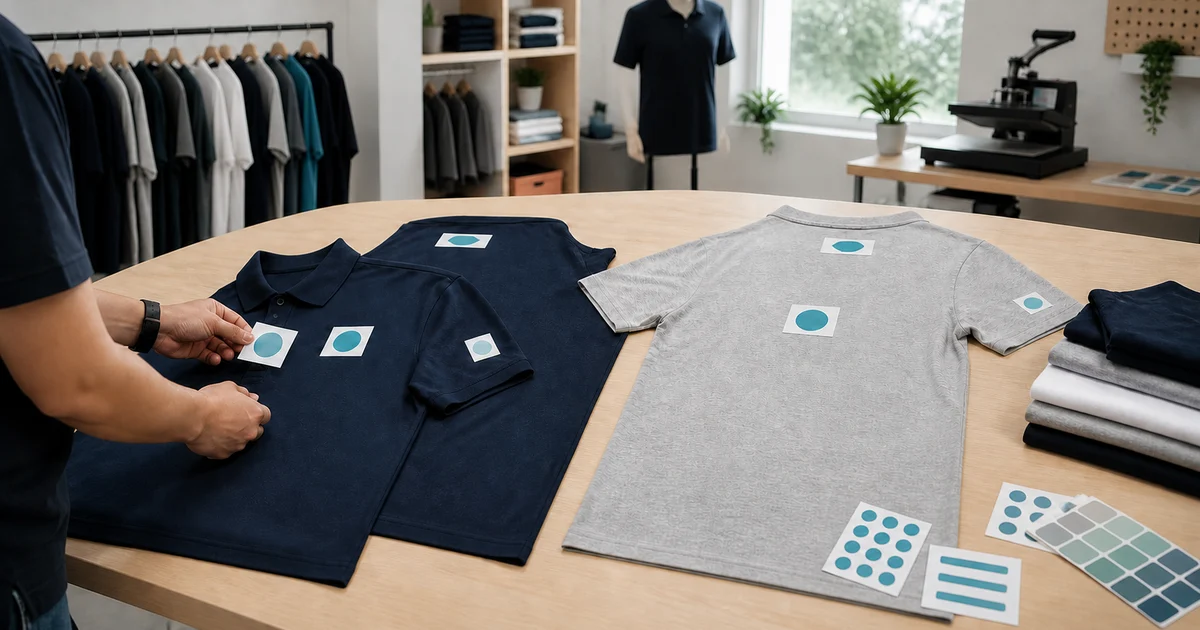
The short answer: for most company t-shirts and polo shirts, a left-chest logo is the safest professional default. Choose a centre-front logo when visibility matters more than subtlety, an upper- or full-back logo when staff must be recognised from behind, and a sleeve logo as secondary branding—not as the only identifier.
The final choice should follow the staff role, garment construction and viewing distance. A placement that suits office polos may be too discreet for an event crew working across a hall.
Compare the main logo positions
| Position | Best use | Main advantage | Main risk |
|---|---|---|---|
| Left chest | Office, retail, front desk and daily uniforms | Familiar, restrained and visible during conversation | Can collide with a pocket, placket or underarm area |
| Right chest | Staff name opposite the logo, pocket conflict or planned uniform layout | Balances another chest element | Less conventional if used without a clear reason |
| Centre chest | Promotional tees, team shirts and simple bold marks | Strong front-facing visibility | Can feel dominant on a formal polo |
| Upper back | Crew identification, department name or wide wordmark | Readable from behind without using the whole panel | Hair, collar or an apron can cover it |
| Full back | Event, service, installation and operations teams | Largest recognition area | Adds another print position and may feel heavy |
| Sleeve | Partner mark, division symbol or secondary brand | Adds detail without crowding the front | Small area, seams and arm movement reduce clarity |
One shirt does not need every available position. Extra locations add setup, production and approval work, so keep only the marks that serve a real purpose.
Why is left chest the usual company choice?
Left chest keeps the logo near a person’s face during normal conversation and remains visible under an open jacket. It also leaves the main front panel clean.
Current first-party decorator guides support it as a conventional corporate location. Printful’s placement guide describes left chest as a common option for corporate logos, while Printify calls it an industry-standard logo position. These are general guides, not fixed measurements for every Malaysian supplier.
On a flat shirt, do not push the logo outward simply because there is extra fabric. Part of that fabric wraps around the body when worn. Transfer Express demonstrates this in its left-chest placement guide: using the collar and arm seam as references helps prevent an “under-the-arm” result.
How should placement change on a polo shirt?
A polo is not a crew-neck t-shirt with a collar added. Its placket, buttons, collar shape, pocket and knit structure change the usable area.
For a left-chest polo logo:
- align it visually with the placket and collar, not the outer edge alone;
- keep it clear of the pocket edge and button placket;
- check whether the logo sits flat when the shirt is worn;
- use a sample from the actual men’s, women’s or unisex cut; and
- record the approved position for reorders.
STAHLS’ polo placement guide recommends referencing the centre placket and adjusting by garment size. SanMar’s product decoration sheet also warns that decoration area depends on garment size, method and equipment.
That is why a printer’s template and physical sample should override a generic online measurement.
When is a centre-front logo better?
Use centre front when the shirt is promotional rather than formal, or when one compact mark must be seen immediately. It suits:
- event participant t-shirts;
- campaign or launch crews;
- retail merchandise;
- simple badges or symbols; and
- layouts where the logo is the main visual.
Centre the artwork from the collar midpoint, then check the top distance on the actual garment. Avoid placing it so low that it reads as a stomach print.
For a dense full-front graphic, consider comfort in Malaysia’s warm conditions. A large solid transfer can feel less breathable than a smaller mark or an artwork with negative space. Ask the printer how the selected method and ink coverage will feel on the chosen fabric.
When does a back logo earn its cost?
A back logo is useful when recognition from behind has operational value. Common examples include:
- event organisers and marshals;
- installation or maintenance crews;
- warehouse and logistics teams;
- booth staff moving through a crowd; and
- delivery or service personnel.
Choose upper back for a department name or wide wordmark. Choose full back for a larger brand mark, role or graphic that must be recognised from farther away.
Before approving it, ask what may cover the area: long hair, tudung, apron straps, safety vest, backpack, chair back or outerwear. If staff usually wear another layer, branding the hidden shirt panel may not solve the identification problem.
Should you add a sleeve logo?
A sleeve is best for secondary information: a division mark, event partner or simple icon. It should support the main company logo rather than compete with it.
Confirm that the supplier can decorate the selected sleeve. Short sleeves, long sleeves and raglan sleeves have different seams and printable areas. A horizontal logo may also wrap around the arm and lose readability.
If both sleeves are used, state which artwork belongs on the wearer’s left and right. Do not rely on a mockup labelled only “left” without confirming whose viewpoint it uses.
Match the layout to the staff role
| Staff use | Practical starting layout |
|---|---|
| Office or front desk polo | Small left-chest logo only |
| Retail or café team | Left-chest logo, optional small back role |
| Event crew | Left chest plus clear upper or full back |
| Technician or installer | Left chest plus back company identifier |
| Promotional t-shirt | Centre front or full front, depending on artwork |
| Sponsored event team | Main logo on chest or back, partner mark on sleeve |
Treat this as a starting brief. Workplace requirements, high-visibility PPE and industry rules may affect the final uniform layout.
Approve placement before mass production
Your proof should state more than “left chest”. Record:
- garment brand or model and cut;
- wearer’s left or right side;
- final logo width and proportional height;
- reference point from collar, placket or seam;
- print or embroidery method;
- whether sizes use one placement or scaled groups; and
- front, back and sleeve artwork as separate views.
Use the companion logo print-size guide to choose starting dimensions. The artwork preparation guide explains how to supply the final file, while the embroidery cost guide covers stitch and setup considerations.
Once the layout is complete, request quotations through Baju Printz using the same annotated proof for every supplier.
Frequently asked questions
What is the safest logo placement for a company polo shirt?
The left chest is the safest conventional choice for a company polo because it keeps branding visible without dominating the garment. Confirm its position against the placket, collar, pocket and actual garment size before production.
Should a company logo go on the left or right chest?
The left chest is more conventional, but the right chest is valid when the left side has a pocket, staff name or another required mark. Consistent alignment and clear separation between elements matter more than following one side blindly.
When should a company use a back logo?
Use an upper- or full-back logo when staff must be recognised from behind or across a venue, such as event crews, installers or operations teams. Check whether chairs, aprons, long hair or outerwear will cover it.
Can the same placement measurements be used on t-shirts and polo shirts?
Not automatically. A polo has a placket, collar and sometimes a pocket, while different t-shirt cuts wrap around the body differently. Approve placement on each garment model rather than copying one set of coordinates.
Ready to compare suitable printers?
Get 5 Free Quotes