
How Do You Order Restaurant Uniforms for Kitchen and Front-of-House Staff?
Plan Malaysian restaurant uniforms by food-handling duty, kitchen and front-of-house role, hygiene, laundry, branding, sizing and reorder control.
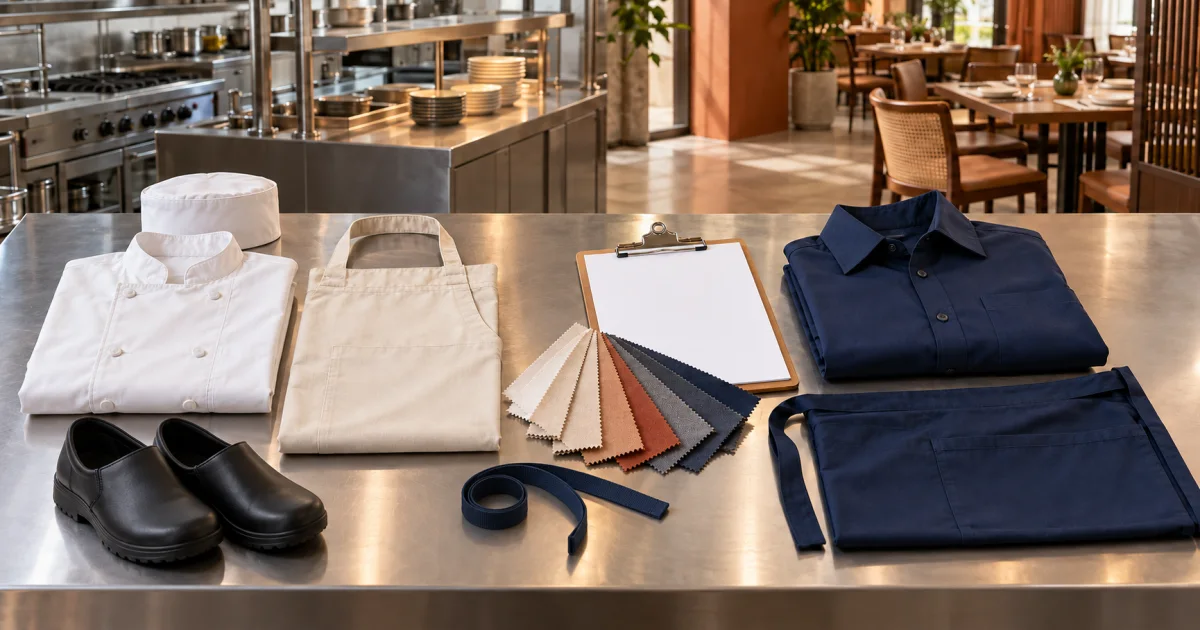
The short answer: build one restaurant identity, but do not order one garment specification for every employee. Separate the brief by actual work: kitchen food handlers, front-of-house staff who handle food, front-of-house staff who do not, and any cleaning, delivery or specialist roles. Let hygiene and workplace requirements set the garment first; then add the smallest useful layer of branding.
In Malaysia, the title on a roster is not enough. A cashier who also plates desserts may handle food, while a host who only manages reservations may not. Map the duties before choosing a dark shirt, chef jacket, apron or logo position.
Start with a role matrix, not a restaurant-wide shirt
| Role group | Practical starting point | Main checks before ordering |
|---|---|---|
| Kitchen staff who handle food | Protective clothing confirmed by the restaurant’s food-safety owner | Regulation 32, heat, movement, soil, head cover, footwear and clean rotation |
| Front-of-house staff who handle food | Service garment and required protective pieces based on actual handling duties | Whether the role falls within food-handler requirements, apron changes, serving movement and presentation |
| Hosts, reception or cashiers who do not handle food | Approved service shirt, polo or other non-protective uniform | Brand tone, fit, visibility, modesty, laundering and customer contact |
| Cleaning, dispatch or delivery roles | Garment selected for the real task and assessed hazards | Chemicals, traffic, weather, contamination separation and any required PPE |
These are briefing groups, not legal classifications. One person may move between tasks during a shift. Record the strictest approved clothing arrangement needed for that person’s actual duties rather than relying on the department name.
Identify who is a food handler before choosing colours
Malaysia’s Ministry of Health publishes the Food Hygiene Regulations 2009 under the Food Act 1983. Regulation 32 addresses clothing for food handlers. It requires clean, suitable and light-coloured protective clothing in the form stated by the regulation, including the applicable outer overall or apron, head cover and footwear. It also controls where that protective clothing is worn and how it is stored when not in use.
That has two important ordering consequences:
- a fashionable black kitchen tee and branded cap should not be assumed to satisfy the food-handler clothing rule; and
- “front-of-house” should not be treated as an automatic exemption when the person serves, prepares or otherwise handles food.
Ask the premises’ food-safety owner to classify the duties and approve the clothing specification before quotations are compared. The Ministry’s current KENDIRI 2.0 self-inspection programme is designed around continuous checks on contamination risks in receiving, storage, handling, preparation and service. The uniform system should make that routine easier, not create an exception that staff must improvise around.
This is an ordering guide, not legal advice. The Ministry page itself says its online regulations are for general reference and advises users to consult the latest published version. Use the restaurant’s current compliance process for the final decision.
Specify the kitchen set around hygiene and work
Do not start with embroidery. Start with the complete worn set approved for the task. Depending on the role and the restaurant’s compliance decision, the specification may need to cover:
- the protective outer garment or apron arrangement;
- head covering;
- footwear;
- base garment beneath the protective layer;
- pocket position and closure;
- sleeve length and cuff behaviour;
- how clean and used items are separated; and
- where protective garments are stored between uses.
Then test the sample during representative reaching, lifting and bending. Check whether apron ties drag, loose fabric approaches food or equipment, pockets gape, the head cover stays secure and the full set remains tolerable near the actual heat source.
Do not describe an ordinary printed shirt as hygienic, food-safe, heat-resistant, flame-resistant or antimicrobial without product evidence for that exact claim. Branding does not convert a general uniform into protective clothing.
Define front-of-house uniforms by task, not appearance alone
Front-of-house clothing must support service without disguising food-handling duties. Split the team where necessary:
- hosts and reception staff who do not handle food;
- cashiers who only process payment;
- servers carrying prepared food and clearing tables;
- bar or beverage staff preparing drinks; and
- supervisors who move between dining and kitchen areas.
A dark service shirt or polo may suit the brand presentation for a non-food-handling role, but the same choice cannot simply be copied to a food handler without the restaurant’s compliance approval. If a staff member changes duties, define when the required protective pieces are put on, changed, removed and stored.
For the service garment itself, test arm reach, tray carrying, sitting, bending and repeated walking. Ensure the hem stays secure, the collar does not restrict movement and the selected fabric does not become unacceptably transparent or clingy under realistic heat and moisture.
Decide whether the apron or base garment carries the logo
The logo should survive the uniform’s real layering system. Compare three simple options:
| Branding arrangement | Useful when | Check before approval |
|---|---|---|
| Logo on the apron | The apron is the consistent visible layer | Bib height, pocket, ties, laundering and replacement stock |
| Logo on the shirt | Staff may remove or change aprons during approved duties | Whether the apron, name tag or folded fabric covers the mark |
| Small marks on both | Both pieces are routinely visible and separate identification is genuinely useful | Added setup, cost, visual clutter and two decoration tests |
Avoid decorating a pocket opening, seam, placket or area repeatedly rubbed by an apron strap. Use the company logo placement guide to write measurements from fixed garment points, then compare embroidery and printing for uniforms on the exact fabric.
A small embroidered chest logo may suit a stable service shirt, but dense stitching can distort light fabric. A printed mark may suit some smooth garments or aprons, but its heat, feel and wash behaviour still need a sample. There is no universal winner across every kitchen and dining uniform.
Test one complete decorated set through the wash process
Approve the garment, protective layer and decoration together. A blank shirt fitting well does not prove that the embroidered, printed and repeatedly washed version will behave the same.
Use the restaurant’s intended wash method and inspect:
- shrinkage and changes in sleeve or body length;
- colour transfer between dark service garments and light protective pieces;
- stain removal and visible residual marks;
- puckering, peeling, cracking or abrasion at the logo;
- apron strap, buckle and pocket distortion;
- label comfort and legibility of internal allocation marks; and
- drying time before the next required shift.
If laundry is outsourced, record collection and return days. If staff wash items at home, provide one care instruction that the approved garments can realistically follow. Do not combine pieces with incompatible care requirements unless the operation has a clear separation process.
Calculate quantities from shifts and clean-item return time
Do not give every role the same number by habit. Calculate each garment component separately:
Required personal rotation = items worn or unavailable before the next clean return + justified clean buffer
A cook may need more apron changes than chef-jacket changes. A host may wear one service shirt per shift. A supervisor working only occasional dining shifts may need a different rotation again. The uniform allocation guide explains how to model the longest laundry gap without turning an example number into a company-wide rule.
Keep three quantities separate:
- garments issued to named employees;
- shared items such as approved spare aprons or head covers; and
- unopened replacement stock for damage, new hires or size changes.
Record the owner, storage point and release rule for shared stock. “Ten spare aprons” is not a control if nobody knows which size, condition or location they belong to.
Collect sizes for every garment code
Do not ask for one “uniform size” if a person receives a chef jacket, service shirt and apron. Each product has its own measurements and fit. A medium from one garment is not proof that another medium will fit.
For every role group:
- issue the exact supplier size chart;
- collect a size for each garment code;
- hold a fit session for representative employees;
- test the smallest and largest required sizes;
- record any unisex, women’s-cut, long-sleeve or modest-fit option separately; and
- reconcile the wearer list to the final order total.
Use the Malaysia bulk-order size guide for measurement and sample checks. If one purchase combines several garments, keep each combination on its own line using the mixed-garment order guide.
Build the quotation as separate production lines
A comparable restaurant-uniform quotation should name each actual item. For example:
| Line | Garment and role | Quantity details | Decoration |
|---|---|---|---|
| A | Approved kitchen outer garment | Sizes and personal or shared allocation | Position, dimensions and method |
| B | Approved kitchen apron | Style, colour and strap range | Position, dimensions and method |
| C | Front-of-house service shirt | Product code, cut and size quantities | Position, dimensions and method |
| D | Front-of-house apron | Style and quantities | Position, dimensions and method |
| E | Approved head cover or other required component | Exact product and quantities | Usually none unless specifically approved |
Ask suppliers to separate garment, decoration setup, decoration unit cost, sample, packing and delivery. State whether individual names, job titles or branch sorting are required. Do not assume different garment lines combine into one quantity tier.
Also name the substitution rule. If the quoted shirt or apron becomes unavailable, production should pause for written approval of the replacement sample rather than silently switching fabric, colour, cut or care requirements. Preserve the approved product codes, artwork, dimensions, thread or ink references, size chart and sample for the next uniform reorder.
Approve a restaurant-ready sample, not a flat mock-up
The final approval should show the complete worn combination for each role group. Check it under kitchen and dining-room lighting, then photograph front, back and side views against the approved specification.
Before bulk production, confirm:
- the restaurant’s food-safety owner approved every food-handler set;
- any workplace-safety owner approved task-specific footwear or PPE;
- garment codes, colours, cuts and size quantities match the roster;
- logo artwork, dimensions and positions match the sample;
- apron, head-cover and layering interactions are visible and usable;
- wash testing used the intended process;
- clean, used and spare stock have named storage controls; and
- the delivery date allows inspection before rollout.
Request restaurant-uniform quotations through Baju Printz after the role matrix and compliance-approved garment list are ready. One coordinated brief can preserve the brand while keeping kitchen hygiene, front-of-house service and production control as separate decisions.
Frequently asked questions
Should kitchen and front-of-house staff wear the same restaurant uniform?
Not automatically. Keep one visual identity, but specify garments by actual duty, food-handling status, heat, movement, laundering and customer contact. A host, server and cook may need different garments even when their colours and logo system are coordinated.
What clothing must a food handler wear in Malaysia?
Regulation 32 of Malaysia's Food Hygiene Regulations 2009 requires a food handler to wear clean, suitable and light-coloured protective clothing in the form stated by the regulation, including the applicable outer overall or apron, head cover and footwear. Ask the restaurant's food-safety owner to confirm the current rule and its application to each role.
Should a restaurant logo go on the apron or the shirt?
Put it where it remains visible, washable and suitable for the role. A removable apron can simplify replacement, while a shirt logo remains when the apron is changed; approve the complete worn combination because straps, bibs, pockets and folds can cover a mark.
How many restaurant uniforms should each employee receive?
Calculate from shifts, the longest time before a clean garment returns, items being worn or awaiting laundry, and a justified spare allowance. Kitchen soil, apron changes and outsourced laundry may create a different rotation from front-of-house service.
What should a restaurant send a uniform supplier for a quotation?
Send role groups, garment codes, colours, fabric details, size quantities, logo files and dimensions, decoration positions, apron or head-cover requirements, packing, sample approval, delivery postcode and required receipt date. Keep hygiene or safety requirements clearly separate from branding preferences.
Ready to compare suitable printers?
Get 5 Free Quotes