
Can One Bulk Order Mix T-Shirts, Polo Shirts and Jackets?
Plan one mixed-garment bulk order by separating product codes, size charts, decoration groups, pricing tiers, samples and packing.
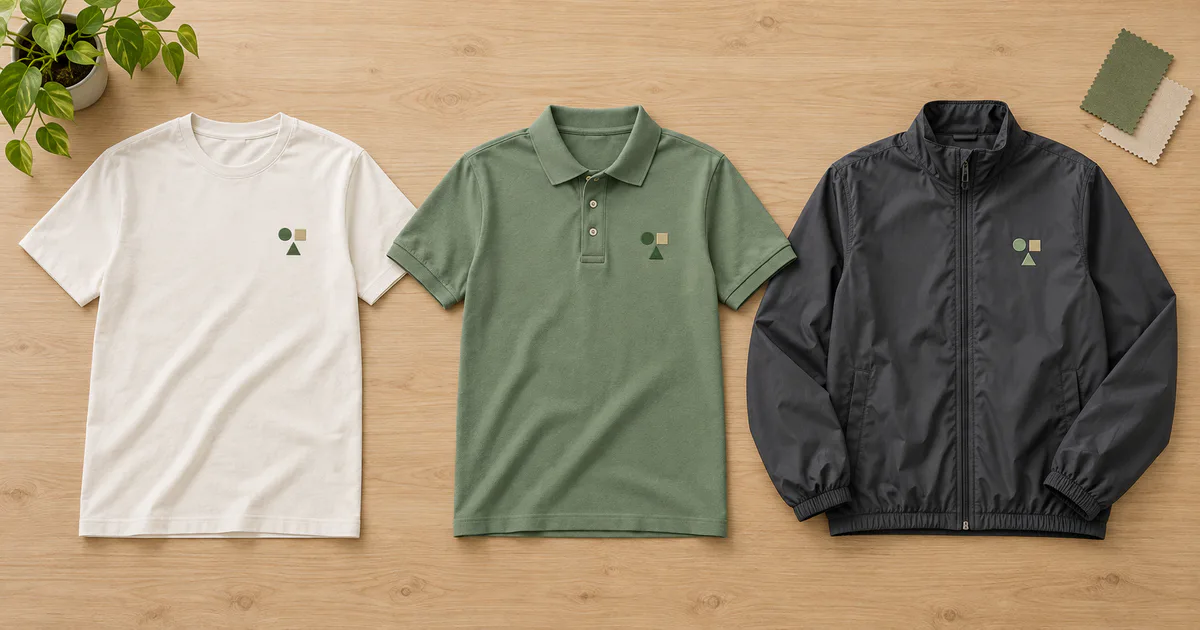
The short answer: yes, one bulk order can include T-shirts, polo shirts and jackets, but it should be managed as one commercial order with several controlled product groups. Give every garment its own code, colour, size chart, quantity, decoration specification, sample and subtotal. Do not assume that placing 100 mixed items on one purchase order makes them one 100-piece production run.
The useful benefit is coordination: one approval owner, one required receipt date, one delivery plan and one complete payable total. The risk appears when “same logo” or “same supplier” hides real differences between jersey knit, textured polo fabric and coated outerwear.
Build a garment-group matrix first
Start with the roles and exact products before asking for price:
| Group | Intended use | Product record | Decoration record | Quantity record |
|---|---|---|---|---|
| Event T-shirt | Roadshow and crew | Tee code, cotton or performance fabric, colour, exact chart | Printed logo or campaign artwork, dimensions and positions | Size subtotal for this tee only |
| Company polo | Reception and sales | Polo code, pique or microfiber construction, colour, exact chart | Embroidered or printed chest logo, finished width and position | Size subtotal for this polo only |
| Lightweight jacket | Outdoor travel or supervisors | Jacket code, shell and lining, coating, zip and panel details, exact chart | Tested embroidery, transfer or patch specification | Size subtotal for this jacket only |
Add separate rows for women’s, Muslimah, kids or other cuts. They may use the same brand design, but they remain different garment products with different fitting and decoration areas.
Use the polo versus T-shirt uniform guide to decide whether each group has a real role. A mixed order is not useful when three garments were added only because a catalogue offers them.
Share the order controls, not every production setting
The groups can normally share:
- one organisation and authorised approver;
- one brand master and list of permitted logo versions;
- one required receipt date and backwards approval schedule;
- one purchase order with clearly separated line items;
- one delivery and carton plan; and
- one final reconciliation of quantity and payment.
Keep these items separate for every garment group:
- supplier product code, fabric, construction, colour and cut;
- product-specific size chart and wearer choices;
- finished decoration size and measurable position;
- print, embroidery, patch or transfer production file;
- sample approval and acceptance notes;
- unit price, setup, minimum quantity and subtotal; and
- approved substitute when stock becomes unavailable.
This distinction prevents a common handover problem: the buyer approves a logo on a smooth T-shirt, then expects the same file and dimensions to work automatically on a textured polo and a zip jacket.
Adapt one brand master to each garment
Keep the logo shape, proportions, wording and approved colour references under one brand master. Then create only the production versions required by the order.
A T-shirt may provide a broad, flat front or back print area. A polo’s placket, collar and textured knit can change the useful position and fine-detail result. A jacket may have zips, seams, lining, insulation or a surface treatment that changes how the decoration can be applied.
Wilcom’s current fabric-setting guidance shows why embroidery density, underlay, pull compensation and stitch length can differ between pique, stretch knit, fleece and nylon. An embroidery file that sews well on one polo is therefore not automatic approval for another garment.
Roland DG states that DTF can transfer to a broad range of materials including cotton, polyester blends, denim and nylon. That range is a capability list, not proof that one heat recipe suits every item. The printer still needs to test the exact garment and follow the chosen system’s settings.
For coated nylon outerwear, Transfer Express specifically notes that waterproofing can affect transfer adhesion and recommends testing. A jacket should be treated as its own approval group even when the T-shirt and polo use a related transfer.
Use the embroidery versus printing uniform guide to choose the method by garment role and logo construction rather than forcing one technique across the whole order.
Keep every size chart and wearer choice separate
Do not ask an employee for “one uniform size” if that person will receive more than one garment. Collect a size for each product, for example:
| Wearer ID | Event tee | Company polo | Jacket |
|---|---|---|---|
| Staff 001 | M | L | L |
| Staff 002 | S | S | M |
The letters are examples only. Use each supplier’s actual chart and fitting sample. Jackets may need room for an inner layer, while fitted polos and unisex T-shirts can have different chest, shoulder and body-length proportions.
Record the product code beside every size so a later substitution cannot silently inherit the old selection. The Malaysia bulk-order size guide explains how to use garment measurements and fitting samples without inventing a conversion between brands.
Ask how quantities and price tiers are grouped
One order total does not answer how the supplier calculated it. Request four figures for every group:
- blank-garment subtotal;
- decoration setup or preparation charge;
- decoration unit charge and the quantity tier used; and
- sample, packing, delivery and other group-specific charges.
Some production work may be shared. For example, compatible DTF transfers may be nested in one print run, or an unchanged embroidery design may start from the same digitised master. The actual garments can still require different transfer settings, hooping, backing, handling or sample work.
Ask the supplier to state whether quantities are combined for:
- garment price;
- screen, transfer or embroidery setup;
- decoration unit rate;
- extended sizes;
- sampling; and
- packing or branch sorting.
There is no universal rule that 40 T-shirts, 30 polos and 30 jackets receive the same rate as 100 identical shirts. Use the bulk-discount guide to compare the written tier rather than relying on the grand quantity alone.
Approve one sample for every production group
Arrange the samples together and check both consistency and garment-specific quality.
For every group, record:
- exact garment, colour, cut and size;
- logo or artwork version;
- method, finished dimensions and position;
- print colour, thread colour, backing or transfer construction;
- appearance while worn and interaction with seams or zips;
- comfort, surface marks, puckering or adhesion; and
- approved care instructions.
Consistency does not mean the decorations must feel identical. A small embroidered polo logo and a printed T-shirt mark can belong to the same brand system while using different physical constructions. Judge whether the approved size, colour and placement logic remains coherent.
Use the sample approval checklist for the physical review. Do not release all three groups because only the easiest garment passed.
Pack and reconcile by garment group
Packing should preserve the matrix. Label cartons or inner bundles by garment code, colour, size and destination. When items are packed for named staff, check every person’s T-shirt, polo and jacket against the roster before sealing the set.
Keep spare stock on separate rows so it is not mistaken for a missing named pack. The individual-packing guide helps choose between size bundles, named packs and retail-style individual protection.
At delivery, reconcile each product subtotal before accepting the grand total. One hundred delivered pieces do not pass when the order required 40 tees, 30 polos and 30 jackets but one group is short.
Send one mixed-garment quotation brief
Attach the garment-group matrix, separate size breakdowns, brand master, production artwork versions, decoration dimensions, positions, sample rule, delivery postcode and required receipt date. Ask every supplier to return the same matrix with method, tier, setup, unit price, subtotal and acceptable substitute completed for each row.
You can request comparable mixed-uniform quotations through Baju Printz once the groups are defined. Keep one commercial order for control, while treating every garment and decoration combination as the production job it actually is.
Frequently asked questions
Can T-shirts, polos and jackets be ordered from one supplier?
Often yes when the supplier can source and decorate all three garments. Keep each garment code, colour, size chart, quantity, decoration method and price on a separate order line even when they share one purchase order and delivery date.
Will mixed garments count together for a bulk discount?
Not automatically. A supplier may combine some decoration quantities while pricing the blank garments, setup or production runs separately. Ask for the quantity rule and payable subtotal for every garment group in writing.
Can the same logo file be used on a T-shirt, polo and jacket?
Use one approved brand master, then prepare a production version for each garment and method. The finished size, position, stitch settings, underbase, transfer or backing may need to change while the logo shape and approved colours stay controlled.
Does one size chart work for all garments in a mixed order?
No. Use the exact product-specific chart for every T-shirt, polo, jacket and cut. A person who wears M in one product may need another size in a different garment, so record each choice separately.
How many samples are needed for a mixed-garment order?
Approve at least one complete sample for every distinct garment and decoration group. Add another sample when the fabric, colour, method, logo size or difficult placement creates a materially different production risk.
Ready to compare suitable printers?
Get 5 Free Quotes