
How Do You Measure a T-Shirt Correctly?
Measure T-shirt chest width, body length, shoulders and sleeves consistently, then compare the flat garment with the exact supplier size chart.
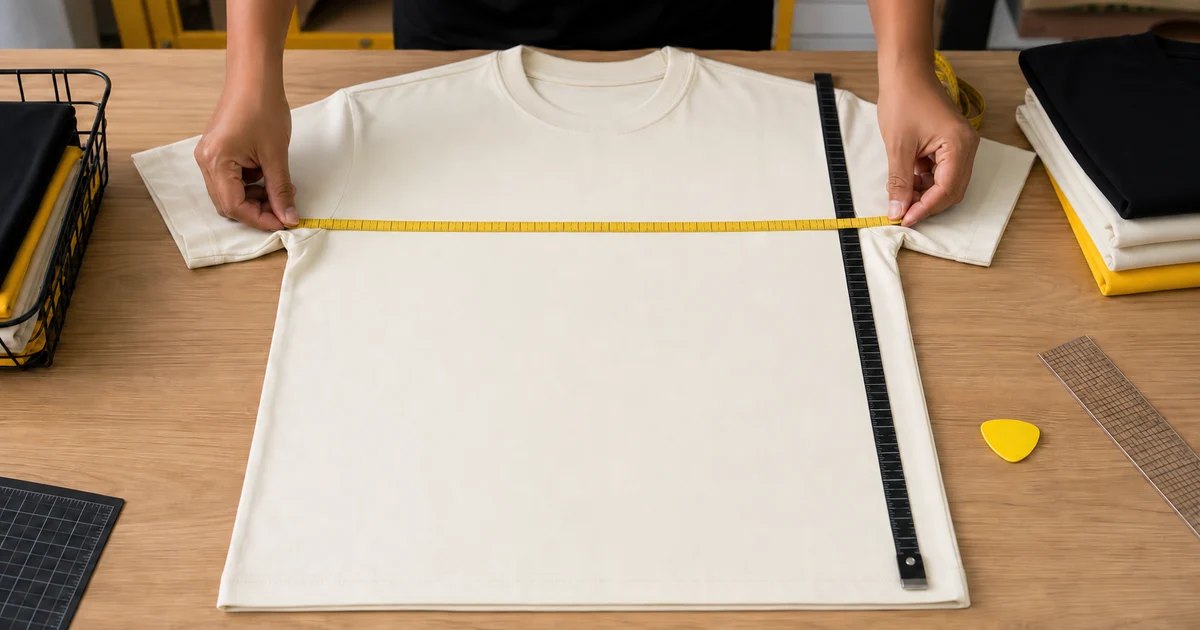
The short answer: lay a well-fitting T-shirt on a flat surface, smooth it without stretching, and measure the same points used by the supplier’s chart. The common checks are chest width, body length, shoulder width and sleeve length, but the chart’s own diagram is always the final reference.
Measuring consistently matters more than forcing every supplier into one method. ISO 18890 defines standard garment measurement points while allowing additional points to be agreed between interested parties. See the current ISO 18890 overview.
Prepare the shirt before measuring
Use a shirt that already fits the intended wearer well and is similar to the product being considered.
- Button or zip it only if the product has closures.
- Lay it front-up on a hard, level table.
- Align the side seams and shoulders naturally.
- Smooth wrinkles with your hands.
- Do not pull the fabric, collar, rib or hem.
- Use a flexible tape and record one unit consistently.
If shrinkage matters, note whether the reference shirt is new or has been washed. A washed favourite and a new production sample are not directly equivalent unless that difference is recorded.
Measure these common T-shirt points
| Measurement | Common flat-garment method | Frequent mistake |
|---|---|---|
| Chest width | Straight across from one underarm point to the other | Measuring around the body or following a curve |
| Body length | From the chart’s shoulder or collar reference point to the bottom hem | Including the collar when the chart excludes it |
| Shoulder width | Straight between the left and right shoulder seam points | Measuring sleeve-to-sleeve |
| Sleeve length | From the stated shoulder seam point to the sleeve edge | Starting at the collar without checking the diagram |
| Hem width | Straight across the bottom opening | Stretching the hem while measuring |
Suppliers may use slightly different start points. Copy the chart method rather than assuming these descriptions override its diagram.
How do you measure chest width?
Place the tape horizontally across the front from one underarm seam point to the other. Keep the tape straight, parallel to the bottom hem and resting on the fabric.
Do not stretch the shirt to remove every ripple. If the side seams twist, settle the garment naturally and note the issue rather than forcing the fabric into a wider shape.
Some buyers double this flat value to estimate the shirt’s circumference. That arithmetic describes the garment, not the wearer’s chest, and it does not remove the need for fit allowance. If the supplier chart lists flat width, compare flat width directly.
How do you measure body length?
First identify the chart’s top reference point. A common method starts near the highest shoulder point beside the collar and runs vertically to the bottom hem. Another chart may define the point differently.
Keep the tape straight down the body. Do not follow the collar curve or measure diagonally to the longest corner of the hem.
For a long-sleeve or Muslimah garment, also check whether front and back lengths differ. Record both only when the chart or purchase specification requires them.
How do you measure shoulders and sleeves?
For shoulder width, measure straight across the back or front between corresponding shoulder seam points, following the supplier’s orientation.
For a set-in sleeve, measure from the shoulder seam to the sleeve edge along the stated line. Raglan sleeves begin at the collar area and need a different measurement path; do not convert them using a set-in sleeve diagram.
An oversized drop-shoulder shirt also has a deliberately extended shoulder. Compare it with the same cut, not a regular tee carrying the same size label.
Use one measurement protocol for the whole order
For a team or event, record:
- product code and chart version;
- whether values are body or garment measurements;
- centimetres or inches;
- each measurement point used;
- whether the sample was washed;
- the measured value without silent rounding; and
- the name or initials of the recorder.
Measure twice if a value is near a size boundary. For production inspection, measure more than one piece because an approved tolerance may apply. Oren Sport’s current catalogue, for example, states that its product sizes may vary by plus or minus 5%; that is its stated tolerance, not a universal rule for every manufacturer.
Turn measurements into a bulk size choice
Do not choose a size by matching chest width alone. Check body length, shoulder position and the wearer’s preferred ease, then try a sample whenever the decision is close.
CUSTA’s current Malaysian guidance similarly recommends laying a well-fitting shirt flat and comparing it with the selected product chart. Review the supplier’s size-chart guidance as a local example.
Use the measurements inside the Malaysia bulk T-shirt size guide to collect named choices and reconcile product subtotals. When the list is ready, request quotations through Baju Printz.
Frequently asked questions
How do you measure T-shirt chest width?
Lay the shirt flat without stretching it and measure straight across from one underarm point to the other. Use the exact points shown on the supplier chart because diagrams can differ.
Do you double a flat T-shirt chest measurement?
Doubling the flat width gives an approximate garment circumference for a simple tubular comparison, not the wearer’s body measurement. Keep using flat width when the supplier chart lists flat width.
Should a T-shirt be measured while someone is wearing it?
No, not when comparing finished-garment dimensions. Measure a well-fitting shirt on a level surface so the fabric is relaxed, flat and not stretched around the body.
Why can repeated measurements of the same T-shirt differ?
Wrinkles, stretching, uneven surfaces, different measurement points and rounding can change the result. Use one agreed method, unit and recorder for the whole bulk order.
Ready to compare suitable printers?
Get 5 Free Quotes