
Ready-Made Blanks vs Cut-and-Sew: What Is the Difference?
Compare ready-made blank T-shirts with cut-and-sew production by design control, sampling, quantity, timing, cost and reorder risk.
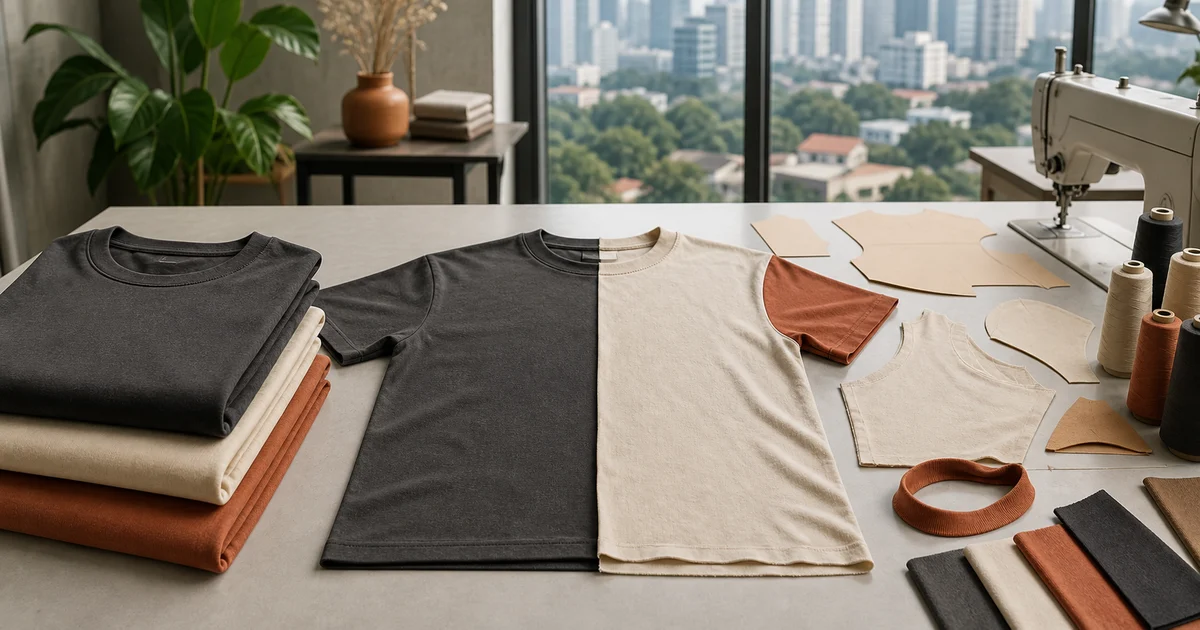
The short answer: a ready-made blank is an existing finished garment that receives your print or embroidery. Cut-and-sew makes the garment itself from fabric panels to an approved pattern. Choose blanks for lower development risk when a suitable product is in stock; choose cut-and-sew when the silhouette, fabric, construction or full-garment design must be yours.
Neither route is automatically “more premium”. A well-selected blank with excellent decoration can outperform a poorly developed custom garment. The decision is about how much product control the collection actually needs.
Ready-made blanks vs cut-and-sew at a glance
| Decision point | Ready-made blank | Cut-and-sew |
|---|---|---|
| Garment | Existing supplier product | Made to an approved pattern and specification |
| Fit control | Limited to available cuts and sizes | High, subject to pattern development and sampling |
| Fabric and colour | Existing range | Custom or nominated, subject to sourcing and minimums |
| Development work | Product selection and decoration sample | Tech pack, pattern, fabric, trims and several approvals |
| Decoration | Within feasible areas on a finished garment | Can be planned around panels before assembly |
| Quantity | Often practical for smaller tests | Factory and material minimums are usually more important |
| Timing | Can be faster if all stock is available | More stages before bulk production |
| Reorder risk | Product or colour may change or sell out | Fabric, dye lot, trim and production capacity may change |
| Unit price | Existing garment plus decoration | Materials, cutting, sewing, finishing, development and decoration |
Ask suppliers to quote the same delivered specification. Comparing a basic stock tee with a fully custom washed garment does not reveal which production route is cheaper on equal terms.
What is a ready-made blank?
A blank is already sewn and sold under an existing product code, colour range and size chart. The printer purchases it and adds screen printing, DTF, DTG, embroidery or another compatible decoration.
The buyer should approve:
- manufacturer and exact product code;
- colour name and physical sample;
- fibre, knit and GSM stated for that product;
- current size chart and tolerance;
- available quantities by size;
- decoration method, dimensions and placement; and
- reorder policy or possible substitutes.
Do not approve “black cotton tee” as the whole garment specification. Two blanks carrying that description may differ in fit, surface, dye, collar and shrinkage. Use the Malaysia T-shirt size guide and GSM guide to compare the actual products.
What is cut-and-sew production?
Cut-and-sew starts with fabric and garment pieces rather than a finished tee. The production team develops or selects a pattern, cuts the front, back, sleeves and other panels, then sews and finishes the garment to the approved specification.
The term describes construction, not one printing method. Printful’s current all-over-print guidance gives a clear example: the design is applied to fabric, then the fabric is cut into shape and sewn into the finished garment. This allows seam-to-seam customisation that is difficult on a pre-made product.
A fully custom programme may involve:
- design brief and technical pack;
- pattern and grading rules;
- fabric, colour, rib and trim approval;
- prototype or fit sample;
- revised sample and size set;
- wash and decoration tests;
- pre-production sample; and
- bulk cutting, sewing, finishing and inspection.
The stages vary by factory. Ask which approvals are included, chargeable and required before production can start.
When should you choose a ready-made blank?
Choose a blank when the available garment already meets the important requirements and the priority is to validate demand, outfit a team or launch without developing a new pattern.
It is a sensible route when:
- the required fit and colour exist;
- quantities are small or uncertain;
- delivery timing is important;
- the design sits within normal print or embroidery areas;
- the standard collar, seams and labels are acceptable; and
- future orders can tolerate a supplier-managed stock range.
Confirm stock by colour and size before collecting final wearer choices. A catalogue image does not reserve inventory. If one size is unavailable, decide whether the whole order will wait, use an approved substitute or ship separately.
When is cut-and-sew worth it?
Use cut-and-sew when the garment itself is part of the brand identity and a stock product cannot deliver it.
Common reasons include:
- a proprietary oversized, cropped, longline or gender-specific fit;
- a nominated fabric, custom colour or wash finish;
- contrast panels, pockets or non-standard seams;
- a custom neck rib, hem, label or trim package;
- artwork planned across panels or from seam to seam; and
- tighter control over the complete product specification.
For an oversized collection, read the Malaysian oversized streetwear production guide before deciding whether the stock silhouette is close enough.
What affects MOQ, cost and lead time?
There is no reliable universal MOQ, price gap or delivery time. A cut-and-sew factory may set minimums for fabric knitting, dyeing, cutting or trims. A blank programme may accept a smaller decoration order but still face carton quantities, size stockouts or a supplier’s printing minimum.
Request an itemised quotation covering:
- development and pattern charges;
- sample rounds and courier costs;
- fabric, dyeing, trims and wastage;
- garment unit cost by quantity;
- decoration setup and unit charges;
- testing, inspection, labels and packing;
- SST or other stated taxes where applicable; and
- delivery to the final Malaysian postcode.
The MOQ guide explains why method and supplier capacity matter, while the hidden quotation-cost checklist helps normalise totals.
Protect the approved specification and reorders
For blanks, save the product code, chart version, decoration files, print dimensions, placement, thread or ink references and an approved physical sample. Ask what happens if the product or colour is discontinued.
For cut-and-sew, also confirm in writing:
- who owns and stores the pattern, graded size set and technical pack;
- approved measurement tolerances;
- fabric and trim references;
- how a new dye lot will be matched;
- minimum material purchase for a repeat; and
- how long samples and production records are retained.
A reorder can still vary because materials and batches change. Keep an approved sample and compare new production under consistent lighting and measurement conditions.
Is relabelling a blank the same as cut-and-sew?
No. Adding an inside print, sewn label, neck tape or packaging to an existing blank is a useful private-label blank route, but it does not create a custom pattern or fabric.
Before removing or covering an original label, confirm supplier permission and the product information that must remain. Certifications and fibre or care claims may apply only when the garment and labelling conditions are preserved. Do not promise a custom origin, composition or certification without documentation.
Send one brief and compare like for like
If you are undecided, ask for two clearly separated options: the closest approved stock blank and a cut-and-sew route matching the desired garment. Give both suppliers the same quantity, size range, artwork, packing, deadline and delivery postcode.
Request quotations through Baju Printz once the non-negotiable requirements are clear. The resulting comparison should show whether custom development buys a benefit that customers can actually see, feel or use.
Frequently asked questions
What is a ready-made blank T-shirt?
It is a finished, undecorated garment made to a supplier’s existing product specification. You select its product code, colour and size, then add printing or embroidery within the garment’s available decoration areas.
What does cut-and-sew mean for a T-shirt?
Cut-and-sew production makes the garment from fabric pieces: a pattern is developed or selected, fabric is cut into panels, the panels are sewn, and the garment is finished and decorated to the approved specification.
Are ready-made blanks cheaper and faster than cut-and-sew?
They usually require less development and can move faster when the exact product, colour and sizes are in stock. There is no universal price or lead-time rule because availability, quantity, decoration, fabric, sampling and delivery still affect the job.
Can a ready-made blank have a custom inside label?
Sometimes, but the permitted method depends on the garment, original label, supplier policy and any legal or certification requirements. Confirm in writing what may be removed, covered, printed or sewn before approving production.
Ready to compare suitable printers?
Get 5 Free Quotes