
Bulk T-Shirt Printing Discounts: When Does the Price Drop?
Learn when bulk T-shirt unit prices fall, which variations count as one batch and how to compare quantity breaks without buying unwanted stock.
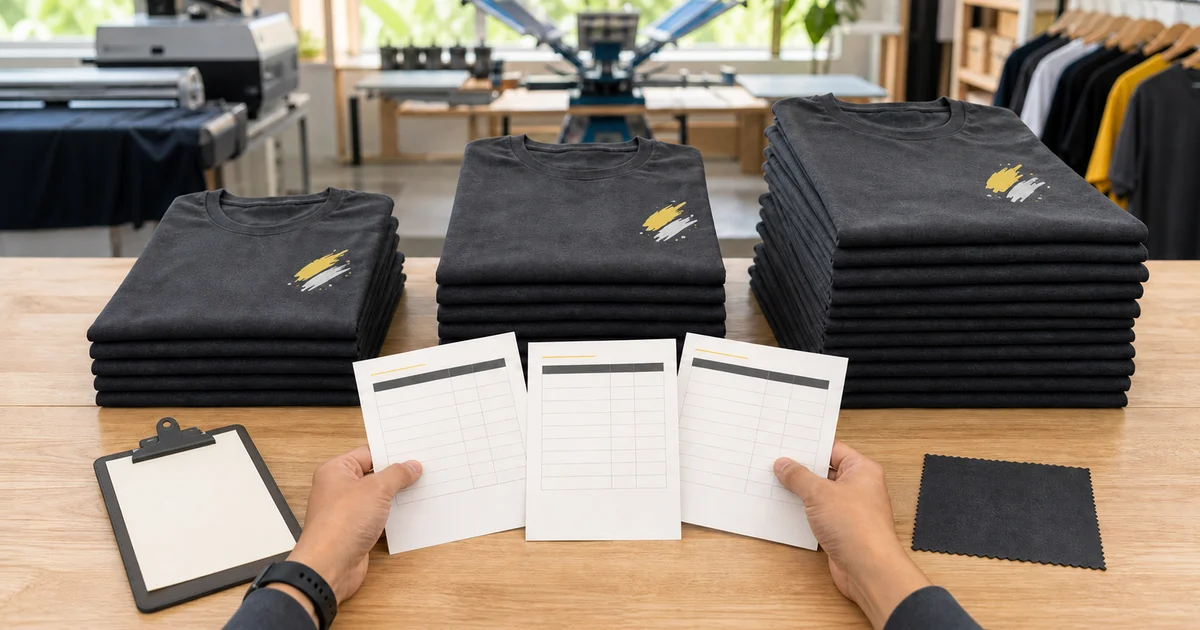
The short answer: a bulk T-shirt price drops when your order reaches a supplier’s next quantity tier without changing the priced specification. There is no Malaysian rule that every printer discounts at 50, 100 or 500 pieces. Ask for prices at your required quantity, the next break and one higher tier, then compare the total payable—not the unit price alone.
A larger order normally spreads setup and production work across more shirts. However, 100 mixed designs are not necessarily priced like 100 identical shirts, and buying unused stock can erase the apparent saving.
Current Malaysian price-break examples
Supplier pages checked on 4 August 2026 show how different the tiers and inclusions can be:
| Published supplier example | Quantity bands shown | Specification boundary |
|---|---|---|
| Tshirts.com.my bulk package | 50–99, 100–299, 300–499 and 500–999 pieces | One-colour, one-position printing; its page says the blank shirt cost is separate |
| Krafezee family-event tee | Individual prices for 1–4, then 5–9, 10–19, 20–99 and 100+ pieces | One-sided DTF on the stated cotton shirt and print area |
| A.K.A. Smart Enterprise tee listing | Below 10, below 50 and above 100 pieces | A published T-shirt package; exact order details still require confirmation |
Review the live Tshirts.com.my package, Krafezee product page and A.K.A. Smart Enterprise listing before relying on a tier. These are supplier-specific offers, not market averages, and they are not like-for-like quotations.
The useful lesson is not the advertised ringgit amount. It is that a quantity band is valid only with its garment, artwork, print method, size and inclusion rules.
Why does the unit price fall?
Most custom orders contain work that happens before or around the actual printing:
- checking and preparing artwork;
- creating screens, separations or embroidery files where required;
- sourcing and counting blank garments;
- setting up ink, transfers, platens or machine files;
- making test prints and aligning positions;
- approving samples or proofs; and
- counting, sorting and packing the finished batch.
Some of this work changes little whether the printer produces 20 or 100 identical pieces. A larger run divides it across more units and can improve production efficiency. The blank-garment supplier may also offer its own quantity tier.
That does not mean every cost falls. More pieces still use more garments, ink, transfers, labour, packing space and delivery weight.
What must stay the same for pieces to share a tier?
Ask the printer to define the price group. It commonly requires the same:
- garment brand and product code;
- garment colour and fabric;
- artwork version;
- print dimensions and positions;
- printing method and ink or transfer specification; and
- packing and delivery arrangement.
Standard sizes may be combined, but 3XL and above can have a different garment cost. Unisex, fitted, kids and Muslimah cuts are different products even when their size labels look similar.
Different shirt colours need confirmation. A black shirt may need a white underbase while a white shirt does not. The black T-shirt printing guide explains why that can create a different production setup.
How does the printing method change the discount?
| Method | Where fixed work appears | Typical pricing question |
|---|---|---|
| Silk screen | Artwork separation, a screen per colour, ink and press setup | Does each garment colour or artwork version need a separate screen set? |
| DTF | File preparation, film nesting, powder curing and heat pressing | Is pricing based on quantity, transfer area, film usage or all three? |
| DTG | File preparation, pretreatment where required and individual machine time | Is there a volume band for the exact garment and colour? |
| Embroidery | Digitising, thread setup, framing and machine time | Is digitising separate, and does the unit rate depend on stitch count? |
| Sublimation jersey | Panel artwork, printing, cutting and sewing as a production batch | Can names and numbers vary within one team design without splitting the tier? |
Silk screen often shows a stronger volume effect for repeated, limited-colour artwork because its screen setup is paid before the run. Digital and transfer methods can start at lower quantities, but their per-piece machine or application work remains.
Compare the methods in the silk screen, DTF and DTG guide before assuming the cheapest tier uses the right process.
Do mixed sizes count together?
Usually, standard sizes of the same product can contribute to one print quantity because the artwork and machine setup remain the same. The garment subtotal may still change by size.
Send a size breakdown such as:
| Product | Colour | Sizes | Quantity |
|---|---|---|---|
| Unisex tee A | Black | S 8, M 20, L 18, XL 8 | 54 |
| Unisex tee A | Black | 2XL 4, 3XL 2 | 6 |
| Fitted tee B | Black | S 4, M 6 | 10 |
Then ask which rows share the print tier and whether their blank-shirt prices differ. Do not hide variants inside “70 shirts”; the printer cannot price what is not specified.
The Malaysia bulk size guide explains how to separate garment cuts and reconcile the final quantity.
Ask for a quantity ladder
Instead of asking only “What is your best price?”, request a small comparable ladder:
- price and total at the quantity you actually need;
- price and total at the supplier’s next price break;
- price and total at one higher practical break;
- exactly which garment and decoration are included;
- setup, sample, packing and delivery charges; and
- the quotation’s validity and stock condition.
Use the same brief for every supplier. If one quote is for a one-colour left-chest screen print and another is for a large full-colour DTF front, their quantity discounts do not answer the same question.
Calculate the landed cost, not just price per shirt
Use this comparison:
Landed unit cost = total payable ÷ number of usable shirts received
The total payable should include the garment, printing, setup, artwork work, sample, personalisation, packing, delivery and any applicable tax. Also record whether the supplier has included spare pieces or only the exact named quantity.
A low unit figure can be misleading when it excludes the blank shirt or delivery. The related guide covers nine quotation costs that buyers often miss.
When should you not chase the next tier?
Stay at the required quantity when the extra shirts are likely to become:
- unwanted sizes;
- stock with an event date that will pass;
- uniforms carrying an old logo or sponsor;
- garments that need storage and stock control;
- a different shade from a future reorder; or
- cash tied up before the final headcount is known.
Extra units can be sensible for new staff, size exchanges or event contingencies, but choose them deliberately. Do not add random sizes solely because the unit price looks lower.
The custom T-shirt MOQ guide explains how minimums and later reorders interact with price tiers.
Send one controlled brief
State the garment code, colour, artwork, print size, positions, quantity ladder, size breakdown, delivery postcode and required date. Ask every printer to return the same inclusions and totals.
You can browse Malaysian T-shirt printers or request BajuPrintz quotations using that controlled specification.
Frequently asked questions
When do bulk T-shirt printing discounts usually start?
There is no universal starting quantity. A discount begins at the supplier's next price tier for one defined specification, and the breakpoints vary by garment, printing method, artwork and factory.
Can different T-shirt sizes count toward the same bulk discount?
Often they can when the garment model, colour, artwork, print size and method stay the same. Extended sizes, different cuts or separately sourced garments may have different blank costs, so the supplier must confirm the combined tier.
Can different shirt colours or artworks share one price tier?
Not automatically. A colour change can require another underbase, ink setup or production run, while a new artwork may need separate screens or files; ask the supplier to state which variations are aggregated.
Should you order extra shirts just to reach the next discount tier?
Only when the new total cost and useful quantity make sense. Compare both the total payable and unit price, then include realistic needs for spares or new members without buying sizes or artwork that may become obsolete.
Ready to compare suitable printers?
Get 5 Free Quotes