
Should Custom T-Shirts Be Individually Packed?
Choose individual bags, paper bands, size labels and carton sorting for custom T-shirts based on retail, event or staff distribution needs.
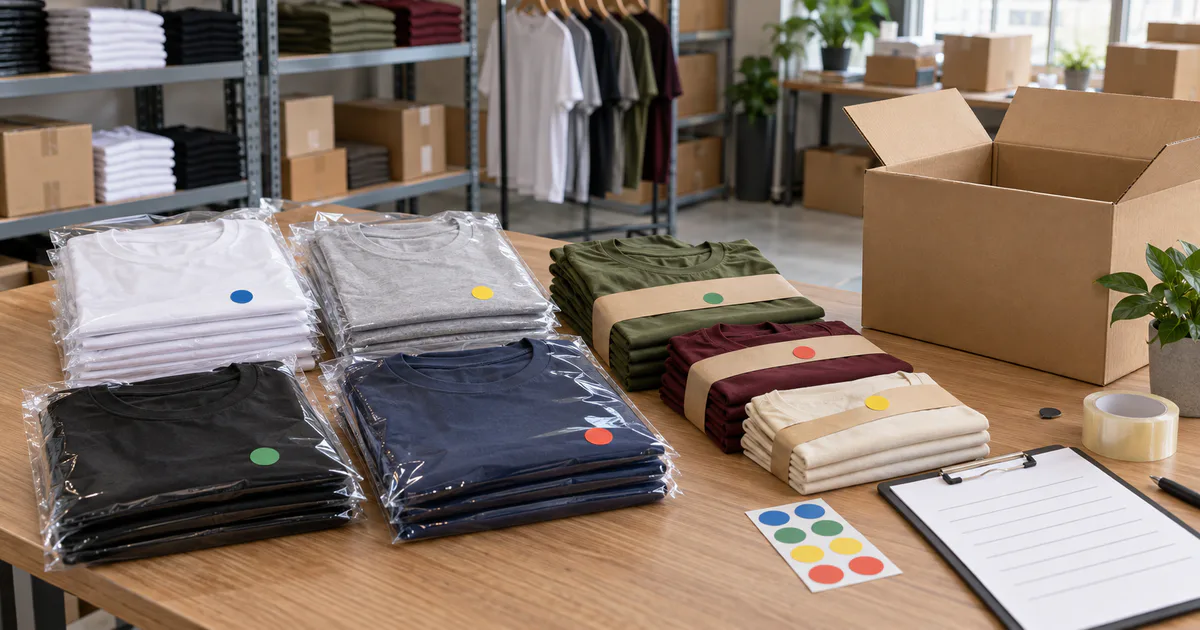
The short answer: custom T-shirts do not always need individual bags. Use individual protection when shirts will be stored, shipped to separate recipients, sold at retail or handled repeatedly. For direct distribution at a controlled event or office, clean size-sorted bundles or paper bands may be enough. Choose the format from the real delivery route, then write the folding, label and carton rules into the quotation.
Packaging is part of fulfilment, not a decorative extra. The wrong choice can create avoidable plastic, hidden labour or a sorting queue on event day. No packaging plan can also leave light-coloured shirts exposed to dirty cartons, wet loading areas or repeated handling.
Start with the handover, not the bag
Map what happens after production:
| Final use | Practical starting point | Main control |
|---|---|---|
| Staff collect by department | Size-sorted bundles or named packs | Department and recipient list |
| Event crew distribute on site | Bundles by size, team or counter | Fast count and visible size marker |
| Individual courier delivery | Protected individual pack inside the approved mailer | Recipient and order match |
| Retail or merchandise sale | Individual pack or approved retail fold and tag | SKU, size, colour and scan workflow |
| Long storage or multi-stop transport | Individual protection plus lined, labelled cartons where required | Dirt, moisture and carton reconciliation |
Do not copy a retail packaging specification for a one-hour school distribution without a reason. Equally, do not approve loose folded shirts for a route that includes warehouse storage, several transfers and outdoor unloading.
The multi-location delivery guide helps separate production packing from courier consignments and destination-level counts.
Compare four simple packing formats
1. Size-sorted bundles
Fold shirts consistently, group them by product, colour and size, then place each group in a clean inner liner or carton arrangement agreed with the buyer. This uses less individual material and can be fast for staffed distribution. It is a poor fit when packs must travel separately or recipients need a named unit.
2. Paper bands or belly bands
A band keeps one folded shirt or a small set organised and can carry a removable size marker. It offers little protection from liquid, dust or an open carton. Test whether the band stays secure during the actual transport and handling route.
3. Clear individual bags
A clear bag protects the fold and lets handlers identify the garment without opening it. Specify the bag size, closure and label position rather than accepting an oversized default. Avoid placing a second individual bag inside another mailer unless both layers solve a documented handling need.
Patagonia’s published garment-packaging study found that bags protected products in its own factory-to-distribution-centre system, while also identifying right-sizing, recycled content and better recovery information as improvement areas. That case shows a trade-off, not a universal rule for every Malaysian order.
4. Recipient, department or kit packs
One pack may contain a named shirt, or several items for one person, team or branch. This reduces sorting at the destination but adds roster control and packing labour. It needs a complete list before sealing and a clear rule for late changes.
Build one packing matrix
Do not send instructions across chat messages and spreadsheets. Give the supplier one controlled matrix:
| Pack ID | Garment | Colour | Size | Recipient or group | Quantity | Pack type | Destination |
|---|---|---|---|---|---|---|---|
| A-01 | Polo A | Navy | M | Sales / Amir | 2 | Named pack | KL office |
| A-02 | Polo A | Navy | L | Sales / Mei | 2 | Named pack | KL office |
| B-M | Tee B | Red | M | Event counter M | 30 | Size bundle | Hall A |
Use an internal pack ID even when the recipient name is shown. An ID is easier to reconcile, reprint and report without repeating personal information across every carton document.
Lock the roster before the packing deadline. If a name or size changes after sealing, record which pack was opened, what changed and who checked it again. The purchase-order checklist explains how to make the approved specification and change rule part of the order.
Keep labels useful and proportionate
For event or staff distribution, a sticker may need only:
- product or garment code;
- colour and size;
- pack ID;
- recipient, team or department when approved; and
- destination or carton number when the order is split.
Do not place phone numbers, identity numbers or unrelated employee data on a visible pack. Use the least personal information that lets the receiving team complete the handover.
Retail packaging is a different workflow. Confirm the retailer’s SKU, GTIN or barcode ownership, label stock, price-display rule and scanner requirement before printing labels. The current GS1 General Specifications emphasise consistent barcode placement and include specific guidance for clothing and fashion accessories. GS1 formatting is relevant only when the sales channel or trading partner requires it; a random barcode made for visual appearance is not a retail system.
Approve the fold and label on a real sample
Ask for one complete packing sample using the production garment. Check:
- the print or embroidery is fully finished and the garment is clean and dry;
- the approved fold does not create a permanent-looking crease through the artwork;
- the bag, band or seal does not catch the decoration;
- the correct size and colour remain visible without unfolding;
- the sticker adheres during handling but does not damage the garment;
- a barcode, when required, scans in the final position; and
- the finished pack fits the selected carton without crushing or excessive empty space.
The packing sample is separate from the decoration approval. Use the pre-production sample checklist to approve the garment, artwork, method, colour and placement before the supplier repeats the final fold across the order.
Plan cartons for counting and distribution
Choose the carton grouping before packing starts. Common rules are:
- one department or destination per carton;
- one garment style and colour per carton, then sizes in separate inner bundles;
- a fixed maximum unit count or safe packed weight; or
- mixed named packs in roster order with a carton-level packing list.
Number cartons as 1 of 6, 2 of 6 and so on. Show the order reference, destination, carton number, pack range and unit subtotal without exposing the full recipient list outside. Put one packing list in an agreed location and send a digital copy to the receiving lead.
When the order arrives, count cartons first, then reconcile garment, size and named-pack subtotals using the bulk delivery inspection guide.
Price the packing work separately
Ask suppliers to show whether the quoted unit price includes:
- folding and individual packing;
- bag, paper band, sticker or retail tag;
- variable name, size or barcode labels;
- roster sorting and second-person checking;
- carton, inner liner and packing list;
- splitting by branch or courier consignment; and
- reopening and relabelling after an approved late change.
There is no reliable universal packing fee. A plain size sticker repeated 500 times is different from 500 named kits assembled in roster order. Compare like-for-like scope using the hidden-cost quotation guide.
Send a complete packing brief
State the final use, quantity, garment variants, folding reference, pack type, required label fields, roster owner, sorting order, units per carton, carton label format, destination split, delivery date and who approves the packing sample. Also state whether substitutes are allowed for any packaging material.
You can then request comparable quotations through Baju Printz with one packing matrix attached. The useful question is not “polybag included?” It is whether the chosen protection and sorting method gets every clean, correct shirt to the intended person with no unnecessary layer.
Frequently asked questions
Does every custom T-shirt need an individual polybag?
No. Individual protection is useful when shirts will be stored, shipped separately, sold at retail or handled many times. A short local event distribution may need only clean size-sorted bundles or paper bands if the buyer accepts the handling and weather risk.
What should be printed on a T-shirt size label or pack sticker?
Use only the information needed for fulfilment: garment code or style, colour, size and an order or recipient reference where relevant. Retail products may also need the retailer's approved SKU, barcode and consumer information format.
Should personalised shirts be packed by name?
Usually yes. Match every name to the locked roster, garment, colour and size before sealing, then label the pack with an approved recipient or department reference. Avoid exposing unnecessary personal data on the outer carton.
Can paper bands replace plastic bags for T-shirts?
They can organise folded shirts for controlled indoor distribution, but they do not provide the same barrier against dirt or moisture. Test the full packing and delivery route before replacing protective packaging.
What packing details should appear in a T-shirt quotation?
State the folding method, pack type, bag or band material, sticker fields, packing order, units per carton, carton labels, destination split, spare-pack rule and whether packing materials and labour are included in the quoted price.
Ready to compare suitable printers?
Get 5 Free Quotes