
How to Manage Uniform Sizes Across Multiple Branches
Collect and reconcile uniform sizes across Malaysian branches with fixed product charts, local coordinators, minimal data and branch packing lists.
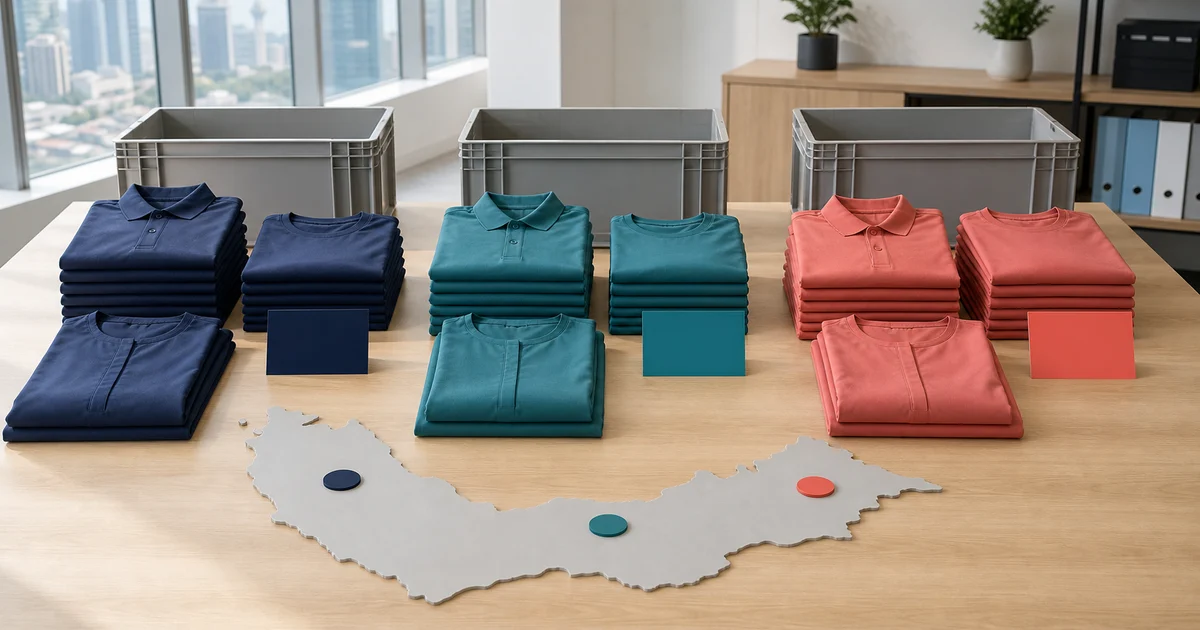
The short answer: choose the exact uniform products first, appoint one sizing coordinator per branch, and collect one confirmed product-and-size choice for every employee. Each branch checks its own subtotal before head office consolidates the order into one locked master roster.
This is an operations problem, not a prediction problem. Do not estimate a Malaysian size ratio or copy employees’ usual brand labels into a bulk purchase.
Use one controlled branch workflow
| Stage | Branch coordinator | Head office or organiser |
|---|---|---|
| Product lock | Confirms the products offered at that branch | Issues exact codes, cuts, charts and a version date |
| Size collection | Shares the same chart or fitting set and follows up missing responses | Defines required fields and deadline |
| Branch check | Removes duplicates and checks every employee | Resolves cross-branch exceptions |
| Consolidation | Signs off the branch subtotal | Confirms product totals equal the purchase total |
| Distribution | Checks the branch packing list on receipt | Packs or instructs the supplier by branch |
| Changes | Records hires, leavers and transfers | Maintains one approved change log |
One person may cover several small branches, but every location still needs a named owner and a clear cutoff.
Freeze every product and chart before collection
Put these details at the top of the form:
- garment supplier and exact product code;
- unisex, fitted, long-sleeve, Muslimah or other cut;
- colour and fabric;
- size chart version or issue date;
- whether the chart shows body or finished-garment measurements; and
- the final response deadline.
ISO 8559-1 defines anthropometric body measurements used in clothing sizing, while ISO 18890 defines main measurement points for finished garments. They are different references: do not compare a body circumference with a flat shirt width as if they were the same value. See the official ISO 8559-1 body-measurement overview and ISO 18890 garment-measurement overview.
Use the Malaysia bulk T-shirt size guide to set the product-level workflow. If employees are checking a shirt they already own, share the step-by-step garment measurement method.
Give each branch the same fitting process
Where practical, circulate a fitting set made from the exact products being ordered. Label the samples by product code and size, and maintain a simple handover record while the set moves between locations.
Each coordinator should:
- check the set against the issued list on arrival;
- keep unisex, long-sleeve and Muslimah products separate;
- let employees confirm their own final choice;
- record the choice immediately in the branch roster; and
- confirm the set is complete before passing it on.
If a branch cannot receive samples, use the same product-specific chart and measurement instructions. Do not substitute a similar polo from a local shop.
Collect only the data needed for the order
A practical named roster may contain:
| Required field | Example purpose |
|---|---|
| Employee name or staff ID | Prevent a person being missed or counted twice |
| Branch | Control packing and delivery |
| Product and cut | Keep different charts separate |
| Confirmed size | Create the purchase breakdown |
| Personalisation | Match an approved name or number to the right garment |
| Response status | Identify missing or changed choices |
| Exception note | Record only a necessary approved issue |
Avoid collecting body measurements when a confirmed uniform size is enough. Restrict the master roster to people who need it, define why it is being used, keep it accurate, and delete or archive it according to your organisation’s retention rules after the operational need ends.
Malaysia’s Personal Data Protection Commissioner says the PDPA applies generally to organisations that process personal data in commercial transactions. Its seven principles cover matters including notice and choice, disclosure, security, retention, data integrity and access. Review the official PDPA introduction and personal-data-protection principles with your organisation’s privacy owner. This article is an ordering workflow, not legal advice.
Keep different cuts as different products
Do not put an employee’s choice in a single field called “Size” when several uniform models are available. Use a product-plus-size value such as:
- unisex polo A — M;
- long-sleeve polo B — M; or
- Muslimah top C — M.
The three M labels may not describe the same dimensions. Keep their product subtotals separate even if the colours and logos match. The Muslimah and long-sleeve specification guide covers length, opacity, sleeve and movement checks beyond the size label.
Reconcile every total before issuing the purchase order
Head office should receive both the named rows and the branch summary. Run four simple equality checks:
- named employees plus separately approved spares equal the branch product subtotal;
- size quantities equal the product subtotal;
- all product subtotals equal the branch total; and
- all branch totals equal the purchase-order total.
Do not repair a mismatch by changing the summary alone. Find the missing, duplicated or outdated named row, correct it, then recalculate.
Lock the approved version with a date and owner. Later changes should record the employee, old choice, new choice, reason, approver and whether the supplier accepted the change before production.
Plan branch packing before production finishes
Ask the printer to pack by branch only after the final roster and quantities are approved. Each branch pack should have a corresponding packing list showing product, colour, size, quantity and any personalisation identifiers needed for distribution.
On receipt, the coordinator checks the sealed or grouped quantity against that list before handing shirts out. Report shortages or wrong branch allocations promptly through the agreed supplier process.
Keep transfer cases visible. A staff member moving from Johor Bahru to Penang should appear once in the final distribution plan, not once on each branch’s old roster.
Treat new hires, leavers and spares as exceptions
Set a cutoff for standard responses and a separate approval route for:
- employees joining after the cutoff;
- leavers whose pieces can still be removed;
- inter-branch transfers;
- late size changes; and
- unassigned spare stock.
There is no defensible universal spare percentage. Use actual recruitment plans, uniform replacement history, supplier lead time and storage limits. Record spare quantities by product, size and owning branch so they are not mistaken for missing employees.
When all branches have signed off, request a multi-location uniform quotation through Baju Printz with the locked product summary and delivery requirements.
Frequently asked questions
What is the best way to collect uniform sizes from several branches?
Freeze the exact garment and chart first, appoint one coordinator per branch, collect one named choice per employee, then reconcile branch subtotals against one controlled master roster.
Can different branches use different uniform size charts?
Only when they are ordering different garment products. Label every product, cut and size separately, and never merge quantities merely because two products use the same S-to-XL labels.
What fields should a multi-branch uniform size form include?
Use only the fields needed to fulfil the order: employee name or ID, branch, garment product and cut, confirmed size, approved personalisation, response status and necessary exception notes.
How many spare uniforms should each branch order?
There is no universal spare ratio. Base the quantity and sizes on actual hiring plans, turnover, replacement history, storage capacity and supplier lead time, then list spares separately from named wearers.
Ready to compare suitable printers?
Get 5 Free Quotes