
Running Event Shirts Malaysia: Fabric, Print and Quantity Guide
Plan Malaysian running-event shirts by matching fabric, print, sizing and quantity to race conditions, participant data and distribution.
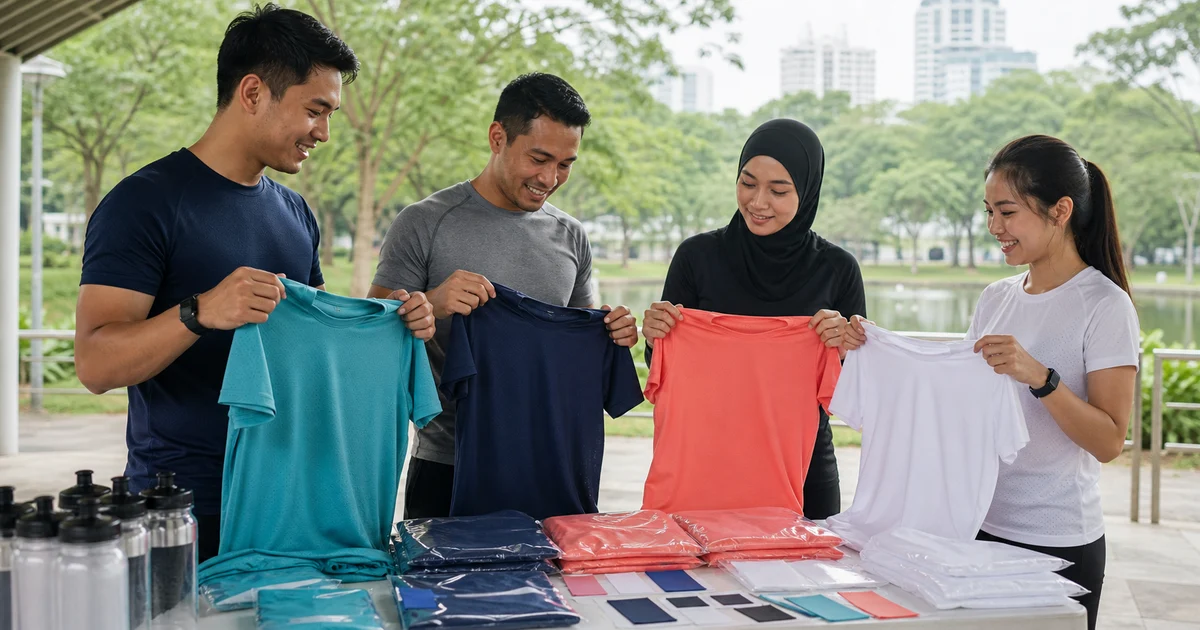
The short answer: for a Malaysian running event, start with a lightweight quick-dry polyester shirt, choose the decoration method together with the actual fabric, and build quantity from confirmed participants plus named event roles and purpose-based extras. Approve the shirt while worn, moving and damp—not only folded on a quotation table.
A 5 km fun run, school cross-country event and timed road race can use different garments. Distance, start time, participant pace, weather exposure, sponsor artwork, size range, budget and whether the shirt is compulsory all change the specification.
Match the shirt to the event, not the word “running”
Write down who will wear each shirt and what they will do in it.
| Wearer or product | Useful starting point | Main approval risk |
|---|---|---|
| Active participant | Lightweight quick-dry tee or singlet, if event rules allow | Cling, opacity, rubbing and poor airflow |
| Casual fun-run participant | Comfortable tee that also works after the event | Heavy fabric or large warm print |
| Crew and marshal | Clearly different colour with practical coverage | Confusion with participant shirts |
| Medical or safety team | Role-specific colour and wording approved by operations | Important identification hidden or unclear |
| Merchandise buyer | Product chosen for repeat casual wear | Ordering speculative sizes and stock |
Do not force every group into one colour or garment if event operations need clear roles. Keep the participant, crew, sponsor, VIP and merchandise quantities separate even when they share artwork.
For an event governed by an athletics body, permit or label programme, ask for the current clothing and advertising rules before artwork begins. World Athletics maintains separate current competition and clothing regulations for its competitions and Label road races. Those rules do not automatically apply to every Malaysian community run, but they show why organisers should not invent requirements after jerseys are printed.
Choose fabric by construction and wear test
MET Malaysia describes the national climate as having relatively uniform temperatures, high humidity and abundant rainfall. That makes sweat, airflow and drying relevant, but it does not make every polyester shirt comfortable. Review the official Malaysia climate overview for the context.
Ask the supplier to state:
- fibre composition;
- fabric or knit name;
- stated GSM or weight;
- stretch direction;
- available colours and size range;
- whether the fabric is treated or marketed for moisture management; and
- the approved garment code or custom construction.
Treat “dry-fit”, “microfibre” and “sports mesh” as product descriptions, not proof of performance. Two samples with the same marketing label can differ in holes, surface texture, thickness, stretch and transparency.
The cotton versus dry-fit guide explains the basic trade-off. Use the broader Malaysia fabric guide when comparing several polyester knits or blends.
Test comfort while moving
Put the shortlisted sample on a runner with the intended base layer or sports hijab, where relevant. Ask them to jog, swing both arms and wear it long enough to warm up.
Check:
- whether the neckline or armhole rubs;
- whether shoulder and sleeve seams restrict movement;
- whether the fabric becomes transparent or clings when damp;
- whether a large decoration feels stiff or traps warmth;
- whether the hem rises or twists; and
- whether the fit remains suitable across body shapes and layers.
A soft dry sample can behave differently after absorbing sweat. Use the same short wear and damp test for every candidate so the comparison is fair. This is a garment-selection check, not a medical or heat-safety assessment; event organisers still need their own risk, hydration and weather plan.
Pick printing after the artwork and fabric are known
There is no single “running-shirt printing method”. Use the production route that fits the garment.
Fully sublimated custom jersey
Sublimation suits polyester panels with all-over colour, gradients and artwork integrated into the fabric. The factory prints the panels before sewing, so the pattern template, seam allowances and sample approval matter. It also means a late player, participant or sponsor change can affect the complete panel file.
Ready-made shirt with silk screen or DTF
Ready-made shirts can shorten garment-development work when stock exists. Silk screen can suit repeated solid-colour artwork at suitable quantities, while DTF can suit detailed multi-colour artwork and smaller versions. The final choice still depends on surface texture, heat sensitivity, colour, coverage, hand feel and supplier setup.
Do not select from a method name alone. Ask for one decorated sample on the exact fabric, especially when the chest print is large. The sublimation versus DTF jersey guide compares the two workflows in more detail.
Keep the bib and operational information clear
If runners wear a race bib, test it with the shirt. Confirm its position, attachment method and whether a sponsor graphic, zipper, pocket or seam interferes. Do not print a fake bib number as part of the garment design if it could confuse volunteers or event photographs.
Keep critical role wording simple and readable. A dense list of sponsors can make both the shirt and the event role harder to recognise. Put low-priority marks in an approved secondary position or on other event materials instead of shrinking everything.
Approve artwork dimensions in centimetres on the smallest and largest shirt options. Check contrast on the actual colour and test important QR codes only if the event genuinely needs them; a screen mockup does not prove a fabric code will scan reliably.
Build quantity from registration data
Use this structure:
Total running shirts = confirmed participant shirts + named event-role shirts + approved operational extras + separate sales stock
Do not multiply expected attendance by an unsupported size ratio. Lock the exact garment first, then collect a product-specific size from every confirmed wearer. Keep kids, unisex, fitted, singlet and Muslimah options in separate columns and subtotals.
For extras, calculate late-entry, exchange, organiser-held replacement and sales reserves separately. The event extra-shirt guide provides a purpose-based formula, while the Malaysia bulk-size workflow helps reconcile the roster.
If registration closes after the printer’s production cutoff, publish a clear shirt-entitlement rule. Do not promise every late entrant a shirt unless stock and sizes are funded.
Plan packing and collection before production
Decide whether shirts will be:
- placed in race packs by participant ID;
- sorted only by size for counter collection;
- delivered to clubs or corporate teams;
- separated for crew and volunteers; or
- packed individually for mailing.
Personalised packing costs time and requires a locked data sheet. Size-only counter collection is simpler but needs a reliable stock count and exchange policy. State the method in the quotation so the supplier prices the real work.
Receive the order several days before pack collection. Count by product, colour and size, inspect representative units, then reconcile the total against registration. Use the event-shirt timing guide to set approval, production and delivery buffers.
Approve one complete running-shirt specification
The final brief should include:
- event type, distance and expected wearing conditions;
- participant, crew and merchandise garment options;
- product codes or custom fabric specifications;
- quantity and product-specific size breakdown;
- final artwork, sponsor approvals and print dimensions;
- decoration method and colour reference;
- sample, movement, damp and wash checks;
- bib and role-identification requirements;
- packing and collection method;
- delivery postcode; and
- required receipt date.
Use the pre-production sample checklist before releasing the full order. When the brief is ready, request running-event shirt quotations through Baju Printz or browse Malaysian printers by location.
Frequently asked questions
Which fabric is best for a running-event shirt in Malaysia?
Lightweight quick-dry polyester is a practical starting point for active outdoor participants, but the fabric name alone is not enough. Approve the exact composition, knit, weight, airflow, opacity, cling and decorated sample under realistic running conditions.
Should a fun-run shirt use sublimation, DTF or silk screen printing?
Use sublimation when a custom polyester jersey needs all-over colour, and compare screen print or DTF for ready-made shirts and more limited artwork. The right method depends on quantity, fabric, artwork, hand feel, heat sensitivity, budget and schedule.
How many running-event shirts should an organiser order?
Start with paid or confirmed participants plus named crew and partner allocations, then add separately approved reserves for late entries, size exchanges, replacements or sales. There is no reliable universal extra-shirt percentage.
When should running-event shirts be ordered?
A straightforward ready-stock order often benefits from a three-to-four-week planning buffer, while custom sublimated jerseys, samples, many variants or split deliveries need more time. The printer must confirm the approval, production and delivered-by dates for the exact order.
What should be checked on a running-shirt sample?
Check fit during movement, neckline and arm comfort, seam rub, airflow, wet cling, opacity, print feel, artwork position, colour, bib visibility and one agreed wash. Test the actual smallest and largest garment options when the order spans a wide size range.
Ready to compare suitable printers?
Get 5 Free Quotes