
Sublimation vs DTF for Custom Jerseys: Which Should You Choose?
Compare sublimation and DTF for custom jerseys in Malaysia by fabric, coverage, comfort, colour, durability, personalisation and order type.
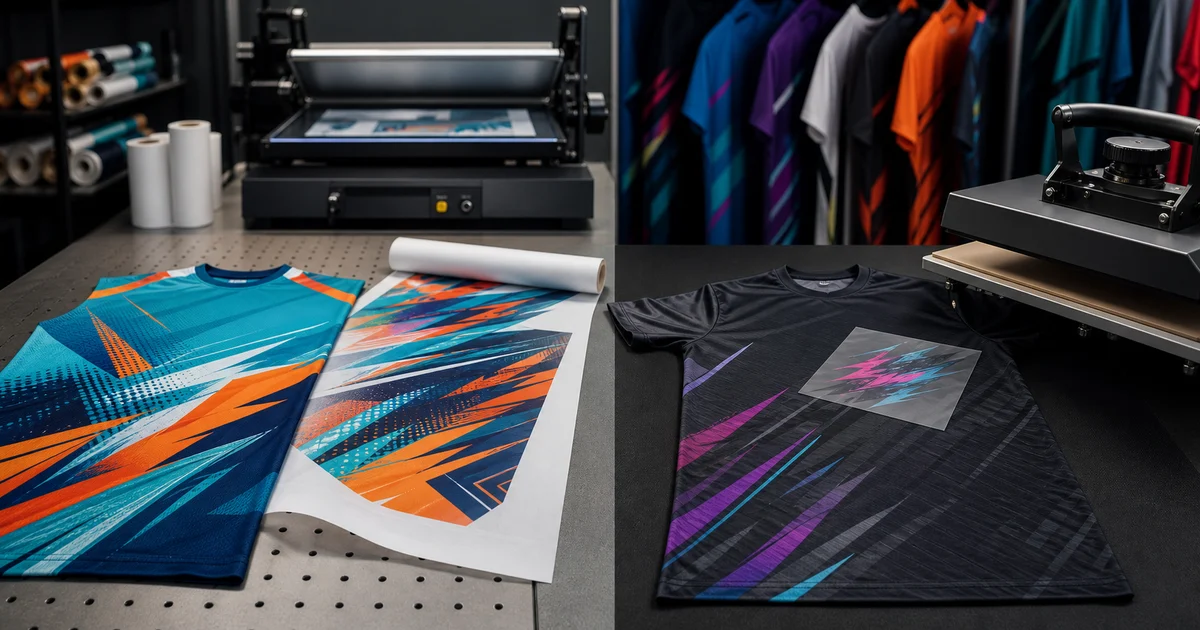
The short answer: choose sublimation for an all-over, lightweight polyester jersey whose design should feel integrated with the fabric. Choose DTF for local logos, names or numbers on ready-made jerseys, especially when garment colour, fabric choice or small-batch flexibility matters. Neither method is automatically best for every team.
The real decision depends on the jersey construction, artwork coverage and personalisation workflow—not only the quoted price. Epson’s dye-sublimation guidance recommends white or light, high-polyester material, while Roland DG’s DTF process description covers transfers to cotton, polyester, blends and both dark and light garments.
Sublimation vs DTF at a glance
| Decision point | Sublimation jersey | DTF on a jersey |
|---|---|---|
| Best starting garment | White or light, high-polyester fabric or printed panels | Ready-made light or dark garment that passes a transfer test |
| Artwork coverage | Excellent for full-panel patterns, gradients and many colours | Better for selected logos, names, numbers and separated graphics |
| Feel | Dye becomes part of the polyester; no transfer layer over the print | Film, ink and adhesive form a layer on top of the fabric |
| White elements | Usually the white base fabric; no standard white sublimation ink | White ink supports colour on dark garments |
| Variable names and numbers | Built into each player’s artwork before production | Separate transfers can be applied to ready-made pieces |
| Small changes after approval | Can affect panel files and sewing workflow | Often easier if blank garments and transfers are still available |
| Main buyer test | Colour, panel alignment, sewing and final fit | Adhesion, opacity, feel, heat marks and fabric compatibility |
This table is a buying guide, not a production specification. The factory must test its ink, paper or film, press settings and garment combination.
Choose sublimation for a full custom polyester jersey
In dye sublimation, printed transfer paper and heat move dye into suitable polyester. Epson’s digital printing primer explains that the result does not change the fabric feel and can reproduce fine lines, details and gradients on white or light, mainly polyester textiles.
That makes sublimation a practical fit when you want:
- colour and patterns across most of the front, back and sleeves;
- a smooth surface without a large transfer layer;
- player details integrated into the jersey design;
- gradients, textures or many artwork colours; and
- a jersey created as printed panels rather than decorated after purchase.
Full-custom sportswear often uses a cut-and-sew workflow: fabric or garment panels are printed, cut and assembled. Epson lists dye sublimation for cut-and-sew sports apparel. Ask the supplier to show the panel layout because important details can cross seams, collars or side joins.
Choose DTF for local graphics and flexible garment choice
DTF prints an image onto special film, adds hot-melt powder, cures it and heat-presses the transfer onto the garment. It is useful when a team has already chosen ready-made jerseys or only needs controlled areas such as a crest, sponsor mark, player name or number.
DTF may be the more practical route when:
- the jersey is dark and the artwork needs an opaque white base;
- you are decorating ready-made stock rather than producing new panels;
- the order mixes small logos with changing player data;
- the fabric is not suitable for dye sublimation; or
- replacement pieces may be required after the main order.
The wider fabric list does not remove the need for testing. Polyester dye can migrate into a transfer, heat can mark some performance fabrics, and raised seams can prevent even pressure. Use the DTF problem-prevention checklist before approving a large jersey order.
Match the method to the actual fabric and colour
Do not approve from the word “jersey” alone. Request the fabric composition, colour and exact garment model.
For sublimation, a higher polyester content normally produces a more vibrant transfer. Standard sublimation has no white ink, so white design areas depend on the base fabric. Printing onto a dark finished jersey will not create an opaque light image.
For DTF, ask for a sample on the exact colour and fabric—not a cotton T-shirt used as a substitute. The supplier should check adhesion, colour migration, stretch, surface change and press marks. If the team has not selected a base garment, compare options in the Malaysian T-shirt fabric guide.
Compare comfort by coverage, not method name alone
Sublimated colour sits within suitable polyester, so an all-over design can retain the fabric’s original surface feel. DTF adds a layer on top; a small crest and separated number will feel different from a solid graphic covering most of the back.
For running, futsal, cycling or an outdoor Malaysian event, approve the actual print coverage. A breathable jersey can still feel warmer where a large solid transfer blocks the fabric. If DTF is chosen, consider negative space or separated artwork elements instead of one large rectangle.
Plan names and numbers before production starts
Both methods can handle a team roster, but the correction path differs.
With sublimation, each player’s name and number may be placed in the panel artwork before the jersey is cut and sewn. A late spelling change can therefore require a new file and new panel. With DTF, variable transfers may be prepared separately and applied to ready-made jerseys, but the correct blank size and colour must still be available.
Send one locked roster containing the display name, number and garment size. Confirm how replacements and late additions will be priced. Use the jersey name and number font guide to check legibility and proofing before you release the data.
Compare durability with a physical sample
Sublimated dye does not form a film that can peel from suitable polyester. DTF is a bonded layer, so its long-term result depends on the complete film, powder, curing, pressing, garment and wash-care system. That does not mean every sublimated jersey will outlast every DTF jersey; fabric quality, sewing, abrasion and care still matter.
Ask the printer for:
- one sample using the final fabric or garment;
- the same artwork coverage and print size;
- a wash-tested production reference;
- written care instructions; and
- an agreed standard for colour, feel, edges and panel alignment.
For a wider comparison, see which T-shirt printing method lasts longest.
Send a quote brief that produces a useful comparison
Include the sport or activity, quantity, deadline, delivery postcode, garment model or fabric composition, base colour, artwork coverage, player roster, size breakdown, sample requirement and replacement policy. State whether you want a fully constructed custom jersey or printing on ready-made stock.
Ask each supplier to identify the proposed method and what is included: blank jersey or custom sewing, artwork setup, names and numbers, sponsor logos, sample, individual packing and delivery. You can submit one brief to compare Malaysian printers or browse T-shirt printing suppliers by state.
Choose the method after you approve the finished jersey—not because one production name sounds more advanced.
Frequently asked questions
Is sublimation or DTF better for sports jerseys?
Sublimation is usually the stronger fit for an all-over polyester jersey because the colour becomes part of the fabric and does not add a transfer layer. DTF is useful for local logos, names or numbers on ready-made jerseys and on a wider range of fabric colours and compositions.
Can DTF be printed on polyester jerseys?
Yes, DTF can be applied to polyester, but the printer must test the exact garment and transfer system. Heat, fabric finish, seams and dye migration can affect the result, so approve a physical sample before bulk production.
Can sublimation print white on a dark jersey?
Standard dye sublimation does not print white ink. It is best on white or light, high-polyester material; white areas normally come from the unprinted base fabric. A dark ready-made jersey is therefore not the usual starting point for full-colour sublimation.
Which method is better for different player names and numbers?
Both can personalise a team. Sublimation can place each name and number into the panel artwork before sewing, while DTF can add variable transfers to ready-made jerseys. Compare the data-lock deadline, replacement workflow and cost for late changes.
Ready to compare suitable printers?
Get 5 Free Quotes