
What Is the Minimum Order for Custom T-Shirts in Malaysia? MOQ Explained
Learn typical custom t-shirt minimum order quantities in Malaysia by printing method, plus how quantity affects price, samples and reorders.
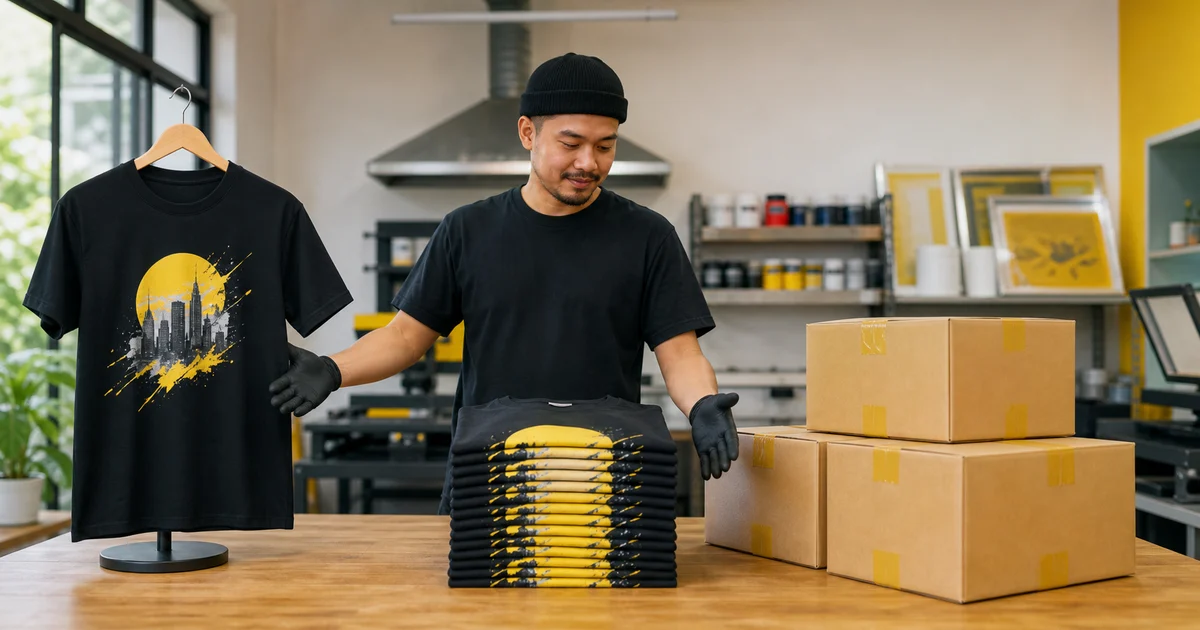
The short answer: custom t-shirt printing in Malaysia can start from one piece with some digital or transfer methods, while silk screen, embroidery and custom jerseys commonly have higher practical minimums. The supplier’s exact minimum order quantity (MOQ) depends on the garment, artwork, print method and number of variations.
MOQ is not only a rule about quantity. It tells you how a printer spreads setup work across the order—and why ten shirts can cost much more per piece than one hundred.
Typical MOQ by printing method
These ranges are a planning guide, not a universal price rule:
| Method | Common practical starting quantity | Why |
|---|---|---|
| DTF transfer | 1–10 pieces | Digital film can support small, detailed batches |
| DTG | 1–10 pieces | Each suitable garment can be printed digitally |
| Heat-transfer vinyl | 1–10 pieces | Useful for simple names, numbers and small runs |
| Embroidery | 10–20 pieces | Logo digitising and machine setup add fixed work |
| Sublimation jersey | 10–20 pieces | Artwork, panels, printing and sewing are prepared as a batch |
| Silk screen | 20–50 pieces | Each colour needs a screen and press setup |
Some factories will accept less, while others may require more. Always ask for the minimum for your exact specification, not only the printer’s general MOQ.
What does MOQ mean?
MOQ means the smallest quantity a supplier is willing to produce under a quoted specification. A “minimum 20 pieces” offer may require all 20 to use:
- the same shirt model;
- the same shirt colour;
- the same artwork;
- the same print dimensions and positions; and
- the same printing method.
Sizes can often be mixed because changing from S to XL does not change the artwork. However, 10 black shirts with a white underbase and 10 white shirts without one may be treated as separate production batches.
Why methods have different minimums
DTF and DTG can start small
Digital processes do not require a separate physical screen for every ink colour. This makes a one-off sample or small team order possible, although the supplier still needs to prepare artwork, garments and equipment.
For a detailed comparison, read DTF printing in Malaysia and silk screen vs DTF vs DTG.
Silk screen becomes efficient at volume
Silk screen production includes screen preparation, ink setup, test prints and press alignment. That work happens whether the order contains 10 or 100 pieces. A larger order spreads the fixed setup over more shirts, which is why the per-piece price usually falls as quantity rises.
A design with four colours needs more setup than a one-colour logo. The printer may therefore set a higher minimum or price for complex artwork.
Embroidery has digitising and machine setup
An embroidery file tells the machine the stitch type, order and direction. The supplier then selects threads, frames the garment and tests the result. Once the logo is prepared, a repeat order may be simpler—but the garment and thread still need to be available.
Sublimation jerseys are produced as a batch
Custom sublimation often involves designing printed panels, transferring the artwork, cutting and sewing. Names and numbers can usually change within the same team design, but suppliers still need a practical batch size for production.
Does a lower MOQ mean a lower total price?
It may reduce your total spend, but not necessarily the price per shirt.
Imagine RM100 of setup work:
- across 10 shirts, setup contributes RM10 per shirt;
- across 50 shirts, setup contributes RM2 per shirt; and
- across 100 shirts, setup contributes RM1 per shirt.
This example is only arithmetic, not a market quotation, but it explains the pricing pattern. Blank garment prices, print area, colours, labour and delivery also affect the final amount.
Use the 2026 t-shirt printing cost guide for budget ranges, then request written prices for the exact quantity you need.
Can sizes be mixed within the MOQ?
Often, yes. A 30-piece order might include S, M, L, XL and 2XL if all pieces share the same shirt and print specification.
Ask about:
- surcharges for 2XL and above;
- different cuts for men, women or children;
- stock availability by size;
- whether different shirt colours count as separate batches; and
- whether personalised names or numbers cost extra.
Do not finalise the quantity before checking the supplier’s size chart. Shirt dimensions vary between brands.
Do samples count toward the bulk MOQ?
Usually, a paid sample is separate from the bulk order. Ask whether:
- the sample uses the final garment and production method;
- its fee is credited when you place the bulk order;
- a sample approval changes the promised delivery date; and
- the supplier will keep the approved sample as the quality reference.
For a simple small order, a digital artwork proof may be enough. For a large, repeat or brand-sensitive order, a physical sample can prevent a far more expensive mistake.
How to order below a supplier’s MOQ
If your preferred supplier’s minimum is too high, the simplest options are:
- choose DTF, DTG or transfer instead of silk screen;
- use a ready-stock blank shirt instead of custom cut-and-sew;
- keep one artwork and shirt colour;
- remove individual names or complex variations;
- combine team or department quantities; or
- ask for a paid sample or prototype first.
Do not order unwanted stock only to reach a price tier. Storage, outdated artwork and unused sizes can cost more than the apparent saving.
What to ask in the quotation
Send these five questions:
- What is the MOQ for this exact shirt, artwork and method?
- Can sizes be mixed within that quantity?
- Do different shirt colours count as separate batches?
- What is the price at my required quantity and at the next price break?
- Can I reorder a smaller quantity later using the same setup?
The answers make it easier to compare suppliers without guessing what “minimum 20 pieces” includes.
Find a printer for your quantity
Start with the quantity you genuinely need, not the supplier’s largest discount tier. You can browse Malaysian t-shirt printers by location or submit one brief through Baju Printz to compare suitable options.
The most useful quotation will state both the MOQ and the conditions behind it: shirt model, colour, artwork, method, sizes, personalisation, delivery and repeat-order terms.
Frequently asked questions
Can I print only one custom t-shirt in Malaysia?
Yes. Some suppliers accept one-piece orders using methods such as DTF, DTG or heat-transfer vinyl. The price per shirt is normally higher than a bulk order, and not every fabric or artwork suits every method.
What is the usual minimum order for silk screen printing?
Many suppliers set a practical minimum around 20 to 50 pieces because every colour needs setup before printing. The exact minimum varies by printer, design, garment and number of colours.
Why do t-shirt printers have a minimum order quantity?
A minimum order helps cover fixed work such as artwork preparation, screens or digitising, machine setup, colour testing, purchasing garments and quality checks.
Can different shirt sizes count toward the same MOQ?
Usually yes when the shirt model, colour, artwork and print specification stay the same. Different garment colours or artwork versions may be priced as separate batches, so confirm this in the quotation.
Ready to compare suitable printers?
Get 5 Free Quotes