
How to Produce an Oversized Streetwear T-Shirt in Malaysia
Define an oversized T-shirt by measurements, fabric, collar, artwork and tested samples before approving Malaysian streetwear production.
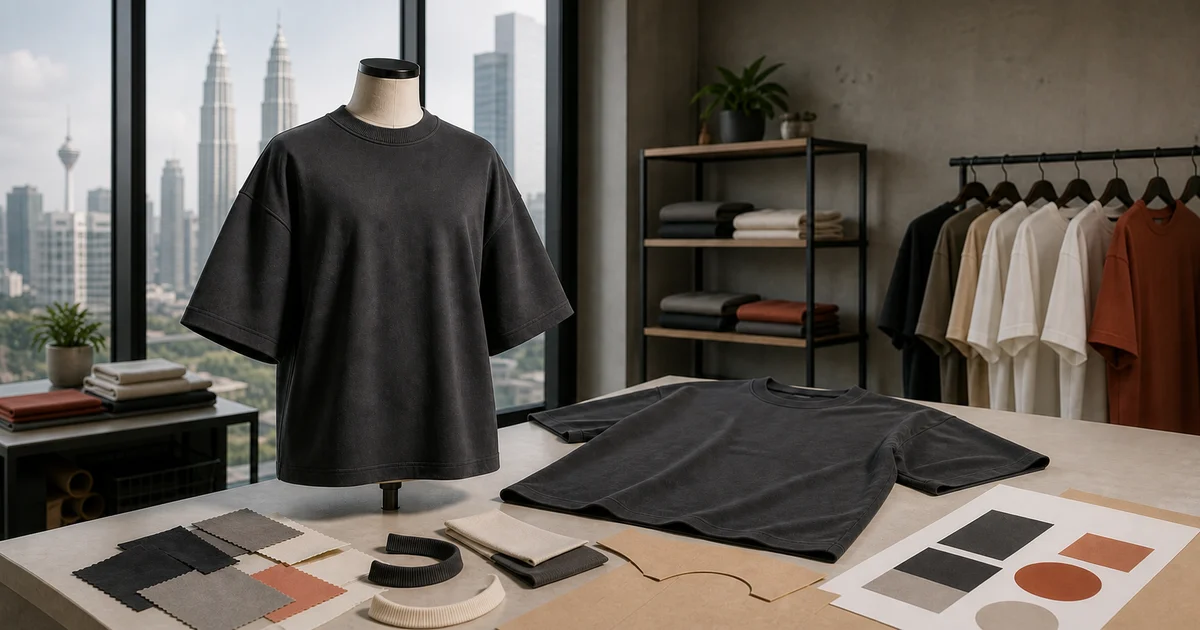
The short answer: produce an oversized streetwear T-shirt by defining a purpose-built silhouette, not by ordering a regular tee two sizes larger. Specify the flat garment measurements, fabric and collar construction, approve artwork on the real cut, and wash-test a production sample before bulk manufacturing.
“Oversized” is not one standard size. It can mean a neat boxy fit, a long relaxed tee or a dramatic drop shoulder. Your supplier needs measurable instructions, not only a mood-board image.
Start with the silhouette, not the size label
A regular XL and an oversized M can have very different proportions. Simply sizing up may add unwanted body length while leaving the sleeve opening, collar or shoulder balance wrong.
Build the specification around these flat-garment points:
| Measurement | What it controls | What to approve |
|---|---|---|
| Half chest | Overall width and ease | Room without excessive side collapse |
| Body length | Cropped, boxy or long appearance | Front and back length on the target wearer |
| Shoulder width | Amount of shoulder drop | Seam position below the natural shoulder |
| Sleeve length | Streetwear proportion | Where the sleeve finishes on the arm |
| Sleeve opening | Volume around the upper arm | Comfort and shape without flaring unexpectedly |
| Armhole depth | Mobility and sleeve balance | Movement without pulling or excess bulk |
| Neck opening and rib height | Collar appearance | Comfort, recovery and visual weight |
| Hem width | Straight or tapered body | How the tee hangs over trousers or shorts |
ISO 18890:2018 defines main garment measurement points and allows additional points to be agreed by the parties. Use one labelled measurement diagram for the quotation, sample and final inspection. Our guide to measuring a T-shirt shows how to keep those checks consistent.
Use a reference garment and a written specification
Choose a physical tee whose fit is close to the target. Photograph it flat and worn, then record the brand, product code, labelled size and whether it has already been washed. Measure it without stretching.
Do not ask a factory to copy only a photograph. Perspective, model height and styling can hide the actual proportions. A useful production brief includes:
- target wearer and intended fit;
- measurement diagram and finished dimensions by size;
- agreed tolerance for each critical point;
- fabric composition, knit, colour and GSM;
- collar rib, neck tape, seam and topstitch details;
- artwork dimensions and placement from fixed reference points;
- label, packing and quantity requirements; and
- approved sample and wash-test result.
If several sizes are required, approve how the pattern is graded. Do not assume every measurement should grow by the same number of centimetres. Check at least a smaller, middle and larger size when the range is broad or the silhouette is unusual.
Choose between a stock oversized blank and cut-and-sew
A ready-made oversized blank is usually the lower-development route when its fit, colour, fabric and available sizes already suit the collection. Confirm the exact product code and inspect the current stock sample; the word “oversized” alone does not guarantee your preferred silhouette.
Current manufacturer examples show how much the specification can vary. AS Colour describes its Heavy Faded Tee 5082 as a boxy relaxed fit with dropped shoulders and wide neck ribbing, while Stanley/Stella lists its Blaster 2.0 as a 200 GSM oversized tee with a dropped shoulder and mock-neck rib. These are examples, not a universal formula for streetwear.
Choose cut-and-sew when you need a proprietary pattern, custom fabric or colour, unusual panel lines, a specific rib, or construction that no stock blank provides. The ready-made blanks versus cut-and-sew guide explains the commercial trade-offs.
Do not choose fabric by GSM alone
GSM is fabric mass per square metre. It does not, by itself, guarantee thickness, softness, opacity, durability or quality. Two fabrics with the same GSM can hang differently because of fibre, yarn, knit structure and finishing.
For a Malaysian streetwear collection, assess the trade-off between structure and comfort in heat and humidity. A heavier compact jersey may hold a boxy shape, but a dense large tee can also feel warmer. A lighter or more open knit may drape and ventilate differently.
Request swatches and a sewn sample, then assess:
- drape while standing and moving;
- opacity under daylight;
- surface texture for the chosen print;
- pilling and colour expectations;
- dimensional change after the agreed wash; and
- availability for future reorders.
Use the T-shirt GSM guide to compare fabric weights without treating the number as a quality grade.
Specify the collar and construction
The collar carries more visual weight on a plain oversized tee. Record its finished height and width, rib structure, stretch and recovery, topstitching and neck-tape requirement. Inspect whether it sits flat after washing rather than judging the new sample only.
Also approve side seams versus tubular construction, shoulder tape, seam type, stitch density where relevant, sleeve and bottom hems, and any garment-dye or wash finish. These details affect shape, consistency and decoration compatibility.
Place artwork on the actual oversized sample
Dropped shoulders and a wider body change the apparent centre of a design. A print that looked balanced on a regular tee may look too small, too high or too close to a sleeve seam on an oversized cut.
Approve artwork at final physical dimensions on the production colour and size. State placement from fixed points such as the collar seam or centre front rather than saying “around the chest”. For a size range, decide whether one print size works across all sizes or whether selected sizes need adjusted artwork.
Check the front, back and sleeve print-size guide and choose the printing method using the silk screen, DTF and DTG comparison.
Wash-test before bulk approval
Test dimensional stability on the exact fabric, colour, construction and print. ISO 3759:2011 covers preparation, marking and measuring for dimensional-change tests, while ISO 5077:2007 covers determining dimensional change after specified washing and drying.
Agree on the care cycle and acceptance criteria with the supplier. Measure the same marked points before and after, then inspect:
- chest, body, shoulder and sleeve change;
- side-seam or body twisting;
- collar rippling and recovery;
- colour and surface change; and
- print adhesion, cracking or distortion.
One good-looking unwashed prototype is not enough evidence for a bulk run.
Send a quotation-ready oversized tee brief
For a comparable Malaysian quotation, send the intended quantity by size, delivery postcode and deadline together with the garment specification, artwork files and sample requirements. Ask the supplier to identify any unavailable colour, fabric or trim before pricing.
When the specification is ready, request oversized T-shirt quotations through Baju Printz. Suppliers can respond to the same measurable brief instead of guessing what “premium oversized” means.
Frequently asked questions
How do you make a T-shirt look properly oversized?
Specify a deliberate pattern: wider chest, extended shoulder, suitable sleeve width and length, controlled body length and a collar that suits the silhouette. Approve these points on a worn sample instead of merely ordering a regular shirt several sizes larger.
Is an oversized T-shirt the same as sizing up?
No. Sizing up enlarges every dimension according to a regular pattern, which may make the body too long or the collar and armhole poorly proportioned. A true oversized style is patterned and graded for the intended boxy or relaxed silhouette.
What GSM is best for an oversized streetwear T-shirt?
There is no universal best GSM. Heavier jersey can support a structured silhouette, while a lighter knit may drape and feel cooler. Compare GSM together with fibre, knit, finish, colour, hand feel and tested shrinkage.
Should you wash-test an oversized T-shirt sample?
Yes. Agree on a wash and drying method, measure the sample before and after, then check dimensional change, twisting, collar recovery, colour and print. Approve acceptable results in writing before bulk production.
Ready to compare suitable printers?
Get 5 Free Quotes