
9 Hidden Costs in a Custom T-Shirt Printing Quotation
Check nine commonly omitted T-shirt quotation costs, from garments and artwork to samples, personalisation, rush work, packing and delivery.
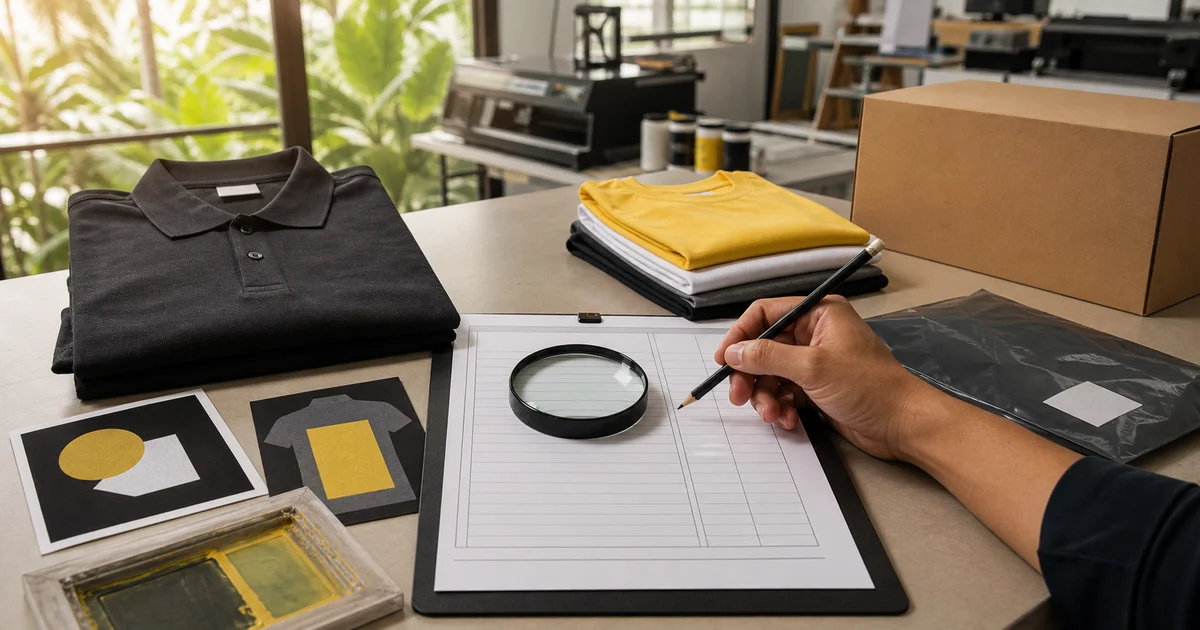
The short answer: the costs most often missed in a custom T-shirt quotation are the blank garment, size variants, artwork work, print setup, extra positions, samples, personalisation, rush handling, packing and delivery. They are not automatically improper charges; the problem is approving a quote before each inclusion and exclusion is written down.
Treat a headline “RM per piece” as incomplete until the document identifies the exact product and finished scope.
The nine-cost audit
| No. | Cost area | Question to put in writing |
|---|---|---|
| 1 | Blank garment and size variants | Is the named shirt code included, including extended sizes and different cuts? |
| 2 | Artwork preparation and revisions | What file cleanup, design, separation or digitising is included? |
| 3 | Screens, underbase and production setup | Which setup charges apply by colour, artwork and garment colour? |
| 4 | Print size and additional positions | What exact dimensions and front, back or sleeve positions are included? |
| 5 | Digital proof and physical sample | Is a sample charged, credited later and made with the production method? |
| 6 | Names, numbers and variable data | What is the rate per person, and who approves the final list? |
| 7 | Rush work and stock sourcing | Does the required date add a rush fee or substitute garment? |
| 8 | Sorting and individual packing | Are size sorting, name labelling and separate bags included? |
| 9 | Delivery and split destinations | Is the quote collected, delivered to one postcode or split across locations? |
Current supplier pages show why scope matters
Public Malaysian pages checked on 4 August 2026 disclose different boundaries:
- Tshirts.com.my publishes a tier for one-colour, one-position printing, states that the blank shirt is separate, and lists a rush surcharge.
- Printlab Malaysia says its listed express T-shirt price excludes design artwork and shows additional amendment charges depending on complexity.
- myT’s sample guidance separates sample treatment by method and says some sample figures exclude digitising, delivery or design.
- Printcious says split delivery to multiple locations is possible but additional shipping fees may apply.
These statements do not mean every supplier charges the same way. They show why you must read the scope behind the number rather than assume “printing included” means everything.
1. Is the blank garment included?
A printing price may cover decoration only. The garment may be a separate line or may change when you select a heavier cotton tee, polo, dry-fit fabric or custom-cut jersey.
The quote should state:
- brand and product code;
- fabric composition and GSM where relevant;
- colour and cut;
- size range and price for extended sizes;
- whether stock is confirmed or subject to substitution; and
- who bears the risk if the buyer supplies the garments.
Do not accept “premium cotton” without a product reference. Two suppliers using different blanks are not quoting the same order.
2. Is artwork work included?
“Artwork supplied” can mean a print-ready vector file or a small screenshot that needs rebuilding. Possible separate work includes:
- redrawing a low-resolution logo;
- converting fonts to outlines;
- removing a background;
- separating silk-screen colours;
- preparing white underbase or DTF layers;
- matching personalisation data; and
- digitising an embroidery logo.
Ask how many revisions are included and what triggers a new design fee. A late request to change the logo after proof approval is not the same as correcting the printer’s error.
Prepare the source properly using the T-shirt artwork file guide.
3. Are screens and setup separate?
Silk screen commonly needs a screen for each colour, plus ink and press setup. A dark garment may add a white underbase. Embroidery can need digitising, while a special transfer may have a minimum film or setup charge.
Ask the quotation to separate:
- one-time setup;
- per-colour or per-screen charges;
- special ink or underbase;
- repeat setup for a second garment colour; and
- whether unchanged reorder files or screens reduce the later fee.
A saved artwork file does not guarantee every physical screen or mixed ink is stored forever. Record the reorder terms rather than assuming.
4. What print size and positions are priced?
“Front and back printing” is clearer than “logo included”, but it still lacks dimensions. A small left-chest logo, A4 front graphic and oversized back print use different amounts of material and machine time.
Confirm the width and height in centimetres for every:
- left or right chest;
- full front;
- upper or full back;
- sleeve; and
- name or number position.
Ask whether the price changes across children’s and adult shirts when one artwork size cannot fit every garment.
5. What does sample approval cost?
A digital mockup checks spelling, scale and position but does not prove fabric, ink feel or colour. A physical sample adds a garment and a short production setup, so it may be charged separately.
Put these conditions in writing:
- digital proof or physical sample;
- garment and method used for the sample;
- fee or refundable deposit;
- amount credited to the bulk order;
- included correction rounds; and
- effect on production timing.
Every Tees, for example, publishes a sample deposit and says it is refundable if the bulk order continues on its official FAQ. That is one supplier’s policy, not a Malaysian standard.
6. Are names and numbers priced per unit?
Individual names, staff IDs, class numbers and jersey numbers turn one repeated artwork into variable production. Even when the base team design stays the same, the supplier must receive, place, print, inspect and sort every record.
Ask for:
- rate per name, number or combined set;
- allowed character length and font;
- one locked spreadsheet format;
- deadline for additions or corrections;
- approval method for the final list; and
- remake terms when buyer data or supplier output is wrong.
Krafezee’s current product page says adding a name or logo is an additional cost and requires a revised quote. The lesson is to send variable data before comparing totals, not after paying a deposit.
7. Does the required date create a rush charge?
Urgent production can require overtime, expedited stock sourcing, a restricted garment choice or faster delivery. A supplier may accept the date only after artwork, sizes, payment and stock are complete.
Ask for two dates:
- normal delivered-by date and price; and
- confirmed rush delivered-by date and full surcharge.
Do not pay for “express” if the quote only shortens production but leaves courier transit undefined. The event T-shirt timing guide shows how to plan backwards from the receipt date.
8. Is sorting and packing included?
A bulk carton is not the same service as 200 individually named packs. Extra handling can include:
- sorting by department, class or branch;
- size stickers or name labels;
- folding to a specified presentation;
- individual polybags;
- gift boxes or inserts; and
- packing lists by carton.
Specify the final handover format. If your committee can sort locally, compare that option with paid factory sorting rather than assuming either is free.
9. What delivery does the quote cover?
Write the exact postcode and delivery arrangement. One Klang Valley collection, one Peninsular Malaysia courier, an East Malaysia shipment and delivery to ten branches have different handling and freight.
Printcious states that its shipping calculation depends on address, lead time and weight, and that split locations can add fees. Ask whether the quote includes:
- packing and courier;
- one or several destinations;
- Sabah or Sarawak transit;
- remote-area or bulky-carton charges;
- insurance or declared value where offered; and
- replacement shipping for an accepted defect.
Do not use “free delivery” as a comparison until the postcode, timing and exclusions match.
Convert every quote to one total
Before approving, require these final lines:
- subtotal for garments;
- subtotal for decoration and setup;
- sample, personalisation and packing;
- delivery;
- applicable tax and whether it is included;
- deposit and balance schedule;
- quotation validity;
- required approval date; and
- grand total payable.
Then divide the grand total by the usable delivered quantity. The companion bulk-discount guide explains why a lower unit rate can still produce a worse buying decision.
Send every printer the same complete brief when you request BajuPrintz quotations, so differences reflect the supplier offer rather than missing information.
Frequently asked questions
What should a complete T-shirt printing quotation include?
It should identify the garment, quantity and sizes, artwork, method, colours, print dimensions and positions, setup, proof or sample, personalisation, packing, delivery, applicable tax, payment schedule and required date.
Are setup charges normal in T-shirt printing?
They can be. Screens, artwork separation, embroidery digitising, machine setup or a special ink mix involve work before production; the quotation should name the charge and say whether it applies again to an unchanged reorder.
Is a physical sample normally included in the bulk price?
Do not assume it is included. Suppliers may charge a separate sample or deposit, credit only part of it against the bulk order, or include a digital proof but not a production sample.
Why do names and numbers cost extra?
Personalisation turns identical pieces into variable units and adds file preparation, data checking, placement, printing or stitching, sorting and error risk. Ask for a per-name or per-set rate and a locked data deadline.
Does the cheapest unit price mean the cheapest quotation?
No. Compare the same garment and decoration, then add setup, samples, changes, packing, delivery and applicable tax to obtain the total payable and landed unit cost.
Ready to compare suitable printers?
Get 5 Free Quotes