
Hari Raya Corporate Shirts: Planning Guide for Malaysian Teams
Plan inclusive Hari Raya corporate shirts with a practical schedule for garment choice, sizing, artwork, approval and staff distribution.
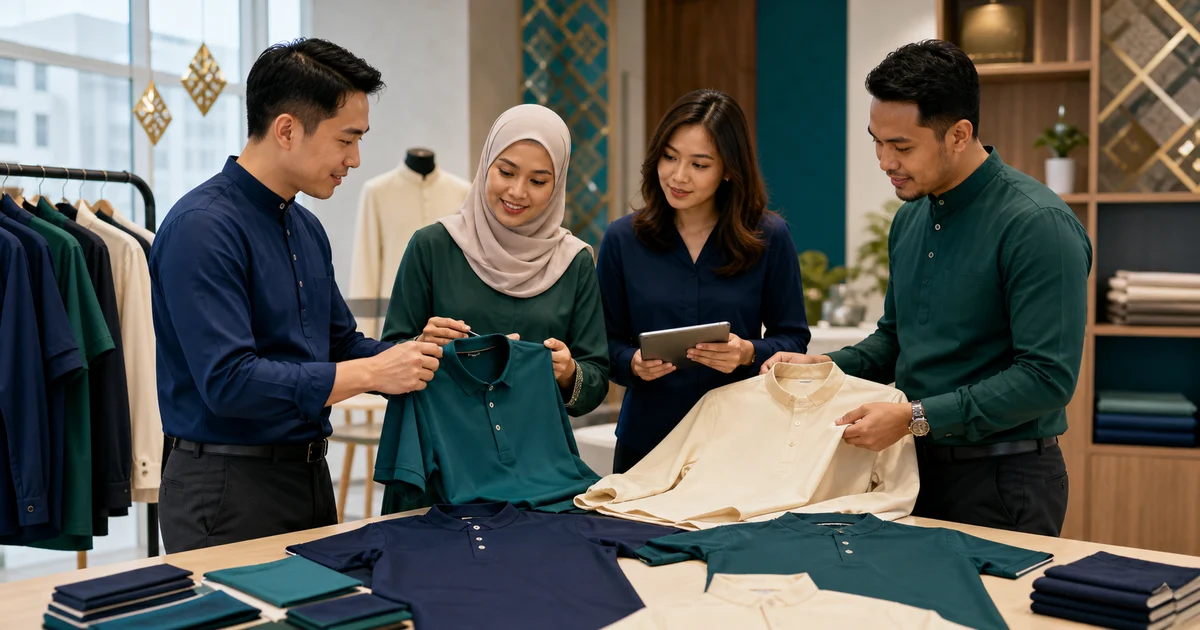
The short answer: plan Hari Raya corporate shirts around the company’s actual wear, photo or gifting date, then lock the garment options, sizes, artwork and approvals before production. Receive and sort the shirts before employees begin leave or branches close.
A coordinated festive shirt can support a staff gathering, open house, customer visit or gift pack. It should still work as practical company apparel: inclusive sizing, suitable coverage, clear branding and a schedule that does not depend on a last-minute festive rush.
Use the internal event date, not an estimated festive date
Malaysia’s official holiday schedule is published by the Cabinet Division, and dates or additional holidays can be addressed through later gazettes. In 2026, for example, the government issued a conditional additional-holiday notification shortly before Hari Raya Puasa. Review the current Cabinet Division holidays and gazettes page when planning a future campaign.
For shirt production, the more useful date is when the organisation needs the garments in hand. This may be:
- a pre-Raya staff photograph;
- a company iftar or appreciation event;
- an open house after the public holiday;
- a branch distribution deadline; or
- the date gift packs leave the warehouse.
Set the required receipt date several working days before that moment. The buffer is for counting, inspection, sorting and solving a shortage—not an invitation to keep changing the design.
Build a simple backwards schedule
| Planning stage | Decision to complete | Why it matters |
|---|---|---|
| Brief | Use, quantity, budget, garment options and locations | Printers can quote the same scope |
| Fit | Product codes, samples, size charts and wearer choices | Prevents incompatible size assumptions |
| Artwork | Final logo, festive graphic, dimensions and positions | Stops version changes after proofing |
| Approval | One authorised approver and one written production release | Gives the supplier a controlled master |
| Production | Payment, stock and delivery dates confirmed | Establishes when the supplier’s clock starts |
| Receipt | Count, inspect, sort and distribute before leave | Keeps errors away from the event day |
For a normal ready-stock order, a three-to-four-week planning buffer is a sensible starting point. Start earlier for custom sewing, physical samples, several garment cuts, personal names, multiple branch deliveries or slow internal approvals. This is buyer planning guidance, not a production promise; obtain the actual delivery date in the final quotation.
The event T-shirt backward schedule explains how to separate approval, production and delivery time.
Choose one team identity, not necessarily one garment
Requiring one unisex cut can exclude wearers whose fit, coverage or role differs. A more useful uniform system keeps the visual identity consistent while offering a small approved menu, such as:
- a cotton-rich polo for indoor customer-facing teams;
- a quick-dry polo or tee for outdoor setup crews;
- a regular long-sleeve option; and
- a longer, looser Muslimah-friendly option.
Keep the colour family, logo and main artwork coordinated, but approve each garment separately. Different fabric constructions can change shade, surface texture and print appearance even when the catalogue colour has the same name.
The corporate polo material guide helps compare cotton lacoste, blends and microfibre. For coverage decisions, use the Muslimah and long-sleeve specification guide rather than relying on a product label alone.
Ask wearers what suitable means
Hari Raya attire is personal and culturally meaningful. A company shirt should not pretend to replace traditional clothing or impose one interpretation of festive dress.
Ask the intended wearers or a representative staff group to review:
- neckline, sleeve and body coverage;
- fabric opacity under daylight;
- looseness while sitting, reaching and working;
- whether the shirt will be worn alone or layered;
- colour comfort and workplace suitability; and
- whether participation or the garment choice is optional.
Translate answers into measurable specifications. If several cuts are offered, issue the exact chart for each product code and collect the product name and size in separate fields. Never convert an employee’s unisex M automatically into a Muslimah M or another brand’s M.
Use the Malaysia bulk size workflow to collect and reconcile the list.
Keep the festive design respectful and reusable
A corporate Raya shirt does not need a crowded seasonal graphic. A restrained design can remain useful after the campaign.
Consider one company logo plus a subtle geometric, woven, floral or colour-block motif. Keep greetings, event names and the year off the garment when reuse matters. If a dated design is necessary, confirm the exact wording and spelling before the proof is issued.
Do not copy a design found through an image search, online marketplace or another organisation’s campaign. The company should own or have permission for every logo, illustration, typeface and sponsor mark. Ask the intended audience to review any Arabic script, religious reference or culturally sensitive motif; a printer is not the organisation’s cultural approver.
For embroidery, simplify fine lines and tiny lettering. The embroidery minimum-size guide explains why a screen mockup cannot prove stitch clarity.
Approve colour on the actual garment
Emerald, teal, navy, maroon, cream and gold may feel festive, but a colour name is not a physical standard. The same digital swatch can look different on cotton pique, smooth polyester and transfer film.
Approve:
- the exact garment product and catalogue colour;
- the physical print or thread reference;
- the artwork size and position on every cut; and
- the smallest and largest sizes when scale may change.
View coordinated options side by side under normal office light and daylight. Record any acceptable shade difference before ordering; do not discover after delivery that the short-sleeve and Muslimah options came from visibly different colour families.
Use a decorated pre-production sample when appearance, comfort or brand colour is important. The sample approval checklist provides one controlled record for garment, artwork, colour and finish.
Plan distribution before employees start leave
A carton delivered to headquarters is not the same as shirts delivered to staff. Collect the final list by branch, department or recipient and tell the supplier whether individual packing or carton labels are required.
Before distribution:
- count every product, colour and size against the approved packing list;
- inspect artwork and personalisation;
- separate branch or employee packs;
- photograph carton labels before onward shipping; and
- record who received each location’s parcel.
For several offices, compare one consolidated delivery plus internal distribution with direct supplier delivery to each branch. Include postcodes, recipient contacts and access restrictions in the quotation.
Send a complete Raya corporate-shirt brief
Your quotation request should contain:
- purpose and internal wear or gifting date;
- total quantity and size breakdown by garment option;
- exact product codes, colours and fabric preferences;
- logo and festive artwork files;
- print or embroidery positions and dimensions;
- sample and approval requirements;
- individual packing or branch sorting;
- every delivery postcode and recipient; and
- the required receipt date before staff leave.
Do not ask only for “100 Raya shirts”. A complete brief lets suppliers quote the same scope and flag a risky schedule early.
When the decisions are ready, request Hari Raya corporate-shirt quotations through Baju Printz or browse Malaysian printers by location.
Frequently asked questions
When should a company order Hari Raya corporate shirts?
Plan backwards from the internal wear, photo or gifting date rather than the first day of Hari Raya. A standard ready-stock order often benefits from a three-to-four-week planning buffer, while samples, custom garments, many branches or personalised packing need more time; the printer must confirm the actual schedule.
Must every employee wear the same Hari Raya shirt style?
No. A team can share one colour and artwork while offering approved polo, round-neck, long-sleeve or Muslimah-friendly cuts. Treat every garment as a separate product with its own size chart, sample and subtotal.
Which fabric suits a Hari Raya corporate shirt in Malaysia?
There is no universal best fabric. Cotton-rich shirts can suit lower-activity indoor use, while quick-dry polyester or microfibre may suit outdoor or active programmes. Compare comfort, opacity, drape, print compatibility and wash performance on the actual sample.
Can a company print festive artwork or greetings on the shirt?
Yes, when the company owns or has permission to use every logo and graphic. Keep the design appropriate to the workplace, avoid copying marketplace artwork, and ask the intended wearers to review culturally or religiously sensitive elements before production.
How should a company distribute shirts before the Hari Raya break?
Set a receipt date before staff travel or office closure, inspect and sort the order by branch or employee, and name one recipient for each location. Keep a signed packing list and a small approved solution for genuine size changes.
Ready to compare suitable printers?
Get 5 Free Quotes