
Esports Jersey Printing: Names, Sponsors and Design Checklist
Plan Malaysian esports jerseys with controlled player names, sponsor approvals, panel-safe artwork, colour proofs, samples and version records.
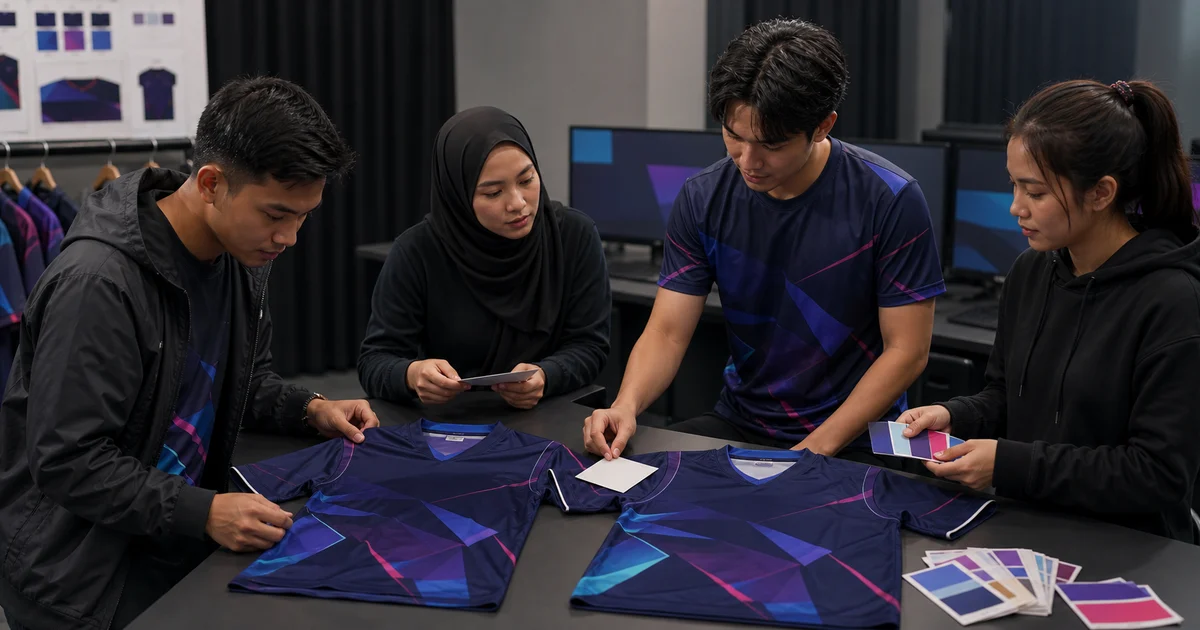
The short answer: before printing esports jerseys, lock the current tournament rules, approved team identity, sponsor matrix, player-name roster and one final garment proof. Keep every logo, name, size and jersey version in a controlled sheet so an outdated or unapproved design does not reach the stage.
An esports jersey is both teamwear and a visible media asset. It may appear on stage, broadcast, sponsor content, photographs and merchandise. That makes approvals and version control as important as the polyester, collar and print quality.
Read the tournament rules before designing
Rules vary by publisher, league, game, region and season. Ask the organiser for the current document and confirm:
- whether a team jersey is mandatory;
- required team, league or competition marks;
- restricted sponsor categories;
- sponsor positions or size limits;
- player-name requirements;
- approval deadlines and submission format;
- colour-conflict or alternate-uniform rules; and
- whether coaches and support staff need matching apparel.
Do not copy the rules from another title or professional league into a Malaysian community tournament. Use them only as evidence that approval can be material. Riot Games’ current Competitive Operations library publishes 2026 policies with sponsorship guidance, while a 2025 official Team Liquid ruling records a penalty for using an unapproved jersey version at a VCT event. Your organiser may set different rules, so obtain its written approval.
Build one sponsor approval matrix
Do not collect logos from messaging apps and place them wherever they fit. Use one row per sponsor or required mark.
| Sponsor control | What to record |
|---|---|
| Owner approval | Contact, written permission and approved competition or campaign |
| Official artwork | Filename, version, vector source and allowed colour versions |
| Tournament status | Allowed, conditional, restricted or not applicable |
| Placement | Front, sleeve, back or other approved panel |
| Finished size | Width, height and clear space in centimetres |
| Visibility | Contrast over the final jersey pattern |
| Expiry or scope | Season, event, roster or merchandise limitation |
MyIPO explains that copyright gives the owner control over protected works and that trademarks identify the source of goods or services. Review the official MyIPO intellectual-property FAQ and obtain permission for marks you do not own. This is an operational checklist, not legal advice.
If a sponsor changes after approval, issue a new artwork version and obtain tournament acceptance again. Do not cover an old logo with an improvised transfer unless the organiser, sponsor and printer approve the result.
Protect player names from roster errors
Create one master roster with a unique row for every garment. Useful columns are:
- player or staff ID;
- exact display name;
- jersey number, only if used;
- role;
- garment size and cut;
- sleeve option;
- jersey version; and
- player and manager approval status.
Preserve capitalisation, spaces, hyphens and permitted special characters. Test the longest handle and easily confused letters before setting the name size. If the tournament requires registered handles, make the organiser’s approved roster the reference instead of retyping names from social profiles.
Generate one proof sheet and ask the player or authorised team representative to approve every row. Corrections should return as one revised master file—not as separate chat messages. The jersey name and number font guide covers character clarity, font licensing, contrast and real-size testing.
Design inside the garment panels
Fully sublimated jerseys are printed as separate panels before sewing. Place critical team and sponsor marks inside the safe area provided by the factory. Avoid running small text, faces or logo edges across:
- shoulder and side seams;
- sleeve joins;
- collar openings;
- zips or plackets;
- ventilation inserts; and
- curved or tapered panel edges.
Ask for the printer’s current pattern template for the exact cut and size range. A mockup from another factory may not match its seam positions or proportions.
Approve the pattern on both a flat technical proof and a sewn sample. Small alignment differences are more visible when diagonal stripes or colour blocks are expected to meet across a seam, so define which joins are critical and what variation is acceptable.
Use the custom jersey planning guide for fabric, cut and panel basics. The AI, PDF, PNG and SVG guide explains how to hand over editable production artwork without relying on a low-resolution mockup.
Choose sublimation or applied decoration deliberately
Sublimation is the usual starting point for custom polyester jerseys with all-over patterns, gradients and many integrated marks. The colour enters the fabric rather than forming a thick surface layer, but the complete design is tied to the printed panels.
DTF or another applied transfer can suit a ready-made jersey, small run, replacement name or approved late-added element. It creates a surface layer and adds heat to the garment, so test feel, flexibility, adhesion and press marks on the actual fabric.
Mixing methods can be useful, but it creates two approval systems. Record which elements are sublimated and which are applied later. The sublimation versus DTF jersey comparison explains the production trade-off.
Check colour for stage and camera use
Approve the physical jersey, not only an RGB screen design. Compare it under normal room light and the lighting used at the event where practical. Look for:
- sponsor marks disappearing into a dark pattern;
- deep navy reading as black;
- bright colours blooming or reflecting under light;
- front and back versions appearing inconsistent;
- skin-facing dye or transfer issues; and
- player names becoming unclear when the fabric folds.
Record the artwork colour references and the approved printed sample. Digital Pantone, CMYK and RGB values communicate intent but do not guarantee identical output on every fabric; use the colour-system guide to keep the handover precise.
Approve every garment and alternate version
Some teams maintain home, away, light, dark, sponsor-specific or staff variants. Each version needs its own:
- artwork filename;
- sponsor matrix;
- tournament approval;
- colour proof;
- roster mapping;
- sewn sample or agreed physical check; and
- packing label.
An alternate is useful only when it is approved and available at the venue. Pack it separately and tell team management which version applies to each match or event. Do not assume removing one sponsor from a file automatically makes the replacement compliant.
Inspect before the team travels
Receive jerseys early enough to check every personalised garment. Compare each piece with the locked roster and inspect:
- display name and number;
- garment size and cut;
- jersey version;
- sponsor presence and position;
- colour and panel alignment;
- collar, seams and loose threads; and
- packing label.
Photograph and isolate any mismatch before issuing the kit. Keep the approved master sample and a clean production file for replacement orders. The bulk-order delivery inspection guide provides a count and defect record.
Send one production-ready esports brief
Your final quotation pack should contain the tournament rulebook, approval deadline, garment specification, quantity, size breakdown, final panel artwork, sponsor matrix, player roster, alternate versions, sample requirement, packing method, delivery postcode and required receipt date.
When the controlled files are ready, request esports jersey quotations through Baju Printz or browse Malaysian jersey printers by location.
Frequently asked questions
What information is needed to order esports jerseys?
Provide the tournament rules, approved team identity, sponsor matrix, final artwork, garment and fabric specification, player display names, sizes, quantities, sample requirement, delivery postcode and required date. Lock one master version before production.
Can any sponsor logo be printed on an esports jersey?
No. Obtain the logo owner's permission and check the current tournament, publisher, venue and applicable legal restrictions. Record each approved file, colour version, position and competition in a sponsor matrix.
Should esports player handles be printed exactly as registered?
Use the display name approved by the player and tournament organiser, including capitalisation, spacing and permitted characters. Generate a roster proof and have one authorised team representative approve every row before production.
Is sublimation or DTF better for esports jerseys?
Sublimation is a practical starting point for custom polyester jerseys with all-over graphics and many integrated marks. DTF may suit ready-made garments, smaller runs or later-added elements, but the fabric, artwork, feel, heat exposure and tournament deadline decide the method.
Why should an esports team keep an alternate jersey version?
An alternate can solve colour, sponsor or approval conflicts when the tournament accepts it. It must be separately approved, sampled, versioned and packed; a last-minute unapproved substitute can create a compliance problem instead of solving one.
Ready to compare suitable printers?
Get 5 Free Quotes