
Pantone vs CMYK vs RGB: Which Colour File Should You Send?
Know when to send Pantone references, CMYK artwork or RGB source files for T-shirt printing—and what to confirm before approving colour.
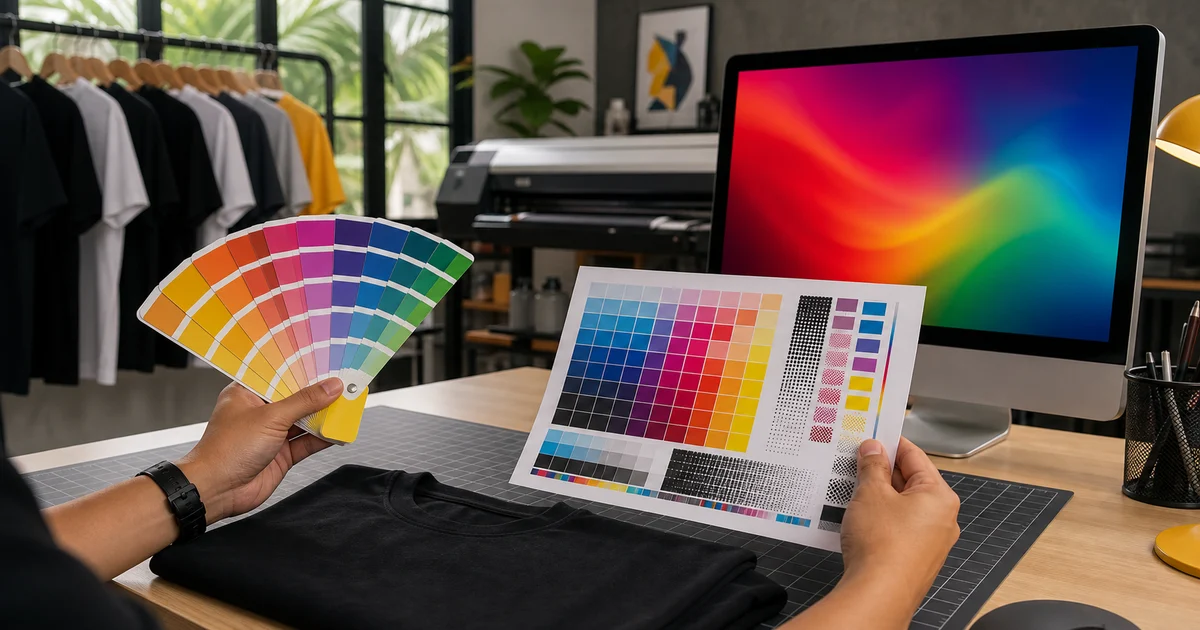
The short answer: send the editable source file plus the colour references the printer requests. Use an exact Pantone reference when a critical brand colour will be mixed or matched as a spot ink; use CMYK values for a defined process-print workflow; keep the original RGB file for screen-based artwork or when the printer’s software performs the conversion. Do not convert everything to CMYK blindly.
Pantone, CMYK and RGB are not three file formats. They describe different ways to identify or produce colour. Your PDF, AI, SVG, PSD or PNG can contain colour information from one or more of them.
Quick decision table
| Colour information | Best starting use | What to send | Limitation to approve |
|---|---|---|---|
| Pantone spot reference | Logos and controlled brand colours in a supported ink-mixing workflow | Editable vector artwork and the complete agreed Pantone code | The physical garment and print process still affect appearance |
| CMYK | Artwork separated or reproduced with cyan, magenta, yellow and black process inks | Print-ready file prepared to the printer’s specification, with profile noted if supplied | Its printable gamut cannot reproduce every spot or screen colour |
| RGB | Original digital artwork, photographs and on-screen assets | Original editable or high-resolution file when the printer requests it | Bright screen colours may shift when converted to printable inks |
The correct choice is the one that matches the printer’s actual output method. Ask this before preparing final files: “Will you mix spot inks, print process colour, or convert my RGB artwork through your RIP workflow?”
What is RGB?
RGB combines red, green and blue light on screens. Pantone describes it as an additive model used by devices such as monitors, televisions and phones. Adobe likewise identifies RGB as the mode used for images prepared for screen display.
Because a display emits light, it can show vivid colours that reflective inks on fabric may not reproduce. Two screens can also display the same RGB values differently because RGB is device-dependent.
Keep the original RGB artwork when it contains photographs, gradients or effects that would be damaged by repeated conversions. Send it if the printer specifically asks for RGB input and handles colour conversion for its equipment. A screenshot is still unsuitable because it may reduce resolution and remove useful document information.
What is CMYK?
CMYK uses cyan, magenta, yellow and black in a subtractive print model. It is relevant when artwork will be output through a defined four-colour process or when a printer requests CMYK-built artwork.
CMYK numbers alone are not an absolute colour promise. Pantone explains that RGB and CMYK values are device-dependent recipes, while Adobe notes that colour conversion varies with the working space and press or printer conditions. Read the official Pantone colour-space overview and Adobe colour-mode guidance.
Before converting, ask the printer for:
- the required colour mode and file format;
- any ICC profile or export preset;
- whether rich black, total ink coverage or transparency needs special handling;
- whether the artwork is process print, simulated process or another digital workflow; and
- whether the printer wants the original RGB file as well.
Converting early with a generic profile can clip colour information. It does not make the garment output predictable by itself.
What is a Pantone reference?
The Pantone Matching System gives printers and designers named spot-colour references. In a spot-colour workflow, the target ink is selected or mixed separately instead of being constructed only from CMYK process dots.
Send the complete reference, not just a number typed in a message. Pantone maintains different systems for graphics, fashion and product materials; the guide, suffix and intended substrate matter. Pantone’s official colour-system explanation separates the PMS graphics system from its Fashion, Home + Interiors system.
A Pantone reference is most useful when:
- a logo has an approved brand colour;
- the printer supports spot-ink matching for the selected method;
- repeat orders need a stable written target; and
- you agree how close the production result must be and how it will be checked.
It is less useful to attach an arbitrary Pantone code when the chosen digital method will only simulate it. Ask the supplier whether the quote covers a true spot ink, a stock ink approximation or a process conversion.
Can CMYK match a Pantone colour?
Sometimes it can produce a useful visual simulation, but not every Pantone spot colour fits inside a given CMYK gamut. Pantone’s Color Bridge product exists to compare a solid spot colour with its closest process simulation and associated colour values. See Pantone’s official Formula Guide and Color Bridge comparison.
That comparison is still made on specified paper conditions. A T-shirt introduces fabric texture, absorbency, garment colour, underbase and ink chemistry. Treat a printed swatch or production-representative sample as the approval object when the colour matters.
What changes on a black T-shirt?
Black fabric makes colour management more demanding. A white base may sit beneath the artwork, and its opacity changes how the upper colours reflect light. An opaque spot ink, screen-printed process image, DTF transfer and DTG print do not render the same colour in the same way.
Our guide to printing on black T-shirts explains underbases, pretreatment and method-specific cost drivers. Tell the printer the garment code and colour before asking for a match; a colour approved on white paper is not approval on black cotton or polyester.
What should your artwork package contain?
Send one organised package with:
- editable source artwork with linked assets included;
- fonts converted to outlines or legally shareable font files;
- a high-resolution raster original where applicable;
- the complete Pantone reference or agreed CMYK values for critical colours;
- a labelled visual preview showing expected placement;
- garment code, colour and fabric;
- finished print dimensions; and
- an unchanged reference PDF for version checking.
Follow the T-shirt printing artwork guide for resolution, vector files and proof checks.
Approve the process, not just the numbers
Before production, record which file version, colour method, garment and sample were approved. Inspect the sample under consistent, ordinary lighting and compare it with the agreed physical reference—not only a phone screen.
If a brand standard is strict, state the permitted tolerance and ask whether the printer can meet it before paying. If it is not strict, describe the priority honestly: for example, “recognisable corporate blue with good contrast on black” may be more useful than an unsupported promise of an exact match.
Include the artwork, colour method, garment, quantity, print positions and delivery details when you request comparable quotations through BajuPrintz.
Frequently asked questions
Should a T-shirt printing file be CMYK or RGB?
Send the editable source and follow the printer's requested colour workflow. RGB is native to screens, while CMYK describes process printing; converting without the printer's profile can discard colours without guaranteeing the final fabric result.
When should you provide a Pantone colour reference?
Provide an exact Pantone reference when a brand colour is critical and the printer confirms that the selected ink system supports spot-colour matching. Include the complete code and library designation because different Pantone systems serve different materials and processes.
Can CMYK reproduce every Pantone colour?
No. CMYK can simulate many spot colours, but some Pantone colours fall outside a particular CMYK printing gamut. Ask whether the quotation is for a mixed spot ink or a CMYK simulation and approve the relevant physical sample.
Will a Pantone code guarantee an exact T-shirt colour match?
No. A Pantone reference creates a shared target, but garment colour, fabric, underbase, ink system, curing, lighting and production tolerances affect the observed result. Agree on the matching standard and approval sample with the printer.
Ready to compare suitable printers?
Get 5 Free Quotes