
Should Company Uniforms Show Employee Names or Job Titles?
Choose employee names, job titles, departments or removable badges for company uniforms while balancing recognition, privacy and reuse.
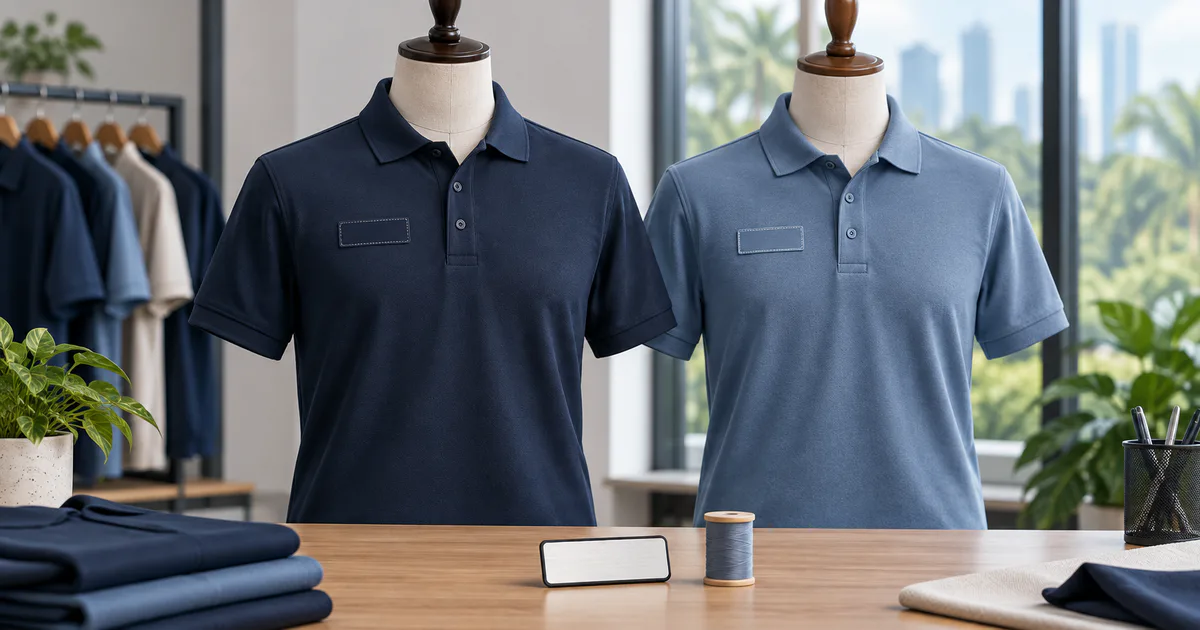
The short answer: use neither a name nor a job title when the uniform only needs to identify the company. Add a preferred name when customer interaction genuinely benefits from personal recognition, a job title when authority or function must be clear, or a department label when the garment should remain reusable.
The best choice is the smallest amount of identification that serves the role. A personalised chest can make service feel approachable, but it also creates privacy, proofing, replacement and staff-turnover work that a logo-only uniform avoids.
Compare the four practical options
| Uniform identifier | Best fit | Main benefit | Main trade-off |
|---|---|---|---|
| Company logo only | Office, warehouse, back-of-house and pooled stock | Most reusable and easiest to reorder | Does not identify the individual or function |
| Preferred name | Retail, hospitality, reception and customer service | Helps customers address the wearer | Personal data, spelling and reassignment need control |
| Job title | Supervisors, advisers, technicians or authorised roles | Clarifies responsibility or authority | Becomes wrong when the person changes role |
| Department or team | Operations, service, events or rotating crews | Clear function with better garment reuse | Less personal and may still need updating after restructuring |
A removable name badge can sit between these options: the garment carries the permanent company mark, while the personal identifier moves or changes separately.
Start with the purpose, not the available print area
Write one sentence explaining why the identifier is needed. For example:
- customers need to know who is authorised to approve a return;
- visitors must distinguish security from maintenance staff;
- event guests need to find the registration team; or
- patients or clients benefit from addressing a front-desk employee by name.
If the answer is merely “because there is space on the right chest”, keep the uniform logo-only. Every extra field becomes another item to collect, approve, manufacture and maintain.
For role recognition, a durable label such as SERVICE, EVENT CREW or a department name may work better than a narrow internal title. Avoid abbreviations that an external customer will not understand.
Use the minimum personal detail needed
A staff name can identify a living person and may therefore be personal data. Malaysia’s Personal Data Protection Commissioner lists a name and address among examples of personal data when an individual can be identified, and describes collecting, recording, holding, using, disclosing and destroying data as forms of processing. See the Commissioner’s current PDPA FAQ.
The same official guidance sets out principles covering notice and choice, disclosure, security, retention, data integrity and access. Before issuing a named uniform, have the organisation’s HR or privacy owner confirm the purpose, what staff will be told, who can access the roster, how corrections work and how long production records should be kept. Review the official personal-data-protection principles. This is a production guide, not legal advice.
For most customer-facing uniforms, start with the employee’s approved display name, not an automatic full legal name. Do not print an identity-card number, personal phone number, full staff credential, health information or access-control detail on a public-facing uniform.
Decide whether the garment must be reusable
Permanent personalisation makes one shirt easier to assign but harder to reissue. Ask:
- Is the garment individually issued or shared by shift?
- How often do staff move between branches, departments or roles?
- Can a leaver’s shirt be reused under company hygiene and uniform policy?
- Will a role title still be accurate through the garment’s expected life?
- Is the cost of replacing a whole shirt acceptable when one name changes?
For high-turnover, seasonal or rotating teams, a logo-only shirt plus a removable badge is often the calmer operating choice. For stable, individually issued uniforms, direct embroidery or printing may be reasonable.
If the business supplies several locations, connect the personalisation roster to the same controlled workflow used to manage uniform sizes across branches. Keep unassigned spare garments separate from named pieces.
Choose a method that matches permanence
| Method | Good for | Watch for |
|---|---|---|
| Direct embroidery | Premium polos and stable long-term assignments | Small text, fabric distortion, stitch density and difficult removal |
| DTF or heat transfer | Clear names or roles on suitable garments | Film feel, heat compatibility and visible residue if removed |
| Screen print | One shared department or role across many pieces | Not efficient for many unique names; changing a title creates obsolete stock |
| Removable badge or patch | Rotating staff, pooled garments and frequent changes | Attachment strength, snag risk, laundering and badge management |
The method should follow the garment, quantity, text size and operating model. Use the embroidery versus printing guide for the permanent options, and compare direct embroidery with embroidered patches when a removable or replaceable element may help.
Place the identifier where it remains readable
A common corporate layout places the company logo on the wearer’s left chest and the name or role on the right. It is a starting point, not a rule. Pockets, plackets, zips, apron straps, tudung, safety vests and other equipment can obstruct either side.
Approve placement on the actual garment model and smallest relevant size. Keep the identifier visually secondary to the company mark unless rapid role recognition is the operational priority. The company logo placement guide explains how chest, back and sleeve positions behave on t-shirts and polos.
If a role must be recognised from farther away, a clear upper-back department label may work better than tiny chest text. Test it at the real viewing distance and check what outer layer staff normally wear.
Lock one personalisation roster
Use one row per garment or wearer. Useful fields are:
- unique order line or garment ID;
- garment product, colour, cut and size;
- approved display name, title or department exactly as shown;
- capitalisation and permitted character set;
- method, colour, final dimensions and position;
- branch or packing group;
- employee or authorised manager approval; and
- production status and change date.
Do not assemble final spelling from chat messages. Collect it in one controlled sheet, generate a proof from that sheet and lock a dated version after approval. Where several languages or scripts are involved, follow the multilingual uniform text guide and confirm the chosen font contains every approved character.
Proof the shortest and longest entries
A fixed text box can make a long title much smaller than a short name. Proof the shortest and longest entries side by side, then check:
- spelling, spacing, punctuation and capitalisation;
- font weight and readable letter height;
- consistent alignment across different text lengths;
- contrast against each garment colour;
- clearance from seams, pockets and plackets; and
- the correct name-to-size assignment.
Ask one authorised person to approve the master proof, while each employee checks their own display text where practical. The sample approval checklist helps turn the approved layout into a production record.
Once the identifier, garment and roster are fixed, request a company-uniform quotation from Baju Printz with separate quantities for shared designs, unique names and removable components.
Frequently asked questions
Should company uniforms show employee names?
Only when a visible name serves a clear customer or operational purpose. Use the least detail needed, confirm each employee's preferred display name, and plan what happens when the wearer changes role or leaves.
Is a first name better than a full name on a uniform?
A preferred first name or approved short display name is usually the more proportionate starting point when customers need to address staff. A full legal name should not be the automatic default.
Should a uniform show a job title or department?
Use a job title when customers must understand the wearer's authority or function. Use a department or team label when garments are pooled, roles rotate or the exact title is likely to change.
Is embroidery, printing or a removable badge best for staff names?
Embroidery and printing suit stable, permanently assigned garments. A removable badge or patch is easier to update and can preserve garment reuse when staff, shifts or roles change.
How can a company prevent spelling mistakes on personalised uniforms?
Use one locked roster with the exact display text, garment code, size, method and position for every item. Let each employee or authorised manager check the proof before production.
Ready to compare suitable printers?
Get 5 Free Quotes