
Do Custom T-Shirts Shrink After Printing? Check Before a Bulk Order
Find out why printed T-shirts may change size after washing and how to test a sample, record measurements and agree a bulk-order acceptance rule.
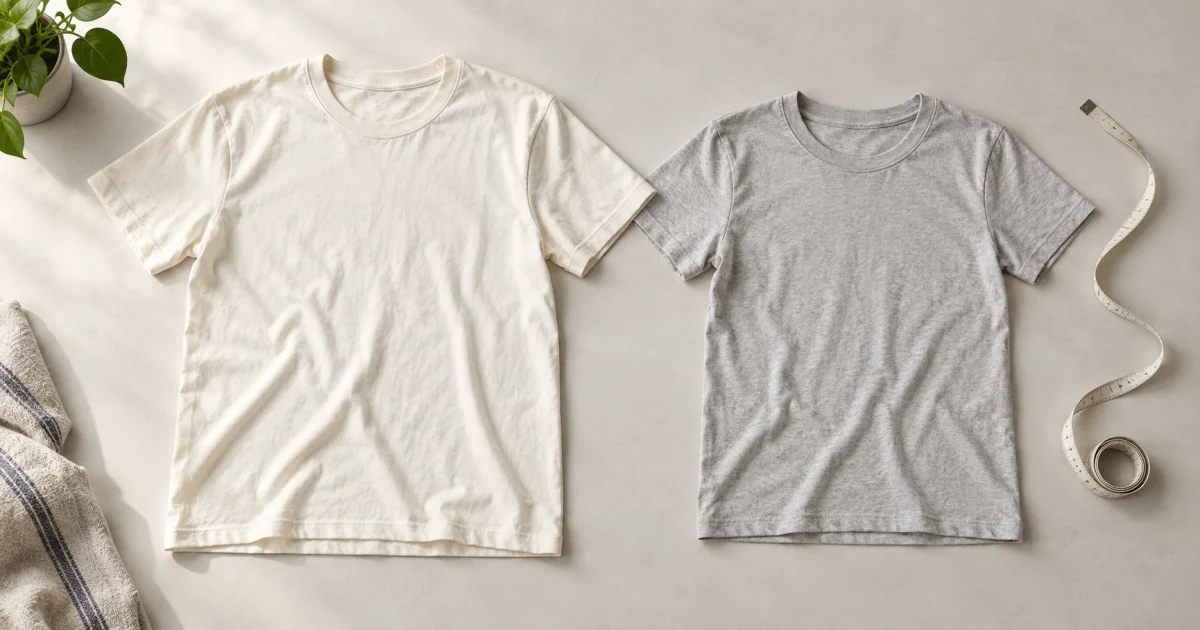
The short answer: a custom T-shirt can change size after washing, but the print is not automatically the cause. The fabric, its finishing, the decoration process and the way the garment is washed and dried all need to be considered. For a bulk order, approve the fit using a washed sample of the exact shirt and decoration when post-wash size matters.
This is a different question from whether two new shirts of the same labelled size fall within a manufacturing tolerance. Our same-size measurement guide explains that receiving check; the procedure below tests change to the same garment after care.
Why can a printed T-shirt change size?
CottonWorks’ shrinkage and skewing guidance identifies fibre, yarn, knit construction, wet processing, finishing, cut-and-sew and garment care as influences on dimensional stability. In other words, “100% cotton” is not a shrinkage specification, and a “pre-shrunk” claim is not a promise that every finished shirt will retain its exact dimensions.
A later change may occur during home laundering; it may also be noticed only then even if an earlier production step affected the garment. Do not diagnose a complaint from the finished shirt alone. Record the blank before decoration, the decorated shirt before washing and the same shirt after washing if you need to locate the stage of change.
The drying method matters too. A sample air-dried according to its label is not a valid prediction for a team that routinely tumble-dries it. Do not deliberately use a hotter wash or dryer setting than the care label permits just to “force out” shrinkage.
Test the actual product before approving the order
Ask the supplier for the product code, fabric composition, care label, size chart and any product-specific dimensional-change claim. Then agree which finished sample represents the order: same blank brand and code, cut, colour, print method and placement. A blank-only test cannot establish how the delivered decorated garment will behave.
Use this simple buyer-side check:
- Photograph the dry, unwashed sample with its label and product code. Lay it flat without stretching and measure chest width and body length at the supplier’s chart points.
- Record the wash temperature, programme, detergent and drying method. Follow the care label and the conditions the wearers will realistically use.
- Let the garment dry and relax consistently. Lay it flat again and measure the same points with the same tape and method.
- Record both before and after values, plus any change in shape, seam twist or print appearance. Repeat the agreed care cycle if the acceptance condition covers more than one wash.
- Compare the result with the written acceptance limit agreed for this product and test, not a general internet shrinkage percentage.
For controlled laboratory evaluation, AATCC’s TM150-2025 garment method determines length and width changes of garments after home-laundering procedures. Its public summary describes multiple wash, agitation and drying options and notes that certain stretch fabrics may be outside its scope. A home sample check is useful for a buying decision, but should not be described as a certified TM150 test unless a qualified laboratory actually performs it.
Calculate change for each measurement
Use (after − before) ÷ before × 100. A negative result means that measured dimension became smaller. For example, a sample with a 70 cm body length before care and 68 cm after care changed by (68 − 70) ÷ 70 × 100 = −2.9%, rounded to one decimal place. This is an arithmetic example, not a prediction or acceptable limit for your order.
Measure width and length separately. A shirt may lose more length than width, or vice versa. If a garment’s shape twists, two percentages alone may still miss the problem. The flat-garment measuring guide helps the team keep tape positions consistent.
Set a usable acceptance rule
Before the deposit, write down the sample identity, care cycle, number of cycles, measurement points, rounding rule and maximum permitted change for each controlled dimension. Also state what happens if the sample fails: a different blank, revised size allocation, another sample or cancellation before mass production, as agreed with the supplier.
Do not invent a universal “safe shrinkage” percentage. Product specifications and wearer needs differ. A fitted staff uniform may need a tighter post-wash fit target than a loose event giveaway. If several cuts, colourways or fabric blends are involved, agree which variants need separate samples; one cotton crew-neck cannot represent a polyester polo.
Use the pre-production sample checklist to record the agreed garment and decoration. Then confirm each wearer’s size against the bulk-order size guide using the approved post-wash fit where relevant. Ordering every shirt one size larger without a measured sample can create a new fitting problem.
What if delivered shirts seem smaller?
Separate new-stock inspection from wash-change testing. First identify the exact code and size, measure unwashed delivered pieces against the approved new-garment chart and its tolerance, and set aside any mismatch. If the concern only appears after washing, retain an unwashed control where possible and compare like-for-like pieces using the agreed care cycle. Photograph measurements and care-label details before discussing a remedy with the supplier.
For care that also protects the decoration, see how to wash printed T-shirts. To specify a sample and acceptance rule before printing, request a BajuPrintz quotation with the product code, expected care method and fit requirements.
Frequently asked questions
Does printing itself make a T-shirt shrink?
Do not assume that printing alone caused a later size change. Fabric construction and finishing, the decoration process, and the subsequent wash and dry conditions can all matter. Compare measured samples at each stage to identify when the change occurred.
Does pre-shrunk cotton mean the shirt will never shrink?
No. A pre-shrunk label describes prior processing, not a zero-change guarantee. Ask for the exact product's dimensional-change information and test a sample using the care conditions your team will actually follow.
How do I calculate T-shirt shrinkage after washing?
Measure the same point before and after the agreed wash and dry cycle. Divide the change by the original measurement and multiply by 100. Record chest width and body length separately; a single overall percentage hides the fit effect.
Should I wash the sample before approving all sizes?
If post-wash fit is important, test the exact blank and decoration combination before bulk approval. Include the sizes and colourways that may differ, and agree the sample count and acceptance limit with the supplier.
Can I order every T-shirt one size larger to allow for shrinkage?
Not safely as a blanket rule. Size steps, cuts and actual dimensional changes vary by product. Use measured post-wash samples and the chosen product's size chart before changing anyone's allocated size.
Ready to compare suitable printers?
Get 5 Free Quotes