
Why Do Two T-Shirts in the Same Size Measure Differently?
Learn why same-size T-shirts can measure differently, how to apply a supplier tolerance, and when a bulk-order variation should be rejected.
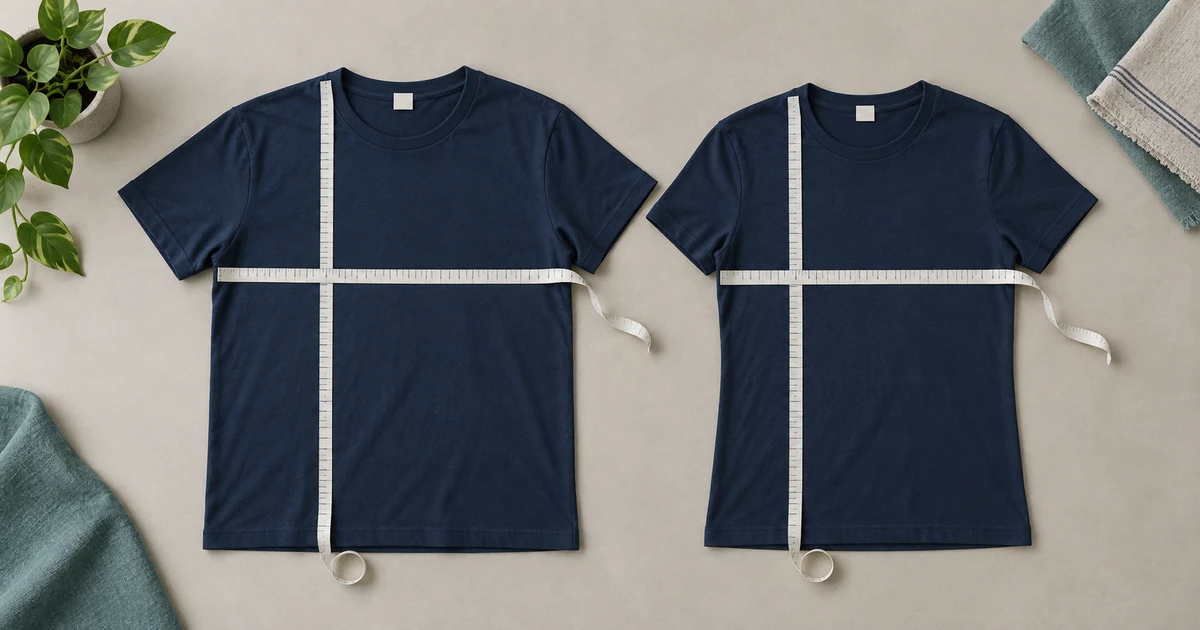
The short answer: two T-shirts carrying the same size can measure slightly differently because cutting, sewing, finishing, fabric relaxation and measuring technique all introduce variation. Accept the difference only when both pieces are the correct product and size, were measured under the same conditions, and remain within the written tolerance for that exact product.
A size label is a category, not a promise that every seam will land on the same millimetre. However, “normal variation” should never become a blanket excuse for the wrong garment, the wrong label or a result outside the agreed specification.
Start with the exact product chart and tolerance
Do not judge an M T-shirt against a general idea of what M should mean. Record:
- brand and product code;
- colour and cut;
- chart version or dated specification;
- labelled size;
- measurement points and unit;
- whether the dimensions are for a flat garment or a body; and
- the permitted tolerance, if any.
There is no universal Malaysian tolerance that applies to every ready-made shirt. A supplier must state the rule for its own product, or the buyer and supplier must agree one in writing.
For a current local example, Oren Sport’s official Vol.23 catalogue states that product sizes may vary by plus or minus 5% and may vary within the same product series. That is Oren Sport’s published condition for those products, not a tolerance to copy automatically into another brand, cut-and-sew job or BajuPrintz order.
Use the Malaysia bulk T-shirt size guide first if the team has not yet locked one product and chart.
Measure every piece by the same method
A comparison is meaningful only when the method stays fixed. ISO 18890:2018 defines main garment measurement points and permits additional points to be agreed; ISO reviewed and confirmed the standard in 2024. The official ISO 18890 overview is a useful common reference, but the selected supplier’s diagram still controls the exact start and end points for its chart.
For each piece:
- place the new, dry shirt on the same hard, level surface;
- align the shoulders and side seams naturally;
- smooth wrinkles without pulling the knit;
- use the same tape and unit;
- measure the stated points in the stated direction; and
- record the value before rounding.
If two people place the tape at different underarm points, they may create an apparent difference that is not in the shirt. Follow the flat-garment measuring method before deciding whether the product has failed.
Separate four different causes
| What you find | Likely category | What to do next |
|---|---|---|
| Repeated readings change on the same piece | Measuring inconsistency | Reset the shirt and repeat with one recorder |
| Small differences across correct pieces | Possible manufacturing variation | Compare each result with the written tolerance |
| Different code, cut, colour batch or label | Product or sorting mismatch | Isolate it; do not average it into the sample |
| Consistent result outside the limit | Possible non-conformance | Document and raise it with the supplier |
Check identity before doing arithmetic. A women’s-cut, oversized or youth shirt may share a familiar size letter while following a different block. A substitution can also introduce a new chart. Use the out-of-stock substitute checklist whenever the original blank changes.
Convert a percentage tolerance correctly
When the product genuinely uses a percentage tolerance, apply it to each stated dimension—not to the size name.
For example, if a supplier chart lists a 50 cm chest width and explicitly allows ±5%, the calculated range is:
- 50 × 5% = 2.5 cm;
- lower limit: 47.5 cm; and
- upper limit: 52.5 cm.
Do the calculation separately for body length, sleeve length or any other controlled point. Do not assume that an approved tolerance for width also defines colour, stitching, print placement or labelled size.
A percentage range can also be visually large on a longer dimension. If that range is unsuitable for a fitted uniform, discuss a tighter written specification or approve a different product before paying the deposit. Do not quietly impose a tighter limit after production.
Keep washing separate from production tolerance
New and washed shirts are not like-for-like samples. Cotton and knitted structures can relax or change after laundering, while the care cycle, temperature and drying method affect the result.
For receiving inspection, compare new stock with the new approved sample and chart. If wash performance matters, create a separate test:
- measure the sample before washing;
- use the agreed care instructions and complete cycle;
- condition and measure it again by the same method; and
- record the change for each controlled point.
Do not reject an entire new batch by comparing it with an old favourite shirt that has been washed many times. Equally, do not use “it will settle after washing” to approve a new garment already outside its receiving specification.
Inspect a useful spread, then expand when needed
For a bulk Malaysian team order, first confirm the count of every labelled size. Then choose pieces across sizes, cartons and packing positions rather than measuring only the top five shirts from one stack.
A practical record can contain:
| Piece ID | Product code | Label | Chest | Length | Result |
|---|---|---|---|---|---|
| Carton 1, piece 03 | Exact ordered code | M | Recorded value | Recorded value | Within / outside limit |
| Carton 2, piece 11 | Exact ordered code | XL | Recorded value | Recorded value | Within / outside limit |
There is no universal sample quantity for every order and risk level. Agree the inspection plan before delivery. Expand the check if failures repeat by one size, carton or measurement point, and consider a full check when the issue could make shirts unusable.
The bulk delivery inspection guide covers counts, decoration, packing and other checks that dimensions alone cannot approve.
Write the acceptance rule before production
Put one clear line in the quotation, purchase order or approval sheet. For example:
Finished-garment dimensions will be assessed against the attached chart for product [code], using its stated measuring points and agreed tolerance, on new unwashed garments.
Then attach the chart version and approved sample record. If a fitted uniform needs a different rule, state the numerical limit for every controlled point and obtain the supplier’s acceptance before mass production.
Avoid vague instructions such as “all L shirts must be identical” or “normal factory tolerance applies”. Neither tells the buyer how to classify a real result.
Report an out-of-tolerance piece before using it
When a piece appears outside the limit:
- stop it from being printed, issued or washed;
- verify the code, colour and size label;
- remeasure it with the agreed method;
- photograph the full garment and tape position;
- record the measured value and allowed range; and
- tell the supplier how many pieces are affected and where they were found.
Do not alter, print or distribute disputed stock before the supplier can assess it. Agree whether the response is replacement, sorting, repair, credit or another documented remedy.
Use the pre-production sample checklist to lock the product and measurement rule. When those details are ready, request a BajuPrintz quotation with the exact product chart and acceptance condition attached.
Frequently asked questions
Is it normal for two T-shirts in the same size to measure differently?
A small difference can be normal when it falls within the exact product's written tolerance and both pieces are measured using the same method. A wrong product, wrong size label or measurement outside the agreed tolerance is a separate issue.
What is an acceptable T-shirt measurement tolerance?
There is no single tolerance for every T-shirt. Use the tolerance stated for the chosen product or agreed in the purchase specification; for example, Oren Sport's current catalogue states plus or minus 5% for its products.
How should two T-shirts be measured fairly?
Condition both pieces the same way, lay them flat without stretching, and measure the exact chart points with the same tape, unit and rounding rule. Recheck any borderline result before classifying it.
Should washed and unwashed T-shirts be compared?
Not as a direct production-tolerance check. Washing can change dimensions, so compare new pieces with new pieces and assess wash change under a separate agreed test using the same care cycle.
What should a buyer do when a shirt is outside tolerance?
Set it aside, remeasure it, photograph the tape position, record the product code, labelled size and result, then notify the supplier before printing, issuing or washing the affected stock.
Ready to compare suitable printers?
Get 5 Free Quotes