
Why Screen Prints Crack: Causes, Prevention and Remedies
Diagnose cracked screen-print ink by timing and location, then prevent repeat failures through correct ink, curing, testing and care.
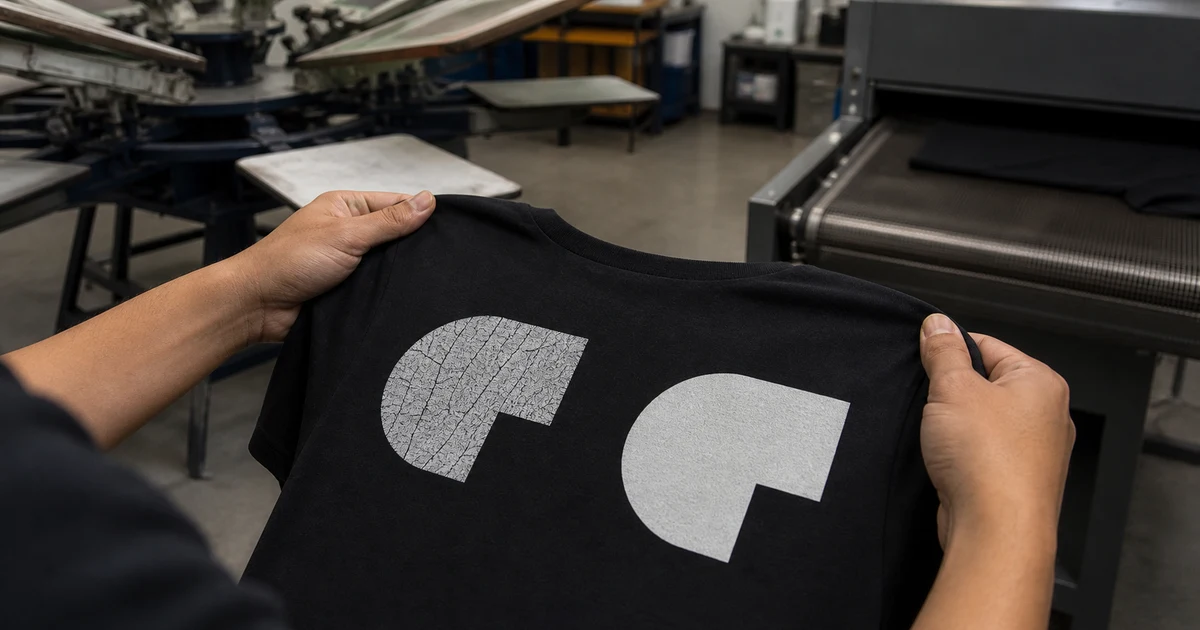
The short answer: screen prints crack when the cured ink film can no longer flex with the shirt. Common causes are incomplete curing through the full ink deposit, the wrong ink for the fabric or stretch, an unnecessarily heavy print, repeated over-stretching, abrasion, or harsh washing and drying. The timing and pattern of the cracks usually provide the best first clue.
A few fine lines on an old, heavily worn shirt are different from a whole company-uniform batch cracking after its first wash. Do not start with glue or a home iron. Isolate the affected shirts, photograph the same print position and ask the printer to diagnose the production record.
Diagnose the crack pattern first
| What you observe | More likely area to investigate | What to do next |
|---|---|---|
| Widespread cracks after the first wash | Cure, ink-and-fabric match, deposit or wash instruction | Stop washing the batch; record the cycle and notify the printer |
| Cracks mainly at side seams, chest stretch or sportswear panels | Ink flexibility, garment stretch or print placement | Compare an unworn sample and test the exact shirt model |
| Cracks mainly in thick white underbase or stacked colours | Heavy ink film or incomplete heat through inner layers | Ask for the ink, underbase and dryer quality-control record |
| Fine cracks only after long service in high-rub areas | Normal wear, abrasion, stretching or repeated high heat | Compare age and use across the batch before assigning cause |
| Blistering, colour migration or flaking as well as cracks | A different heat, fabric or adhesion problem | Request professional inspection rather than assuming one remedy |
This table narrows the investigation; it does not prove liability. Retain one unworn shirt, the approved sample, delivery date, wash history and photos under similar lighting.
1. The ink film may be under-cured
Screen-print ink must reach the manufacturer’s specified cure throughout the printed film. Under-cured ink may look acceptable when it leaves the dryer yet fail when stretched or washed.
Avient’s official ink-curing tips identify under-curing as a common production problem and recommend checks such as stretch and wash testing. Its conveyor-dryer profiling guide also explains that the relevant measurement is the heat reached by the ink film, not merely the dryer setpoint.
The required conditions are product-specific. Low-cure polyester ink, standard cotton plastisol and water-based ink are not one universal recipe. Shirt colour, moisture, ink deposit, belt speed and workshop conditions can change the heat actually reaching the print.
For a bulk order, ask how the printer:
- identifies the exact ink series and substrate;
- measures the printed ink rather than only the dryer air;
- checks the first production pieces after a stop or speed change; and
- records stretch and wash results for the approved construction.
2. The ink may not match the fabric or stretch
Cotton, polyester, poly-cotton and high-stretch performance fabric behave differently under heat and movement. An ink system that works on a stable cotton tee may not provide the same flexibility, low-temperature cure or dye control on an elastic sports shirt.
Avient’s performance-wear printing guidance notes that incorrect ink selection or cure can produce cracking and wash failures on technical garments. This is why the printer needs the exact brand, model, colour and fibre composition before approving the method.
If the print crosses a rib, seam or body area that stretches greatly, placement also matters. A flexible ink cannot make an inflexible solid block immune to unlimited garment extension.
Compare water-based and plastisol ink before specifying the print, but let the printer match the actual product series to the garment.
3. A heavy deposit can hide a cure problem
More ink is not automatically more durable. Dark garments often need an underbase and one or more top colours. Large stacked solid areas take longer to heat through and can feel stiffer than a controlled deposit.
The outer surface may appear dry while the lower film has not completed cure. A very stiff block can also resist the way a soft T-shirt stretches in use. Artwork separations, mesh, underbase, flash time and print passes should create the opacity needed without unnecessary build-up.
During sample approval, touch the broadest solid area, stretch it only as the garment would normally move and inspect the underside of the fabric. Use the sample approval checklist before mass production.
4. Use and care can accelerate cracking
Even a correctly produced print has limits. Repeated high-temperature drying, direct ironing over the decoration, strong abrasion and stretching a small shirt far beyond its intended fit can age the ink film faster.
Follow the garment’s permanent care label and the printer’s decoration-specific instructions. GINETEX explains that the care label states the maximum permitted treatment and that the decoration forms part of the finished textile article. For practical steps, use the printed-shirt wash-care guide.
Care does not excuse an early production failure. If several shirts crack after the same compliant first wash, keep the evidence and ask the supplier to investigate the batch.
What should you do with an already cracked print?
- Stop further washing and drying. Preserve the current condition.
- Photograph the whole shirt and a close-up. Include the same print area on unaffected shirts.
- Record the facts. Note shirt size, batch, first-wear date, wash programme, detergent and drying method.
- Count affected units. One worn sample and 40 matching failures imply different investigations.
- Contact the printer. Provide the order number, approved sample and photos before attempting a repair.
Avoid fabric glue, solvent, direct ironing or an uncontrolled home heat press. These can contaminate the surface, distort the garment and remove evidence. A printer may test a retained sample, but once an ink film has fractured, replacement or controlled reprinting is normally more dependable than an invisible patch.
How to prevent cracking on the next order
- Name the exact shirt brand, model, colour and composition in the quotation.
- Approve the production garment, not a different demonstration blank.
- Keep large solid areas and stacked colours only where the design needs them.
- Ask which ink system and cure verification suit the fabric.
- Approve hand feel, opacity and normal-use stretch on a physical sample.
- Agree a wash test and acceptance criteria before the full run.
- Put the correct care instructions into staff or event handover notes.
- Retain one approved sample and one unworn production shirt.
For method-level durability, see which T-shirt printing method lasts longest. No method guarantees permanent life, but an exact garment specification, controlled ink deposit, verified cure and realistic care greatly reduce avoidable cracking.
Send a crack-resistant printing brief
Tell the printer the garment model, composition, colour, quantities by size, print dimensions and positions, artwork colours, expected stretch, working conditions and care route. If this is a reorder after a failure, attach photographs and state when the cracks appeared.
You can request comparable quotes from Malaysian T-shirt printers or browse screen-printing suppliers by state. Ask each supplier how it proves the ink-and-shirt combination is production-ready, not simply which machine it owns.
Frequently asked questions
Why did my screen print crack after the first wash?
Cracking after the first correct wash can point to incomplete curing, an unsuitable ink-and-fabric combination or an ink deposit that cannot flex with the garment. Photograph the defect, record how it was washed and contact the printer before washing the rest of the batch.
Can a cracked screen print be repaired?
A durable invisible home repair is unlikely. Glue, direct ironing or an uncontrolled heat press can worsen the ink and fabric. Ask the printer to inspect it; replacement or professional reprinting is usually safer than patching a failed production print.
Does cracking always mean the printer made a mistake?
No. Early batch-wide cracking suggests a production or compatibility issue, while older prints may crack after repeated stretching, abrasion, high heat or care outside the label. The timing, location and number of affected shirts matter.
How can a printer test whether screen-print ink is cured?
The printer should follow the exact ink manufacturer's process, confirm heat through the full ink film and use relevant stretch, wash and rub tests. A dryer control-panel setting alone does not prove that the printed ink reached cure.
Will a thicker screen print last longer?
Not automatically. Extra ink can improve opacity, but a heavy deposit is harder to heat through and may flex less comfortably. The right mesh, deposit, underbase, ink system and cure are more important than thickness alone.
Ready to compare suitable printers?
Get 5 Free Quotes