
Unisex vs Women's-Cut T-Shirts for Team Orders: Should You Offer Both?
Choose one or two T-shirt cuts for a Malaysian team order with separate size charts, samples, artwork checks, quantities and costs.
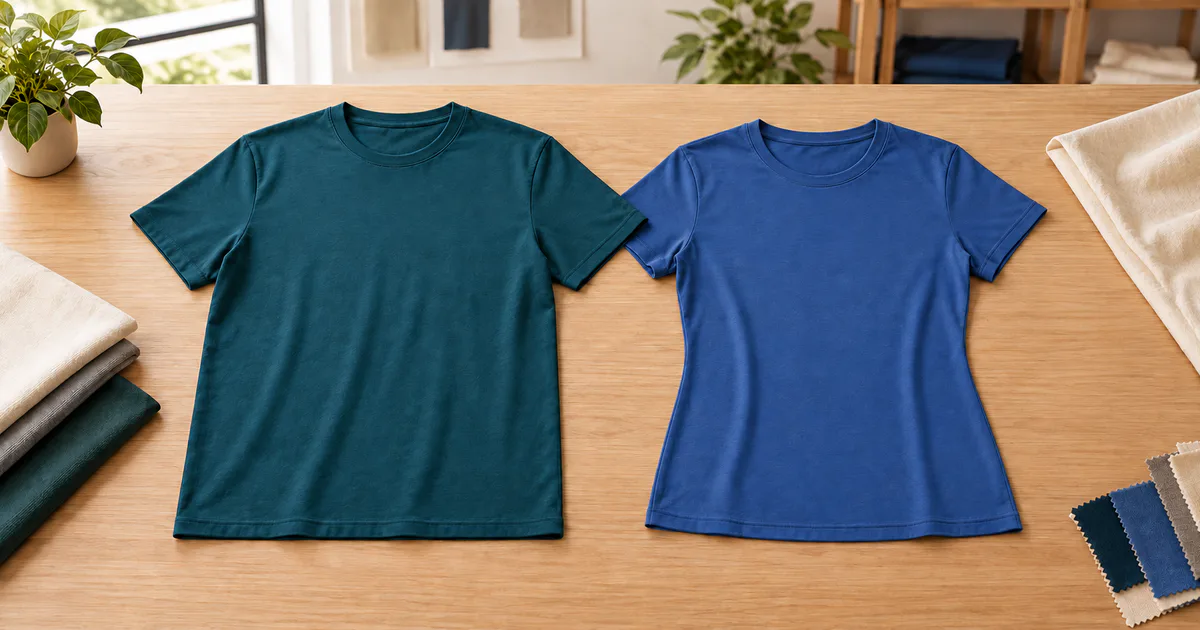
The short answer: offer both unisex and women’s-cut T-shirts when the choice improves fit for a meaningful part of the team and you can manage each cut as a separate product. Use one approved unisex shirt when the group values the simplest size collection, stock control and reorder process. Do not call either option universal, and never treat the same size label as the same measurement across two cuts.
For Malaysian company uniforms, event crews and association shirts, the practical question is not which cut is “better”. It is whether the second option gives enough value to justify another product code, chart, sample, quantity line and stock risk.
Compare the actual products, not the category names
“Unisex”, “classic”, “regular”, “women’s”, “ladies’”, “fitted” and “semi-fitted” are product descriptions, not one universal measurement system. A women’s-cut shirt may have a more contoured side seam, narrower shoulder, shorter sleeve, different neckline or different body length. Another brand may change only some of those features.
Current manufacturer pages show why buyers must read the named product specification. Gildan describes its G5000L women’s T-shirt as a semi-fitted, side-seamed body with a slightly contoured silhouette. Its G8000 adult T-shirt is described separately as a classic fit for loose comfort and has its own size range. These examples do not create a conversion rule; they show that fit, construction and available sizes are properties of the individual product.
For a Malaysian catalogue example, Oren Sport’s current garment catalogue publishes product-specific measurements for selected unisex shirts and notes that actual measurements may vary. Check the quoted code and current chart rather than relying on a generic S–XL list.
Use the Malaysia bulk T-shirt size guide to collect measurements without converting labels between products.
Choose one unisex cut when simplicity is the priority
One unisex product is usually easier to administer because the organiser has:
- one product code and colour to confirm;
- one chart and fitting sample to circulate;
- one size list to reconcile;
- one base artwork placement to approve;
- fewer stock substitutions to manage; and
- a simpler record for future reorders.
This can suit a short event, promotional giveaway or large volunteer group when the actual sample fits the intended wearers acceptably. It is also useful when the deadline is tight and adding another garment would create an avoidable sourcing delay.
Simplicity is not permission to guess. Show the actual shirt, explain whether it is intended to fit loosely or close to the body, and let wearers select from its own chart. A “unisex M” is not a body type and should not be assigned from gender alone.
Offer both cuts when the choice solves a real fit problem
A second cut is useful when wearer feedback or a fitting session shows that one product does not serve the team well. It may also support a longer-term uniform programme where comfort and regular use matter more than having one stock line.
Before offering both, confirm:
- the supplier can provide both product codes in the required colour;
- the fabrics have an acceptable visual match under normal light;
- the available size ranges cover the people choosing each cut;
- the logo can be placed consistently on both garments;
- the quantity and price rules are clear for each product; and
- replacements or later reorders remain realistic.
If the team also needs more coverage, do not treat a larger unisex shirt as an automatic substitute. Compare a purpose-made option using the Muslimah and long-sleeve team-shirt guide.
Keep size collection separate by product code
Give every wearer the exact chart for each approved option. Better still, provide labelled fitting samples in representative sizes and ask people to record both product and size.
Use a roster like this:
| Staff ID | Product | Supplier code | Colour | Size | Quantity |
|---|---|---|---|---|---|
| A014 | Unisex tee | Tee A | Navy | M | 2 |
| A015 | Women’s-cut tee | Tee B | Navy | M | 2 |
The two M entries must remain separate. They may differ in chest, shoulder, sleeve and length even if both labels say M. Keep a subtotal for every product-size combination, then confirm that subtotal against the printer’s quotation and packing list.
Avoid asking people only “men’s or women’s?” That can produce the wrong fit and unnecessary personal assumptions. Show neutral product names, measurements and samples, then let each wearer choose the approved option that suits them.
Check colour and fabric compatibility before promising a matched set
Two catalogue products with the same colour name may use different fabric compositions, knit structures, finishes or dye lots. Under office lighting or daylight, one navy can appear warmer, darker or shinier than the other.
Ask the supplier to place the actual garments together before approval. Record the code, colour and fabric of each. If an exact match is critical, approve the pair physically rather than accepting two web thumbnails.
This is the same control needed in a broader mixed order. The mixed T-shirts, polos and jackets guide explains how to separate garment groups while keeping one team identity.
Approve logo scale and position on both cuts
The same logo file can often be used, but one set of placement coordinates may not suit both garments. A narrower chest or different neckline can make an unchanged print appear too large, too low or too close to a seam.
For each cut, record:
- finished logo width and height;
- reference point, such as distance below the collar seam;
- left-chest or centre alignment rule;
- smallest and largest garment sizes covered by that rule; and
- whether a second print size is needed at an extreme size.
Approve a proof on the correct garment outline and use a physical sample or controlled first-off where the shape materially changes the result. The sample approval checklist helps separate what a digital proof can confirm from what needs the real fabric and fit.
Price both products without hiding the extra line
Ask for separate garment, setup, decoration and quantity subtotals. The printer may be able to share artwork preparation or screen-print settings when the logo, colour and placement remain unchanged, but the blank shirts still have separate product codes, costs, stock and size ranges.
A clear quotation should state:
- quantity by cut and size;
- unit price and surcharge by product;
- whether quantities combine for any decoration tier;
- whether each cut has its own MOQ;
- sampling or fitting-set cost;
- approved stock alternatives; and
- the treatment of unused or exchanged fitting samples.
Use the quotation comparison guide so two suppliers are pricing the same product matrix.
Make the final decision with a small fitting exercise
Do not add a second cut because it sounds inclusive, or reject it because one product is easier. Ask a representative group to try the actual samples, note the preferred product and size, and flag gaps in the available range. Then count how many people need each option and obtain a quote using those real subtotals.
If only one or two people prefer the second product, ask whether a compatible alternative can be handled as a documented exception. If a substantial group chooses it and the products work together visually, two controlled lines may produce a better everyday uniform.
You can request a product-specific quotation through Baju Printz with the required colour, team quantity, wearer deadline and separate size subtotals. Ask the supplier to identify the exact unisex and women’s-cut codes before anyone submits a final size.
Frequently asked questions
Should a company offer both unisex and women's-cut T-shirts?
Offer both when enough wearers prefer the second cut, the supplier can provide compatible products and the organiser can manage two charts, samples and stock lines. Use one unisex product when simplicity matters more and wearers have approved its actual fit.
Is a women's-cut T-shirt just a smaller unisex T-shirt?
No. A women's-cut product may change the body contour, side seams, shoulder, sleeve, neckline and length. Its size labels and measurements belong to that specific product, so do not convert a unisex M automatically into a women's M.
Can both cuts use the same logo size and position?
Sometimes, but verify the artwork on each cut. A narrower chest, different neckline or shorter body can change the visual scale and measurable placement. Approve a proof or sample for every materially different garment and placement.
Do unisex and women's-cut quantities combine for bulk pricing?
Not automatically. The printer may combine some decoration work when artwork and settings stay unchanged, but the garments are separate product codes and may have different costs, stock, size ranges or minimums. Ask for separate subtotals and a stated pricing rule.
How should sizes be collected when a team can choose either cut?
Show the exact chart and fitting sample for each product, then record product code and size together for every wearer. Keep separate subtotals such as Unisex Tee A–M and Women's Tee B–M rather than one combined M count.
Ready to compare suitable printers?
Get 5 Free Quotes