
What If Your T-Shirt Is Out of Stock? How to Approve a Substitute
Use this Malaysian buyer checklist to compare a replacement T-shirt by product code, fabric, colour, fit, print result, price and delivery date.
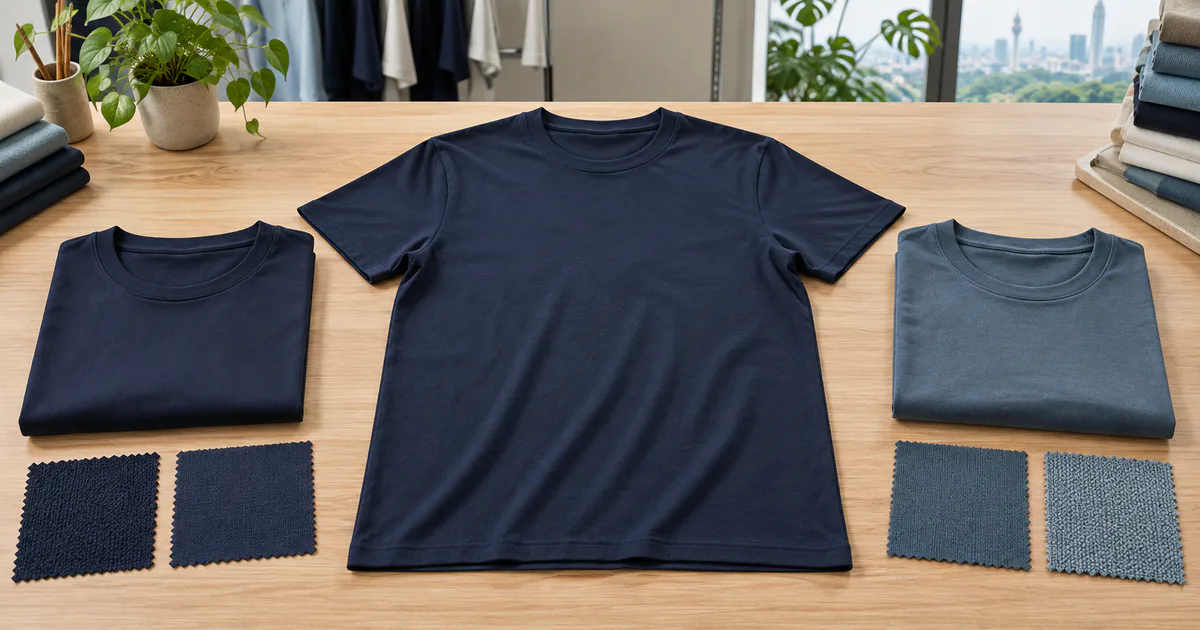
The short answer: do not accept an unnamed “equivalent shirt” when your selected T-shirt is out of stock. Ask the printer to pause the affected line, identify exactly what is unavailable and propose a replacement by product code. Compare the substitute’s fabric, weight, colour, cut, measurements, decoration result, price and delivery date, then approve or reject it in writing.
Stock can change between quotation, payment and production. The goal is not to find any available shirt quickly; it is to choose the least disruptive option without weakening the specification your team approved.
First identify the exact shortage
Ask for a written stock table before discussing alternatives:
| Approved product | Colour | Affected sizes | Required quantity | Available now | Shortfall |
|---|---|---|---|---|---|
| Tee A | Navy | M | 40 | 32 | 8 |
| Tee A | Navy | XL | 18 | 0 | 18 |
Confirm whether the problem affects:
- one size, several sizes or the whole product code;
- one garment colour or every colour;
- stock at the printer, distributor or manufacturer;
- the full quantity or only a small shortfall; and
- the current delivery date or only a future reorder.
Do not let “out of stock” hide a different issue such as an expired quotation, missed reservation, minimum pack quantity or discontinued model. You need the affected code and quantity before you can judge the remedy.
Live availability is time-sensitive. Oren Sport’s current Malaysian product listing shows stock status beside individual product codes, while the same page lists different fabrics and GSM values across seemingly similar basic shirts. Treat any online status as a current reference only and ask the supplier to confirm the quantity reserved for your order.
Choose the least disruptive replacement route
Work through these options in order rather than jumping straight to a different garment:
- Keep the same product and wait for confirmed replenishment. Use this when consistency matters more than the original date.
- Keep the product but change colour. Check the artwork contrast, team approval and whether the new colour is available in every required size.
- Split the delivery. Release available stock first and receive the balance later only when the event or allocation plan can support two dates.
- Replace only the unavailable sizes. This preserves more of the original order but may create visible fit, colour or fabric differences within one team.
- Move the whole order to one replacement model. This creates more rechecking work but can keep the finished group consistent.
- Remove or cancel the affected line under the agreed terms. Record any revised price, credit or refund arrangement rather than assuming an automatic remedy.
The right choice depends on the event date, acceptable visual variation, number of affected pieces and the contract. Use the production timeline guide to recalculate approvals, printing and delivery after a material change.
Compare a substitute as a new product
Give the printer a comparison table to complete:
| Check | Approved shirt | Proposed substitute | Buyer decision |
|---|---|---|---|
| Brand and product code | |||
| Fibre composition | |||
| Stated GSM or weight | |||
| Cut and construction | |||
| Colour reference | |||
| Measurements by size | |||
| Available size range | |||
| Decoration method | |||
| Unit price and surcharge | |||
| Confirmed delivery date |
A broad label such as “cotton round-neck T-shirt” is not enough. Oren Sport’s current CT08 product specification identifies a specific code, cotton composition, 270 GSM weight and its own size range. Gildan’s current 64000 product page likewise identifies a style number with its own fabric, colours and sizes. These are manufacturer examples, not recommendations; they show why a named product record is more useful than a generic description.
Use the quotation comparison guide when the proposed substitute changes the commercial basis of the order.
Check colour, hand feel and fit physically
Never approve a colour-critical substitute from a screen image alone. Put the approved sample and proposed replacement together under normal office lighting and daylight. Look for changes in:
- hue, depth and sheen;
- knit texture and surface smoothness;
- collar width, rib and seam construction;
- fabric stretch, drape and opacity;
- shoulder, chest, sleeve and body length; and
- shrinkage or care instructions supplied for the product.
If the original garment is unavailable, compare the replacement with a retained sample, fitting-set piece or clear approval photograph. Record any accepted difference explicitly; do not call two shirts “same navy” when the team can see otherwise.
Size labels must stay with their product codes. A medium in the substitute is not automatically equal to a medium in the original. Reissue the exact chart and use the Malaysia bulk size guide before changing staff allocations.
Re-test the decoration on the replacement fabric
A different fabric or colour can change the decoration result. Dark garments may need a different underbase; polyester can create heat or dye-migration risks; textured knits can affect small print or embroidery detail; and a changed neckline or pocket can alter placement.
Ask the printer to confirm:
- the proposed print or embroidery method remains suitable;
- the finished logo size and position still fit every replacement size;
- ink, transfer, thread and pressing settings remain appropriate;
- the approved artwork contrast still works on the new colour; and
- any new setup, sample or unit cost.
At minimum, obtain a physical blank and an updated proof showing the named substitute. Require a decorated sample or controlled first-off when the new material or construction changes production risk. Follow the sample approval checklist rather than extending the old approval to a product nobody examined.
Keep mixed substitutions visible in the size list
If only unavailable sizes move to another model, give each combination a separate line:
| Product | Colour | Size | Quantity |
|---|---|---|---|
| Tee A, original | Navy | S | 12 |
| Tee A, original | Navy | M | 32 |
| Tee B, substitute | Navy | M | 8 |
| Tee B, substitute | Navy | XL | 18 |
This prevents the printer from treating all M or XL pieces as interchangeable. It also lets the organiser warn affected wearers, label cartons correctly and preserve a reliable record for replacement pieces.
When the visual difference is obvious, switching the whole order may be cleaner than mixing models. If the difference is minor and the deadline is fixed, a documented size-only exception may be reasonable. The buyer, not an informal production chat, should make that trade-off.
Issue one written substitution approval
The final change note should state:
- order and purchase-order reference;
- original product code and affected quantity;
- approved replacement code, colour and size breakdown;
- accepted differences from the original specification;
- updated proof or sample reference;
- revised unit price, total and payment treatment;
- revised production and delivered-by dates; and
- name and time of the authorised approval.
Mark the old product as superseded. Update every working document instead of leaving the replacement only in WhatsApp messages.
For covered consumer transactions, sections 34 and 35 of Malaysia’s Consumer Protection Act 1999 address goods supplied by description and by reference to a sample or demonstration model. Review the official KPDN copy of Act 599 for scope and exact wording. This article is an operational checklist, not legal advice, and business contracts may set additional terms.
Before the next order, name acceptable alternatives in the quotation and decide who may approve them. Keep the final replacement record with the uniform reorder specification so the substitute does not become an undocumented new standard.
You can request product-specific quotations through Baju Printz with the required product code, colour, size breakdown, receipt date and substitution rule already stated.
Frequently asked questions
Can a printer replace an out-of-stock T-shirt without asking?
The safer process is to pause the affected line, name the proposed replacement and obtain written buyer approval before production. The replacement should be compared against the approved product code, colour, fabric, fit, size chart, decoration, price and delivery date.
Is another T-shirt with the same colour name an equivalent substitute?
Not necessarily. Two products called navy or black can differ in shade, fabric composition, surface texture, sheen and dye lot. Compare physical garments together under normal lighting before accepting a colour-critical replacement.
Can only the unavailable sizes be changed to another T-shirt model?
It may be possible, but the mixed models can fit, look and print differently. Keep each model as a separate order line, check its size chart and sample, and decide whether the visual difference is acceptable to the team.
Does a substitute T-shirt need a new sample?
Request a new blank sample and updated artwork proof whenever the product code changes. Add a decorated sample or controlled first-off when the fabric, colour, construction or print behaviour creates a material production risk.
What documents should change when a substitute is approved?
Update the quotation or change note, purchase-order line, product and size breakdown, proof or sample record, price, production date, delivery date and authorised approval. Keep the superseded product clearly marked so it cannot return by mistake.
Ready to compare suitable printers?
Get 5 Free Quotes