
Can One Company Polo Use Both Embroidery and Printing?
Combine an embroidered chest logo with a printed back or sleeve on one company polo using separate specifications, costing and sample checks.
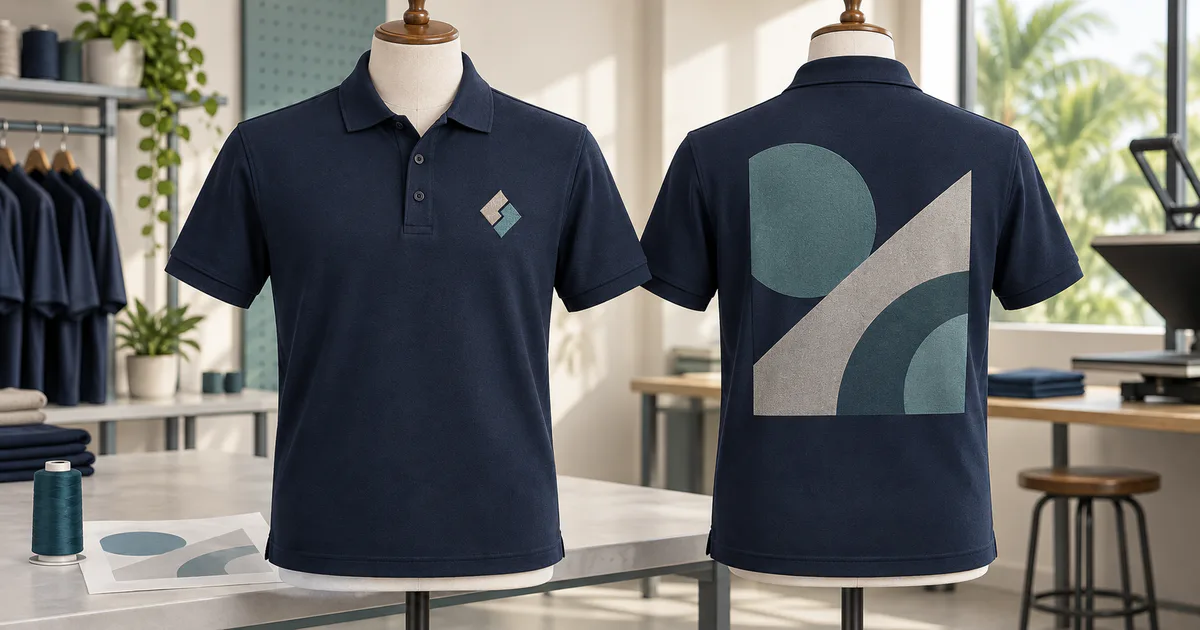
The short answer: yes, one company polo can use embroidery and printing together—for example, a small embroidered chest logo with a larger printed back graphic. Approve the exact polo with both decorations completed, because compatibility with one method does not automatically approve the other.
This mixed approach is useful when the chest needs a restrained corporate finish but the back or sleeve must carry information that would be too large, detailed or heavy in embroidery. It also means two production processes, two sets of risks and a more detailed quotation.
Choose a mixed layout only when each method has a job
| Layout | Why it can work | Main check |
|---|---|---|
| Embroidered chest logo + printed back | Corporate identity in front, larger team or campaign graphic behind | Back-print comfort, coverage and visibility |
| Embroidered chest logo + printed sleeve | Formal front with a small event or division element | Sleeve seam, wrap and usable print area |
| Embroidered name + printed company mark | Individual identification plus a shared graphic | Roster accuracy and visual hierarchy |
| Embroidered patch + printed garment | Replaceable badge with a flat supporting graphic | Patch attachment, heat path and total thickness |
Do not add a second method merely to make the shirt look more expensive. If one small logo serves the whole purpose, one process is easier to sample, price, replace and reorder.
The embroidery versus printing guide helps decide what each method should do. This article covers the next decision: controlling both on the same garment.
Lock the exact polo before designing both positions
Record the polo brand, product code, colour, fabric composition, knit, cut and size range. Then draw a placement map showing every decoration on front, back and sleeves.
Current manufacturer documentation shows why the garment matters. SanMar’s official decoration specification for a polyester polo lists embroidery, screen printing and heat transfer as available techniques, but also states that the decoration area depends on garment size, method and equipment. Its heat guidance calls for extra care on that particular 100% polyester product.
That is useful evidence that multiple techniques may be possible—not permission to copy its dimensions or settings to another Malaysian polo. Your selected garment needs its own supplier assessment and sample.
Check whether:
- the chest panel can be hooped or framed without catching the placket, pocket or seam;
- the back panel lies flat enough for the selected print process;
- backing, thread and print feel are comfortable during a full workday;
- heat or curing requirements suit the stated fabric and colour; and
- the smallest and largest sizes provide enough clearance for every position.
Treat embroidery and printing as two separate specifications
Do not write only “logo front and back”. Create one line for each decoration.
| Field | Embroidery line | Printing line |
|---|---|---|
| Artwork master | Digitised stitch version and source logo | Named print-ready file and colour version |
| Finished size | Width, height and stitchable detail | Width, height and artwork coverage |
| Position | Wearer’s side and measured reference points | Front, back or sleeve with measured references |
| Colour control | Thread range or approved swatch | Ink or transfer colour reference |
| Production control | Backing, topping and approved sew-out | Named method, fabric compatibility and approved print |
An embroidery file and a print file are not interchangeable. Small stitched lettering may need simplification, while a large printed graphic may retain detail that would become stiff and costly in thread. Use the minimum embroidery detail guide before shrinking a full-colour print master into a chest logo.
Give every final file a version name. If the print artwork changes after the embroidery sample is approved, the combined garment is not automatically approved.
Let the decorator control the production sequence
Do not prescribe “embroider first” or “print first” without the exact production setup. The correct sequence can depend on:
- whether the garment must be hooped before another decoration obstructs access;
- whether a heat press platen can isolate the print area;
- whether screen-print curing or transfer application exposes other areas to heat or pressure;
- how the finished garment is handled between workstations; and
- whether the supplier performs both processes in-house or transfers the job between facilities.
Ask the supplier to state the sequence in the production record and take responsibility for the completed result. If work moves between two decorators, name one party that owns garment counts, transport, damage control and final inspection.
STAHLS’ official heat-press loading guidance explains how platen size, garment loading and pillows help isolate an application area from seams, buttons and zips. A raised embroidery area creates another reason to map what sits above and below the press, rather than laying the whole finished polo flat without a plan.
Keep the two positions visually related
The chest and back do not need identical artwork, but they should look like one uniform system.
Control:
- the approved logo version used by each method;
- relative scale, so the chest mark remains restrained and the back graphic does not dominate accidentally;
- thread and print colours under the same viewing light;
- clear space around the placket, collar, seams and pocket; and
- what remains visible under a jacket, apron, safety vest or tudung.
Use the company polo logo-placement guide to define measured positions. If a large back transfer will be worn outdoors in Malaysia, include wearer comfort and airflow in the sample review instead of judging the flat garment only.
Price it as one garment with multiple production lines
A useful quotation separates:
- polo model, colour, size breakdown and quantity;
- embroidery digitising or file adaptation;
- embroidery per piece and its position;
- printing setup, named method and print position;
- individual names or role variations;
- combined decorated sample and revisions;
- packing, delivery and replacement handling; and
- the complete payable total.
Two decorations do not necessarily receive the price tier of one repeated setup. Ask which charges are one-time, which repeat per piece and which will apply again on a small reorder. The logo embroidery cost guide explains the stitch-related line, while the quotation comparison guide helps normalise the whole job.
Approve one complete polo, not two isolated samples
A sew-out on fabric and a printed test panel are useful process checks, but neither proves how the fully decorated polo will look and feel. Approve at least one complete sample containing both methods on the selected garment.
Check:
- exact polo code, colour and labelled size;
- embroidery dimensions, placement, puckering, backing and comfort;
- print dimensions, placement, edges, opacity, adhesion and press marks;
- front-to-back alignment and whether either decoration shows through;
- colour relationship between thread, print and garment;
- collar, placket, seams and fabric after both processes; and
- the agreed care instructions for the finished combination.
Use the pre-production sample checklist and save the approved sequence, file versions, dimensions and photographs with the order. A reorder should reproduce the combined specification, not rely on “same as before”.
When the garment and both decoration lines are ready, request a mixed-method uniform quotation through Baju Printz using the same placement map and approval requirement for every supplier.
Frequently asked questions
Can one polo shirt have both embroidery and printing?
Yes, when the exact polo fabric and construction suit both processes. Treat the embroidery and print as separate production specifications, then approve one finished sample that contains both before the bulk run.
Where should embroidery and printing go on the same company polo?
A practical starting layout is a compact embroidered chest logo with a larger printed back or sleeve graphic. The final positions must avoid the placket, seams, pockets and equipment worn by staff.
Should embroidery or printing be completed first?
There is no universal sequence for every garment and process. The decorator should set and document the order after considering hoop access, heat, pressure, curing and handling, while the buyer approves the completed sample.
Does combining embroidery and printing cost more?
Usually it creates at least two production setups and more than one decoration line, so the quotation should separate digitising, embroidery, print setup, each position, sampling and any personalisation. The actual price depends on the specification and quantity.
Can polyester polos use both embroidery and heat-applied printing?
They can in some cases, but the supplier must test the exact polo. Lightweight knit may need suitable embroidery support, while heat-applied printing must account for heat tolerance, sheen change and possible dye migration.
Ready to compare suitable printers?
Get 5 Free Quotes