
Why Does an Embroidered Logo Pucker a Polo Shirt?
Learn why polo fabric puckers around an embroidered logo, what buyers should inspect, and how to approve a flatter bulk-uniform result.
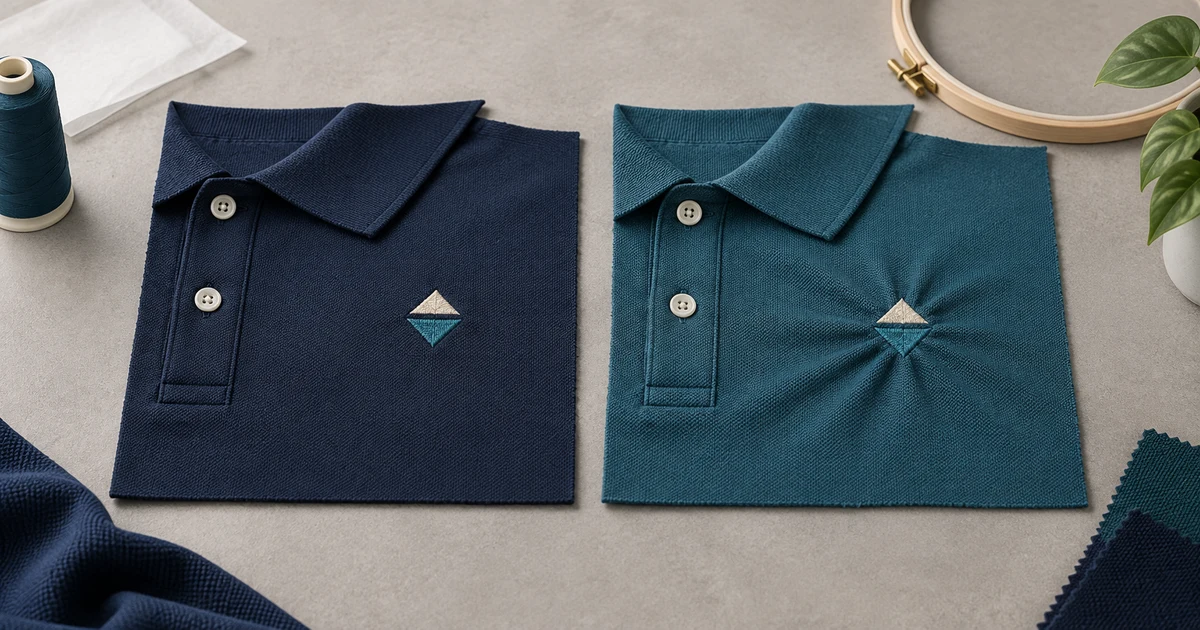
The short answer: a polo puckers around an embroidered logo when the fabric and stitch system are not working as one controlled combination. Common causes include unsuitable backing, stretched or loose hooping, a stitch file that is too dense or poorly stabilised for the knit, and needle or machine factors. Approve the exact logo on the exact polo, not a sew-out on unrelated fabric.
Puckering is the visible gathering, rippling or pulling of fabric around the stitched area. A textured pique surface is not automatically a defect, and a temporary hoop mark is not the same as permanent distortion. The buyer’s task is to compare the finished garment with the approved sample and decide whether it lies flat enough for the agreed uniform standard.
Identify the pattern before naming the cause
| What you see | Possible cause to investigate | Buyer evidence to record |
|---|---|---|
| Ripples radiate from the whole logo | Fabric stretched in the hoop, weak support or excessive stitch pull | Full front photo while flat and worn |
| One dense area pulls more than the rest | Density, underlay, sequence or stitch direction may not suit the fabric | Close-up and marked area on the proof |
| Only some pieces are distorted | Inconsistent hooping, backing, needle or machine setup | Piece IDs, sizes, cartons and counts |
| The sample was flat but ripples appear after washing | Garment, thread or backing may have changed differently | Before-and-after measurements and care cycle |
| A rectangular outline shows through | Backing may be too visible rather than the embroidery itself puckering | Photo from front and inside of garment |
Do not diagnose from one close-up alone. Lay the polo naturally without pulling it, view it at normal conversation distance, put it on a wearer, and inspect the inside. Then compare several pieces from the same size and other sizes.
Why does polo fabric make the setup important?
A polo is not one standard material. Pique, honeycomb, cotton-rich interlock and lightweight performance knit can differ in stretch, stability, surface texture and weight.
Oren Sport’s current Vol.23 catalogue for 2026–2027 includes Quick Dry, CVC Polo and premium polo ranges, illustrating the variety available to Malaysian uniform buyers. A logo approved on one heavy polo cannot automatically approve a thin microfiber model.
Wilcom’s current fabric-property guidance explains that stretchy knits distort more than stable wovens and that pique or polo knit may need adjusted underlay, density, stitch length and pull compensation. These are production decisions for the embroiderer, but buyers need to supply the exact garment code before digitising.
Use the corporate polo material comparison to choose the garment before evaluating its embroidery.
Backing must support the actual fabric and design
Backing, also called stabiliser, sits behind the fabric to control movement during stitching. The right type and weight depend on both the garment and the design.
Madeira’s current embroidery backing guide recommends cut-away support for knits and stretchy materials, while stable wovens may suit tear-away backing. It also identifies unsuitable backing, overstretching during hooping and poor digitising as causes of puckering.
That does not mean every polo needs the same cut-away product or the heaviest possible layer. Excess backing can feel uncomfortable or show through a lightweight garment. Ask the supplier to state the backing category used on the approved sample and to preserve that construction for production.
Check the inside for:
- backing that extends consistently around the design;
- rough, sharp or poorly trimmed edges;
- visible backing through the front;
- loose thread tails or missed trims; and
- a construction that feels acceptable against the skin.
Hooping should hold the fabric without stretching it
The hoop must stop the polo from shifting while the needle works. If the fabric is loose, the design can move. If the knit is pulled beyond its relaxed shape, it may spring back and gather around the finished stitches when released.
Madeira’s official fabric-puckering troubleshooting page recommends checking improper hooping first, using the smallest hoop that fits the design, then reviewing stabiliser and needle condition.
A buyer does not need to prescribe hoop pressure or machine technique. Instead, require the supplier to make the production sample using the intended hooping and support method. The sample must arrive in its relaxed state, not stretched flat for photography.
Digitising controls how thread pulls the polo
The visible logo may be simple, but the machine file controls underlay, stitch types, directions, sequence, density and pull compensation. These choices distribute force across the fabric.
Wilcom’s underlay guidance notes that underlay forms a foundation for cover stitches and can reduce puckering and pulling. Simply adding more top stitches for heavier coverage is not necessarily the answer; it can add more needle penetrations and stiffness.
Ask for digitising review when:
- the logo moves from a stable polo to a lightweight or stretch model;
- the finished width changes materially;
- a large filled block pulls the surrounding fabric;
- outlines no longer register with filled areas;
- small lettering has become dense or closed; or
- the previous approved file puckers on the new garment.
The embroidery digitising guide explains why a vector logo and a machine-ready stitch file are different. Use the minimum embroidery detail guide if reducing density also requires simplifying tiny text or lines.
Separate production puckering from wash change
Inspect and photograph the sample before washing. Then run only the care test agreed with the supplier and garment label.
If the sample is already distorted when new, laundering is not the root cause. If it lies flat initially but puckers after the agreed wash, record:
- garment code, colour and size;
- logo file version and finished dimensions;
- wash and drying settings;
- garment measurements before and after; and
- flat, inside and worn photographs under similar light.
Do not compare a new production sample with an old polo that has been washed repeatedly. Keep a new approved control sample or clear acceptance photographs with the order record.
Approve a physical sample with a clear flatness test
A digital mockup confirms logo content and placement but cannot show fabric pull. Approve at least one sample on the exact production polo and colour, with the final-size digitised file, thread, backing and machine method.
Inspect it in this order:
- lay the polo flat and let the fabric relax;
- view the complete front from normal distance;
- check the logo edge and surrounding knit close up;
- wear it to see how body shape changes the area;
- inspect backing and comfort inside; and
- complete the agreed wash test before final release when wash response is material.
Write the decision as approved, approved with named changes, or rejected. “Looks okay” is not a reproducible standard. The pre-production sample checklist provides the wider approval record for garment, colour, size and placement.
What should you do if the bulk order puckers?
Stop printing, issuing or washing any unprocessed pieces from the affected group. Isolate the visibly distorted garments and compare them with the retained approved sample.
Send the supplier:
- affected quantity and total quantity checked;
- product codes, colours and sizes;
- whether the problem repeats in one carton or size;
- full garment, close-up and inside photographs;
- the approved sample or its record; and
- the condition when the puckering appeared.
Do not press, steam, stretch or unpick the embroidery to make it look flatter before assessment. Those actions can change the evidence or damage the uniform. Agree a documented response such as sorting, rework trial, replacement or credit only after the supplier identifies a safe remedy.
Use the bulk-order delivery inspection guide to record the affected lot. For a new order, request a BajuPrintz quotation with the polo code, logo dimensions and requirement for an exact-garment embroidery sample.
Frequently asked questions
Why does fabric pucker around an embroidered logo?
Puckering can come from stretched or loose hooping, insufficient or unsuitable backing, a stitch plan that does not suit the fabric, excessive pull or density, or a needle and machine issue. The exact garment and embroidery file must be assessed together.
Is slight puckering around polo embroidery acceptable?
There is no universal allowance. Judge the result against the approved sample and written appearance standard under consistent light, both flat and worn; pronounced ripples visible at normal viewing distance should be raised before bulk approval.
Can puckered embroidery be fixed after production?
Light pressing may change temporary handling marks, but it does not reliably correct unsuitable backing, hooping damage or a poor stitch plan. Do not iron, steam, stretch or unpick disputed uniforms before the supplier assesses them.
Does a microfiber polo need different embroidery setup from a pique polo?
Often it does because stretch, weight, surface texture and stability differ by product. The supplier should review backing, hooping, underlay, density, pull compensation, needle and stitch sequence for the exact polo, then produce a representative sample.
What should a buyer approve before bulk polo embroidery?
Approve the exact garment code and colour, finished logo size and position, thread colours, digitised file version, backing comfort, flatness around the design, detail quality and appearance after the agreed care test.
Ready to compare suitable printers?
Get 5 Free Quotes