
What Must Be on a Custom T-Shirt Purchase Order?
Build a custom T-shirt purchase order that controls garments, sizes, artwork, approvals, delivery, payment and supplier acknowledgement.
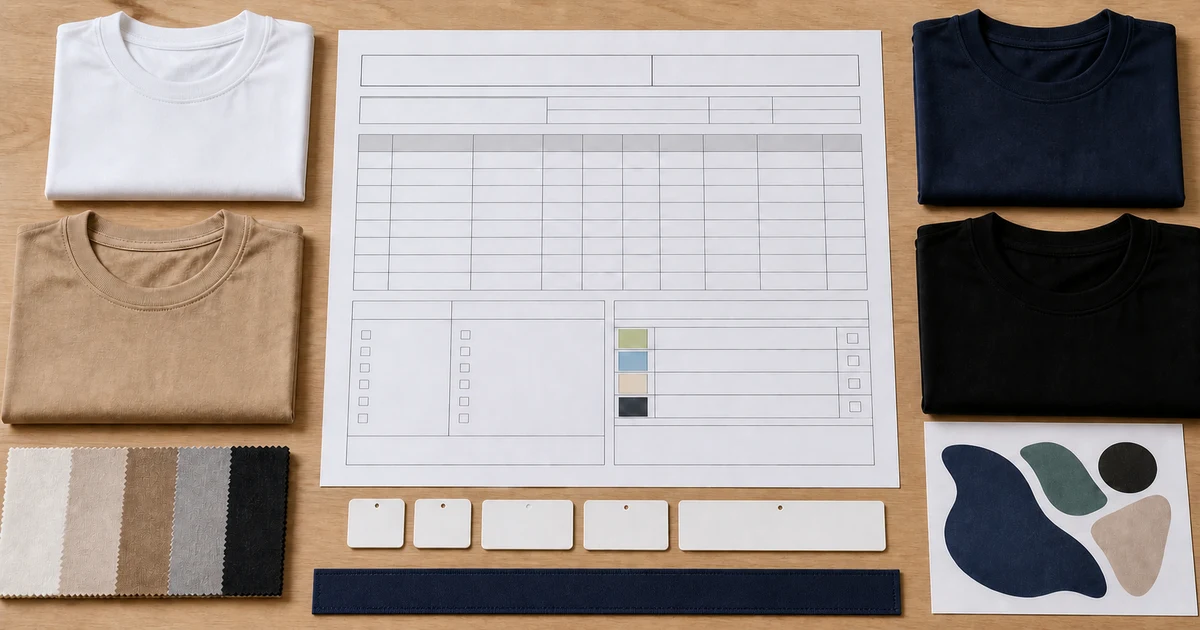
The short answer: a custom T-shirt purchase order should identify the buyer and supplier, link the accepted quotation, list every garment and decoration requirement, reconcile quantities by size, state prices and payment terms, control artwork approval and changes, define delivery and acceptance, and require supplier acknowledgement. A PO number alone does not make an incomplete order production-ready.
Treat the purchase order as the buyer’s control document. It authorises a defined scope; it is not the artwork file, supplier invoice, payment proof or delivery record.
Purchase-order checklist at a glance
| Section | Minimum useful information |
|---|---|
| Document control | PO number, issue date, buyer entity, authorised issuer and currency |
| Supplier | Legal or business name, registration reference, address and contact |
| Source offer | Accepted quotation number, version, date and validity condition |
| Garments | Brand, product code, cut, fabric, colour and size chart reference |
| Quantities | Units by product, colour and size, plus a reconciled grand total |
| Decoration | Method, artwork version, dimensions, positions, colours and setup |
| Approval | Proof or sample required, approver and production-release condition |
| Commercial | Unit prices, setup, extras, delivery, taxes, total and payment milestones |
| Fulfilment | Delivery locations, dates, packing, recipient and partial-delivery rule |
| Control | Attachment list, change process, acceptance terms and supplier acknowledgement |
If your system has a short PO form, place technical detail in numbered attachments and reference them clearly. Do not delete specifications merely to fit one page.
1. Identify the buyer, supplier and document
Include:
- buyer’s legal entity or registered business name;
- billing address and delivery contact;
- PO number and issue date;
- department, cost centre or project code if your company uses them;
- authorised buyer name or approval route;
- supplier’s legal or business name, registration reference, address and contact; and
- transaction currency.
The supplier name should match the accepted quotation and expected invoice. If the payee is different, resolve it before issuing the PO or transferring money.
2. Link the accepted quotation without copying it badly
State the exact quotation number, revision and date. Then define the document order, for example:
- signed contract or agreed terms, if any;
- purchase order and approved changes;
- accepted supplier quotation;
- approved garment and decoration specification; and
- final artwork, size and personalisation attachments.
This hierarchy matters when a quotation says “black cotton tee” but a later approved sheet names a product code and poly-cotton composition. Ask the supplier to acknowledge the complete set, not only the PO cover page.
Use the quotation comparison guide before selecting the offer that the PO will authorise.
3. Name the exact garments
For every garment variant, record:
- brand or supplier and product code;
- T-shirt, polo, jersey, Muslimah or other cut;
- fabric composition and stated GSM where relevant;
- garment colour;
- size-chart version;
- extended-size price difference;
- approved substitution rule; and
- whether the buyer or printer supplies the garments.
“Premium cotton, assorted sizes” is not enough. A different blank can change fit, colour, print feel, opacity and delivery time.
4. Reconcile quantities by product, colour and size
Use one line per meaningful variant. The total of every size line must equal the PO quantity, quotation quantity, production sheet and eventual packing list.
For a multi-branch order, attach a controlled allocation table with:
- branch or recipient code;
- product and colour;
- size quantities;
- personalisation data reference;
- packing method; and
- delivery destination.
Do not put names, phone numbers or addresses into a widely shared PO when a restricted delivery attachment can hold them. The multiple-branch size guide shows how to reconcile branch totals before ordering.
5. Specify the decoration as a production item
For each print or embroidery position, state:
- method: silk screen, DTF, DTG, sublimation, embroidery or another agreed process;
- final artwork filename or version;
- finished width and height;
- position and measured placement reference;
- colour or Pantone reference where relevant;
- underbase, special ink or finish when included;
- names, numbers or other variable-data file; and
- setup, screens or digitising lines.
Attach the production-ready artwork separately. A thumbnail in a PO helps recognition but is not a reliable manufacturing file.
Use the print-size guide when positions still lack measurements.
6. Separate the PO from production release
The PO should say whether the supplier may begin immediately or must wait for:
- deposit receipt;
- stock confirmation;
- final size and name list;
- digital proof approval;
- decorated sample approval; or
- a separate written mass-production release.
For most custom orders, keeping proof approval separate prevents an administrative PO from releasing an outdated artwork file. Name the authorised approver and deadline. The sample approval checklist can become a referenced attachment.
7. Show the complete commercial total
List line items for:
- garments;
- decoration and each extra position;
- artwork preparation, screens or digitising;
- sample or size set;
- extended sizes and personalisation;
- sorting, labels and individual packing;
- delivery by destination;
- discount;
- taxes where applicable; and
- grand total.
Then state the deposit, balance trigger, due dates and document required for payment. Link to the T-shirt printing payment-terms checklist rather than trying to fit all finance procedures into the PO.
HASiL’s current e-Invoice Guideline Version 4.8 describes an e-Invoice as a supplier-buyer transaction record containing item description, quantity, price excluding tax, tax and total. A PO does not replace that supplier document.
8. Define delivery and packing precisely
Record:
- production-complete and required receipt dates;
- collection or courier responsibility;
- full delivery address and authorised recipient;
- cartons, size sorting, labels or individual bags;
- one-location or split-location allocation;
- whether partial delivery is permitted; and
- handling of courier loss, shortage or visible transit damage.
For several sites, put destination quantities into a versioned delivery matrix. The multi-location delivery guide covers packing and recipient controls.
9. Define acceptance and change control
State the agreed inspection period and how the buyer reports:
- shortage or overage;
- wrong garment, colour or size;
- artwork or placement mismatch;
- personalisation errors;
- verified workmanship defects; and
- transit damage.
Do not promise a remedy the supplier has not accepted. Record the process for investigation and possible rework, replacement, reprint, credit or refund.
Any change after PO issue should receive a revision number or change order showing scope, price and schedule impact. Instructions in chat should be copied into that controlled record.
What can private buyers learn from Malaysia’s ePerolehan model?
Private companies are not required to copy a government PO format. However, Malaysia’s official ePerolehan specification guide shows a useful discipline: name the item, unit of measure, quantity, delivery period and specification. The current Treasury ePerolehan procedure also separates order confirmation, fulfilment, receipt, invoice and payment matching.
Use that as a process example, not a claim that government procurement rules apply to your private T-shirt order.
Require supplier acknowledgement
Ask the supplier to confirm:
- the PO and all attachments were received;
- quantities and totals reconcile;
- garment stock position is understood;
- artwork and sample status are correct;
- payment and delivery milestones are accepted; and
- production will stop for any unapproved substitution or material change.
Save the acknowledgement with the accepted quotation and approvals. A clear PO reduces ambiguity only when both sides are working from the same version.
You can request comparable quotations through Baju Printz or browse Malaysian T-shirt printers. Once a supplier is selected, turn the accepted quote into this controlled PO instead of forwarding a chat summary.
Frequently asked questions
What information must be on a custom T-shirt purchase order?
Include buyer and supplier identities, PO number and date, accepted quotation reference, exact garments, quantities by size, decoration specification, artwork and approval references, unit and total prices, taxes where applicable, payment milestones, delivery details and authorised acknowledgement.
Is a purchase order the same as a quotation?
No. The supplier's quotation is an offer for a defined scope, while the buyer's purchase order authorises an order. The PO should reference the accepted quotation and state which document controls if the two conflict.
Should artwork be attached to the purchase order?
Reference the final artwork filename or version and attach the approved proof or technical sheet. Do not rely on an image pasted into the PO because it may not preserve print dimensions, colour references or production-ready data.
Does issuing a purchase order mean production can start?
Only if the written terms say so and all start conditions are complete. A safer order separates PO issue, deposit receipt, stock confirmation, final data lock, sample or proof approval and mass-production release.
Can a purchase order replace an invoice?
No. A PO records the buyer's order authorisation; an invoice or e-Invoice records the supplier's transaction and amount due. Keep the PO, invoice, payment record and delivery evidence under the same reference.
Ready to compare suitable printers?
Get 5 Free Quotes