
T-Shirt Printing Payment Terms: Deposit, Balance and Invoice Checklist
Structure a Malaysian T-shirt printing deposit, balance milestones and payment documents without relying on one risky percentage rule.
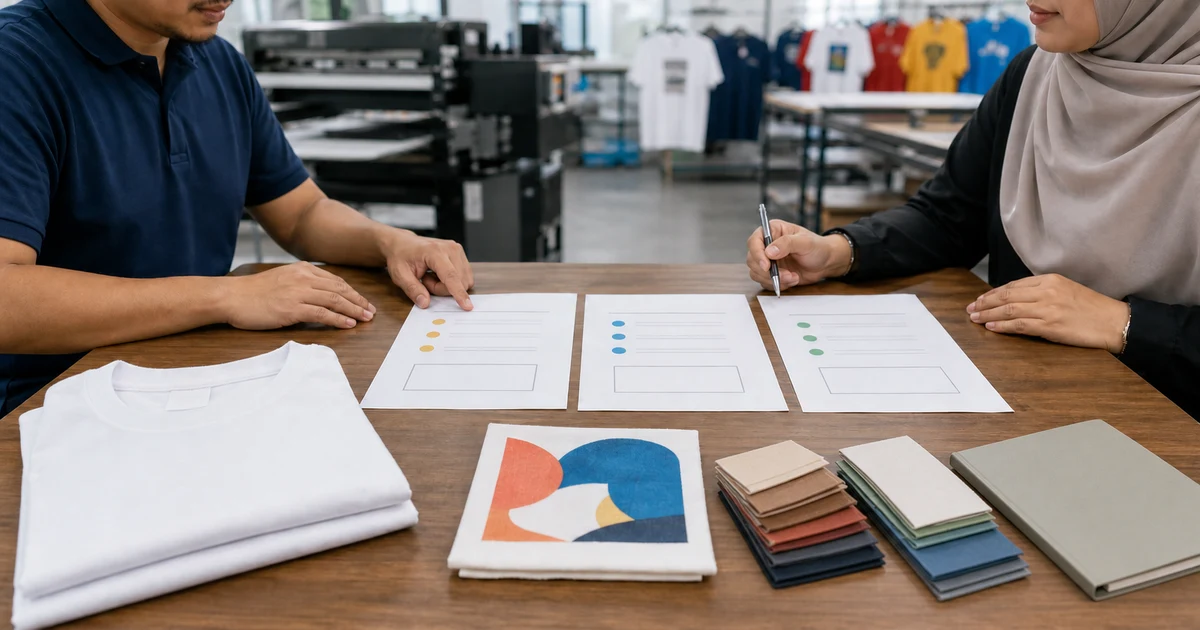
The short answer: use T-shirt printing payment terms that connect every payment to a named milestone, document and piece of evidence. There is no universal Malaysian deposit percentage. The safer structure states what the deposit authorises, what must happen before production, what releases the balance, which changes cost extra and which invoice or receipt the supplier will issue.
Payment, artwork approval and production release should be three separate records. A transfer should never silently approve the wrong artwork or an unfinished size list.
A practical payment-term structure
| Stage | Buyer should receive or confirm | Payment wording should define |
|---|---|---|
| Before deposit | Final quotation, supplier and payee, garment scope, artwork route, total and key dates | Deposit amount, purpose, refundability and expiry |
| After deposit | Receipt or invoice, stock status and sample or proof schedule | Work authorised by the deposit and what remains blocked |
| Before mass production | Final size list, artwork version and written proof or sample approval | Separate production-release milestone |
| Before balance | Agreed completion evidence, quantity or QC summary, packing and delivery status | Exact event that makes the balance due |
| After final payment | Payment document, final invoice status and delivery records | Treatment of shortages, accepted defects, credits or refunds |
This is a control sequence, not a rule that every order must have five payments. A simple local order may use two. A multi-branch uniform order may need more milestones. Use only the stages that carry real risk.
What must the deposit clause say?
Do not write only “50% deposit” or “deposit required”. Record:
- the amount and due date;
- the quotation or purchase-order reference;
- whether it reserves stock, buys garments, prepares screens, digitises embroidery or funds a sample;
- the date until which stock or price is held;
- whether artwork approval is separate;
- what happens if the buyer delays sizes or approval;
- what part, if any, becomes non-refundable and why; and
- how cancellation, quantity reduction or garment substitution is calculated.
The amount should be understandable against the supplier’s exposure. A printer buying a special garment or completing custom screens carries different committed cost from a supplier holding standard stock without starting production.
Use the 15 questions before paying a printing deposit for the supplier and order checks that come before this payment structure.
Keep payment separate from approval
A safe order records at least these events independently:
- deposit received;
- stock reserved or ordered;
- final sizes and personalisation data locked;
- digital proof or physical sample approved; and
- mass production released.
This prevents an accounts team from transferring money while a marketing team is still correcting artwork. Name one authorised approver and one production-release channel. If a WhatsApp message is allowed, save it under the same order reference rather than leaving approval inside a personal chat.
The sample approval checklist explains what a digital proof, fitting sample and decorated production sample can each prove.
When should the balance become due?
The correct trigger is the one both parties accepted before work began. Common triggers include:
- final sample approval;
- confirmed production completion;
- buyer inspection at collection;
- before courier dispatch;
- delivery to one named address; or
- accepted receipt after an agreed inspection window.
Avoid vague phrases such as “balance before delivery”. Does delivery mean before the printer books a courier, before the parcel leaves the factory or after the buyer receives it? Name the event and evidence: dated completion photos, packing list, collection inspection, courier tracking or signed delivery record.
If full payment is due before dispatch, the buyer still needs written shortage, wrong-specification and verified-defect procedures. If payment follows receipt, the buyer should not delay it for issues outside the agreed acceptance criteria. Use the bulk delivery inspection guide to define a realistic receiving check.
How are changes and extra charges paid?
Late changes to quantity, sizes, garment colour, artwork, names, packing or address should not appear as an unexplained final balance. Require a written change that states:
- the old and new scope;
- additional or reduced amount;
- tax treatment where applicable;
- effect on deposit and balance;
- effect on the delivery date; and
- person authorising the change.
The supplier may issue a revised quotation, debit note, credit note or other appropriate transaction document. HASiL’s current e-Invoice Guideline Version 4.8 describes invoices, credit notes, debit notes and refund notes as distinct transaction records. The correct tax document depends on the actual transaction and supplier position; obtain accounting advice where needed.
Does a refundable deposit need an e-Invoice?
HASiL’s official general e-Invoice FAQ updated 5 May 2026 states that an e-Invoice is not required for a refundable deposit, while a non-refundable deposit requires one. That is an e-Invoice treatment; it does not decide whether your commercial deposit is refundable or settle a contract dispute.
Malaysia’s e-Invoice rollout and exemptions have changed over time. The official implementation timeline was updated on 30 August 2026, so do not assume every printer has the same implementation status. Ask what document the supplier will issue and have your finance team check the current HASiL position.
Invoice and receipt checklist
Before paying, ask the supplier’s document to show the information relevant to your transaction:
- supplier legal or business name and contact details;
- buyer name and required billing details;
- invoice or receipt number and date;
- quotation and purchase-order reference;
- garment, decoration, setup, sample, packing and delivery lines;
- quantity, unit price and line total;
- discount and tax treatment where applicable;
- grand total, amount already paid and balance outstanding;
- payment due date or milestone;
- consistent payee or bank-account instructions; and
- validated e-Invoice identifier where one is issued.
HASiL’s Version 4.8 guideline describes an e-Invoice as containing seller and buyer details, item description, quantity, price excluding tax, tax and total. A purchase order or transfer screenshot does not replace the supplier’s transaction document.
For purchases covered by Malaysia’s Consumer Protection Act 1999, section 140 includes receipt requirements and particulars. Check the official KPDN copy of Act 599 for scope and wording. Business purchases and contracts may involve different rights, so this guide is not legal or tax advice.
Verify the payee before every material transfer
Use the bank account stated in the accepted document. If account details change, verify the instruction through a known supplier contact, not only the message announcing the change. Compare the account-holder name with the quoted business and keep the transfer record.
Do not split a company payment across unrelated personal accounts without a documented reason approved by your finance process. A traceable transfer proves that money moved; it does not prove artwork approval, delivery or final acceptance.
Save one payment-control pack
Keep these under one order reference:
- accepted quotation and purchase order;
- supplier and payee verification;
- deposit and balance terms;
- payment instructions and transfer records;
- receipts, invoices or validated e-Invoices;
- final size and personalisation files;
- proof or sample approval;
- production-release message;
- change confirmations; and
- packing, delivery and inspection records.
Before comparing terms, make sure every supplier is pricing the same total with the fair quotation comparison guide. You can then request comparable quotes through Baju Printz or browse Malaysian printers and apply the same payment checklist to each shortlisted supplier.
Frequently asked questions
How much deposit should I pay for T-shirt printing?
There is no universal percentage for every order. Agree an amount that reflects stock being committed, custom setup and completed work, then state what the deposit authorises and when any part becomes non-refundable.
Should the balance be paid before or after T-shirt delivery?
Use the written term agreed before production. The balance trigger may be sample approval, production completion, collection, dispatch or accepted delivery; name the exact event and evidence instead of using only “before delivery”.
Does paying a deposit approve the artwork?
Not unless the agreement explicitly says so, and combining the two is risky. Treat payment received, artwork approved and mass production released as separate written milestones.
What document should a printer issue after payment?
Ask for a receipt, invoice or validated e-Invoice where applicable that identifies the supplier, date, amount, order reference and payment status. Keep it with the accepted quotation, proof approval and transfer record.
Is a T-shirt printing deposit refundable?
Refundability depends on the written commercial terms and work or materials already committed. Do not infer it from the word deposit; state the cancellation calculation and obtain advice for a disputed or high-value contract.
Ready to compare suitable printers?
Get 5 Free Quotes