
Custom Kids’ T-Shirts Malaysia: Safety, Sizes and Fabric
Choose custom kids’ T-shirts by safe construction, exact product sizing, suitable fabric, verified claims and wash-tested printing.
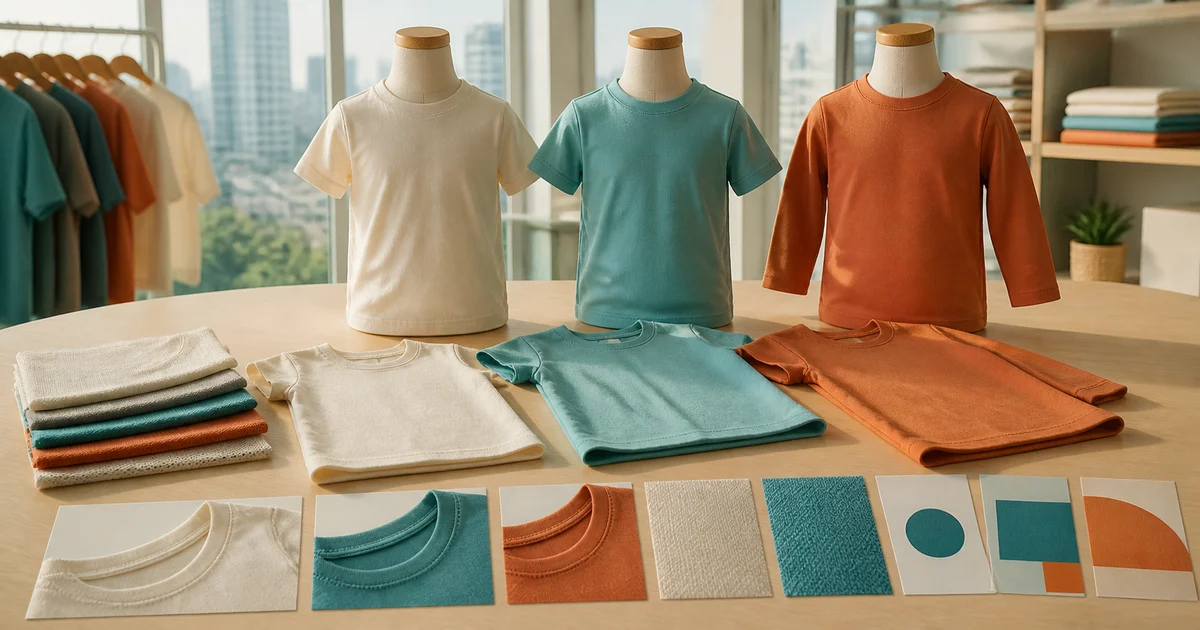
The short answer: choose a custom kids’ T-shirt by locking the exact child-size garment, simplifying anything that could become loose or irritating, checking the fabric for the activity, verifying any safety or certification claim, and wash-testing the fully printed sample before a bulk order.
Do not treat “kids’ tee” as one standard product. A preschool activity shirt, a primary-school sports tee and a youth club shirt involve different sizes, movement, care and supervision. Start with the actual wearers and use case.
Kids’ T-shirt approval checklist
| Decision | What to record or inspect | Do not approve when |
|---|---|---|
| Intended wearer | Age range, activity, indoor or outdoor use | The supplier only knows “children” |
| Garment | Product code, construction, fibre, GSM and colour | A substitute may be used without approval |
| Safety | Seams, labels, trims, attachments and print surface | A part is loose, sharp, rough or easily detached |
| Size | Exact chart, measurement basis and fitting sample | Size is guessed from age or another brand |
| Decoration | Method, ink or transfer, dimensions and placement | Claims are undocumented or the print is peeling |
| Care | Wash method, dimensional change and care instructions | The final decorated sample has not been tested |
This is a buyer’s practical check, not a declaration that one garment satisfies every child or application.
Begin with Malaysia’s general product-safety baseline
KPDN’s mySAFE product-safety guidance summarises Part III of Malaysia’s Consumer Protection Act 1999 and states that products supplied, offered or advertised must be reasonably safe for their nature and intended use. A school, event organiser or parent should therefore give the printer enough information to choose and produce an appropriate article.
Tell the supplier whether the shirts are for:
- babies or toddlers;
- preschool or primary pupils;
- older children or teenagers;
- seated classroom use;
- sports, camp or outdoor activity; or
- one-day distribution versus repeated uniform wear.
A product suitable for an older supervised group is not automatically suitable for a toddler.
Keep the garment and decoration simple
For a standard event tee, simplicity removes avoidable inspection problems. Prefer secure seams and flat, well-finished decoration. Check the complete sample for:
- loose buttons, badges, toggles, cords or decorative pieces;
- sharp zip, fastener or label edges;
- rough neck tape, side seams or backing against the skin;
- an unstable collar or sleeve opening;
- print film that lifts, cracks into loose pieces or feels abrasive; and
- residue, strong unexpected odour or visible contamination.
This does not mean every transfer, embroidery or sewn label is unsuitable. It means every added component must be appropriate for the wearer, securely attached and included in the approval. If the design does not need a detachable feature, leaving it out is the lower-risk choice.
Verify “non-toxic”, “safe” and certification claims
Do not accept an unsupported phrase such as “child-safe ink” as the whole evidence. Ask for the manufacturer, product or certificate reference, its validity and the article it covers.
OEKO-TEX STANDARD 100 is one voluntary textile certification buyers may encounter. Its Product Class I covers products for babies and children up to three years and has the strictest requirements; Product Class II covers articles with direct skin contact. The official site also provides a Label Check for certificate numbers.
Scope matters. The current STANDARD 100 rules say a certificate scope identifies the certified article, composition, processed state, printing technique, colourants and accessories. A certified blank does not automatically prove that a later ink, transfer, label or trim is included.
Certification is not a substitute for checking the delivered product. If the supplier makes no certification claim, ask what material and process records support its safety statement and obtain an appropriate sample.
Choose sizes from the exact kids’ chart
Never convert age directly into a universal shirt size. Malaysian supplier ranges illustrate why: current kids’ catalogues can use numbered sizes while adult and youth products use different scales. CUSTA’s current kids’ T-shirt category also separates cotton, quick-dry and long-sleeve products, each with its own product chart.
For each child, use one of these methods:
- try the exact product in a fitting sample;
- measure a similar well-fitting shirt flat; or
- compare the product chart using the supplier’s stated points.
Check chest width, body length, shoulder width, sleeve length and neck opening. Leave enough room for normal movement without choosing an unnecessarily long or loose garment that interferes with the activity.
Keep kids, youth and adult products as separate subtotals. The Malaysia bulk T-shirt size guide explains how to collect named choices without mixing charts.
Match the fabric to the activity
Fabric choice should balance skin feel, heat, sweat, opacity, durability and care.
Cotton is a sensible starting point for classroom activities, family events and casual daily wear. Inspect shrinkage, wet feel, colourfastness and whether the seams remain comfortable after washing.
Quick-dry polyester or microfibre is often more practical for sports days, camps and active outdoor programmes. Check airflow, cling when damp, surface texture, odour retention and heat sensitivity during printing.
Blends can balance drying, shape retention and a familiar hand feel, but the fibre percentages and knit still need to be stated.
For Malaysian heat and humidity, a lighter fabric is not automatically better if it becomes transparent, clingy or unstable. Compare real samples under daylight and during movement. The cotton versus dry-fit guide provides a fuller activity-based comparison.
Scale artwork for the smallest shirt
An adult print size can overwhelm a small kids’ tee or run too close to a seam. Approve the artwork on the smallest and largest garments in the order.
Ask the printer to state:
- physical artwork width and height;
- distance from the collar or another fixed reference;
- whether one print size will be used for every garment;
- the maximum area available on the smallest size; and
- whether kids and adult garments need separate production setups.
A large solid print may also feel less flexible than a small mark, especially on a light shirt. Handle and bend the actual sample instead of judging the mockup only. Use the print-size approval guide as a starting method, not as an adult dimension to copy blindly.
Wash-test the finished sample and label the care
Test the garment after the final print, embroidery, label and trim are applied. Agree on a realistic domestic wash and drying method, then compare:
- chest and body dimensions;
- neck and seam shape;
- print adhesion and surface;
- colour transfer or fading;
- loose components; and
- remaining comfort against the skin.
ISO 6330:2021 specifies domestic washing and drying procedures for textile testing, while ISO 5077:2007 covers determining dimensional change. These standards show why the wash and drying procedure must be stated rather than simply promising “washable”.
Give parents or wearers clear care information. ISO 3758:2023 establishes the international care-symbol system for the most severe treatment that does not cause irreversible damage to a textile article.
Send a child-specific quotation brief
Include the wearer age range, activity, garment code, size breakdown, fabric, colour, decoration, sample requirement, documented claims, care information, delivery postcode and required date. For a school order, follow the approval workflow in the custom class T-shirt guide.
When the specification is complete, request kids’ T-shirt quotations through Baju Printz. Compare suppliers against the same child-specific brief rather than the lowest price for an unspecified “kids’ shirt”.
Frequently asked questions
What is the safest printing method for a kids’ T-shirt?
No printing method is automatically safest. Approve the exact decorated garment, verify any material or ink claim with current documentation, check that the print is properly cured and smooth, and reject peeling, loose or sharp components.
Can you choose a kids’ T-shirt size by age?
Age can be a catalogue label, but it is not a reliable fit measurement across brands. Use the chart for the exact product code and let the child try a sample or compare it with a well-fitting shirt.
Is cotton or quick-dry fabric better for children?
Cotton is a sensible starting point for casual, lower-activity wear, while quick-dry polyester or microfibre often suits sports and sweaty outdoor use. The actual knit, weight, seams, opacity and wash result matter more than the category name alone.
Does an OEKO-TEX certificate cover the finished printed shirt?
Only if the current certificate scope identifies the relevant article, components and processed state. Check the certificate number, product class and scope; certification for a blank fabric or garment should not be assumed to cover a later print or accessory.
Ready to compare suitable printers?
Get 5 Free Quotes