
How Do You Order Custom Aprons for Café and Restaurant Staff?
Choose bib or waist aprons for a Malaysian café or restaurant, then specify fit, pockets, logo placement, wash care and a decorated sample.
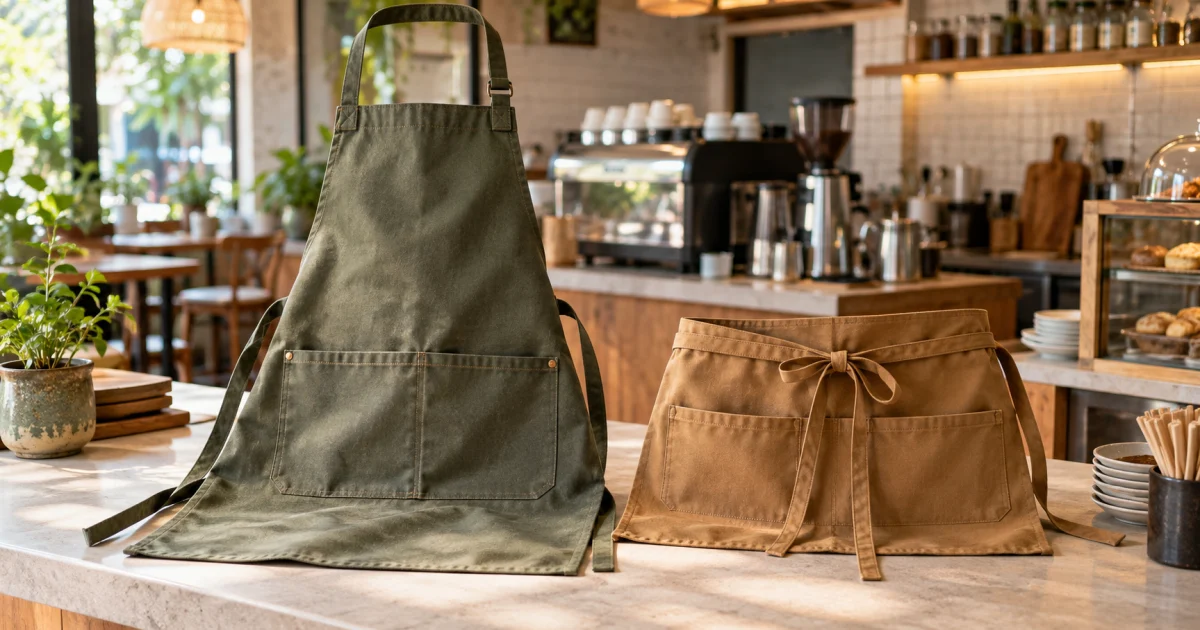
The short answer: order aprons by work, coverage and fit first, then add the logo. A full-bib apron covers the torso; a waist apron leaves the upper body free. For a Malaysian café or restaurant, choose a precise model, try it during real tasks, and approve one decorated sample after the intended wash before ordering for the whole team.
An apron is one part of a uniform, not a shortcut around food-handling rules. Our restaurant uniform guide explains why the restaurant’s food-safety owner must decide the complete clothing arrangement for each role. This article focuses on the apron specification you can send to suppliers.
Match apron coverage to the actual job
| Apron choice | Useful starting point | Check on a worn sample |
|---|---|---|
| Full bib | You need coverage over the upper body and waist | Bib height, neck comfort, reach, upper logo visibility and whether a pocket interrupts the print area |
| Waist or half apron | The upper garment can remain visible and the apron mainly serves the waist area | Tie length, pocket access, hem length, movement and whether the shirt beneath meets the role’s requirements |
| Cross-back or adjustable-neck version | Different wearers need a more adaptable fit | Strap adjustment, pressure on neck or shoulders, loose ends and replacement parts |
These are buying choices, not a claim that any style is certified protective equipment. Malaysian supplier Arte Uniform lists half, full and canvas apron models with different dimensions. Yally Garment lists bib, waist and cobbler styles, plus loop-neck and cross-back options. That variety is why “black apron with logo” is not enough for a comparable quote.
If the wearer handles food, confirm the applicable garment requirements with the premises’ food-safety owner before approving a dark fashion apron or a waist-only option. The Ministry of Health’s Food Hygiene Regulations 2009 page is the regulatory starting point; the current official text and your compliance process govern the final choice. Do not describe an ordinary promotional apron as heat-resistant, flame-resistant, antimicrobial or food-safe without evidence for that exact product.
Specify fit, pockets and fabric as part of one model
Ask for an exact product code, not a generic “free size”. On a sample, record apron width and length, bib height, neck adjustment, tie length, pocket positions and fabric composition. Have wearers of different builds tie and untie it, reach across a counter, bend, carry a tray and retrieve a tool from the pocket. Check whether a loose tie approaches food or equipment and whether the apron remains secure without uncomfortable pressure.
Real products show why these details matter. GreenChef’s Malaysian bib apron lists two sizes, an adjustable neck and a right-side pocket. IKEA Malaysia’s SANDVIVA apron lists an adjustable neck band, pockets, fabric composition and care instructions. These are examples of specifications to check, not BajuPrintz stock promises or a recommendation to substitute one maker’s measurements for another’s.
Choose a fabric and care label your laundry routine can actually support. Ask the supplier for the exact garment’s written wash and drying instructions. A cotton-rich, polycotton, canvas or twill label alone does not prove stain removal, shrinkage, comfort or logo durability. If kitchen and service teams use different wash processes, quote the aprons separately rather than forcing one specification onto both.
Place the logo where the apron stays flat and visible
Decide whether the logo needs to be visible above a bib pocket, on a lower panel, or on the shirt beneath a waist apron. Measure the decoration from fixed points on the actual apron, and mark the pocket opening, straps, seams and likely folds on the proof. A digital mock-up of a flat rectangle cannot show how a tie changes the apron when worn.
For a printed design, the supplier may need a safe distance from cut edges and stitching. Custom.my’s Malaysian apron listing states a product-dependent gap between the design and pattern edge and recommends a bulk-order sample. Treat its stated tolerance as that supplier’s specification, not a universal BajuPrintz rule. For embroidery, ask for a sew-out on the chosen fabric and check whether dense stitching pulls or stiffens a small bib panel. Our pockets, seams and zips guide explains why decoration near a raised edge needs extra scrutiny.
Printing and embroidery are both offered by local apron suppliers such as Arte Uniform. Neither is automatically best. Compare the final logo’s detail, feel, care requirements, and cost on the exact model. The uniform embroidery-versus-printing guide helps frame that discussion, but the apron sample decides.
Approve a decorated and washed sample before the bulk order
Give every supplier the same brief:
- exact apron code or pattern, bib/waist style, colour, fabric and dimensions;
- neck or cross-back construction, waist ties, pocket count and pocket position;
- quantities by model, size and colour, including any replacement allowance;
- logo source file, final width and height, position measured from fixed points, and proposed print or embroidery method;
- the wash process, the person approving the physical sample, and any required revision; and
- packing, delivery postcode and the date the aprons must be in hand.
Photograph the decorated sample laid flat and worn. Check the logo from a normal customer distance, then wash it by the intended method and inspect colour, shape, ties, pocket, print or stitching. A sample that passes only a screen proof is not approved for daily service. Use the sample approval checklist to record the version, decision and any correction.
For a comparable quote, send BajuPrintz the apron brief and ask each supplier to confirm the same model, decoration and sample stage. If a model or fabric changes later, approve the new decorated apron again before releasing bulk production.
Frequently asked questions
Should café staff order bib or waist aprons?
Choose by the job and required coverage, not appearance alone. A bib covers the upper body as well as the waist; a waist apron leaves the upper body uncovered. Have the food-safety owner approve the complete uniform for food-handling roles.
Where should a logo go on a custom apron?
Choose a flat, visible area on the exact apron model, away from pocket openings, seams, straps and folds. Approve the final-size logo on a worn, decorated sample before a bulk order.
Is embroidery always better than printing on an apron?
No. The suitable method depends on the apron fabric, logo detail, position and intended washing. Ask the supplier to test the proposed method on the exact apron and inspect a washed sample.
What should be included in an apron quotation request?
Specify the apron model and fabric, bib or waist style, dimensions, ties, pockets, colours, quantities, logo file and size, decoration position, sample approval, washing requirements and delivery details.
Ready to compare suitable printers?
Get 5 Free Quotes