
Puff, Reflective and Glow Prints: Are Special Effects Worth It?
Decide whether puff, reflective or glow decoration is worth the extra sampling, artwork limits and production control for custom shirts.
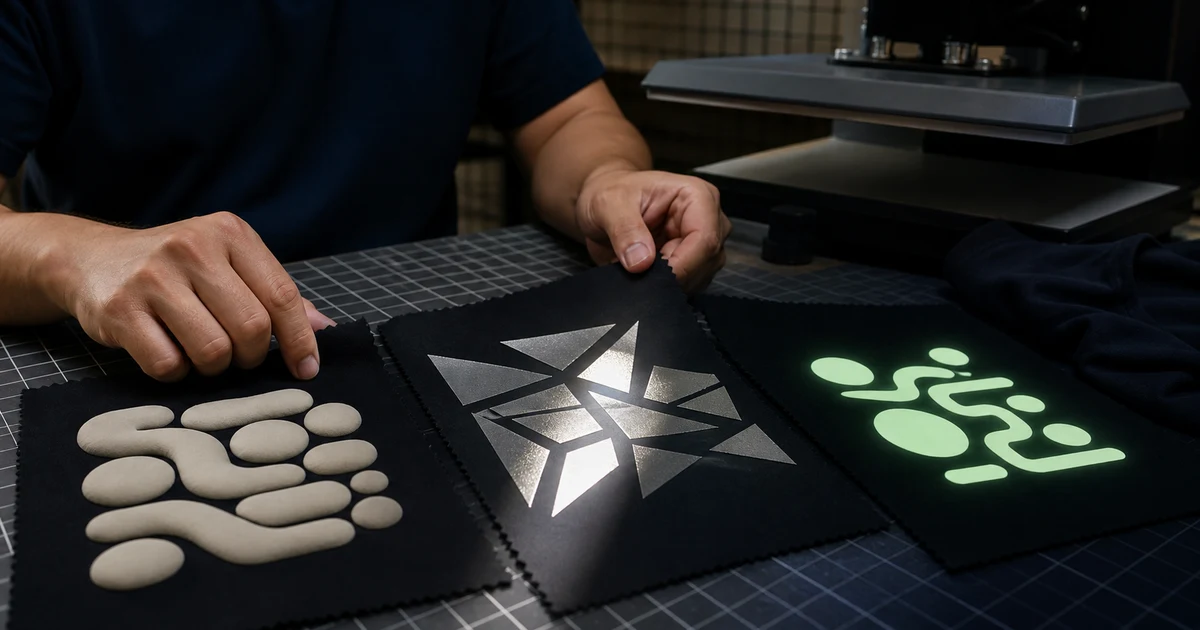
The short answer: special-effect printing is worth it only when puff texture, reflected light or after-dark glow has a clear job in the design. Use the effect as a controlled accent, approve a final-size sample on the actual garment, and do not pay extra for an effect that will not be seen in the shirt’s real setting.
“Puff”, “reflective” and “glow” describe visual effects, not one universal production method. A supplier may offer a screen-printing ink, additive, heat-transfer film or another system. Ask what exact product and process is included before comparing prices or performance.
Which special effect fits the intended result?
| Effect | Best starting use | Main artwork limit | Approval test |
|---|---|---|---|
| Puff | Raised tactile focal point on bold lettering or simple shapes | Expansion can soften fine detail and change edges | Side view, touch, compression and wash check |
| Reflective | Decorative marks that return light when illuminated | Appearance changes strongly with light angle and source | Normal light plus directional-light test |
| Glow in the dark | Novelty or event accent visible after charging and in darkness | Glow colour, brightness and duration vary by product and construction | Defined charge time, dark-room viewing and timed check |
The “best” effect depends on the moment you want the wearer or viewer to notice. Puff is mainly tactile and visible in ordinary light. Reflective decoration reacts to incoming light. Glow material must first be exposed to light and then viewed in darkness.
Use puff when texture is the design
Puff ink expands during curing to create a raised surface. Avient’s NuPuff technical bulletin describes a raised texture and notes that mesh, stencil, passes, flashing and overprinting can change the effect. That means the same flat artwork can look different after expansion.
Puff works best as a deliberate, reasonably simple element rather than a substitute for every normal ink area. Before approval, inspect:
- final height and edge shape;
- small gaps and counters inside letters;
- consistency across a larger print area;
- surface after bending or light compression;
- interaction with seams or stretch zones; and
- the printer’s wash-tested reference.
Do not specify the printer’s mesh, cure temperature or additive percentage unless you control its complete ink system. State the appearance and acceptance standard you need, then let the production team use the current manufacturer data for its product.
Use reflective decoration for a light-reactive visual—not an automatic safety claim
Reflective ink or film can appear restrained in normal conditions and brighten when light returns towards the viewer. This can create a strong event, streetwear or logo accent, but results vary with the material, light source, angle, print coverage and garment movement.
Test the finished shirt twice: first under ordinary room or daylight, then with the intended directional light. Photograph it only as a reference because phone exposure can exaggerate the effect. Approve what is acceptable to the eye at a stated distance and angle.
Most importantly, do not describe a decorative reflective print as certified high-visibility clothing without evidence for the complete garment. ISO 20471:2013 covers colour, retroreflection, minimum material areas and placement for high-visibility protective clothing. A small reflective logo alone does not demonstrate those requirements.
If visibility is safety-critical for road crews, runners, cyclists or event marshals, request the applicable certified garment, material evidence, design assessment and conformity documents. Treat visual branding as separate from personal protective equipment.
Use glow ink when the viewing environment can support it
Glow-in-the-dark decoration is phosphorescent: it is exposed to light, then produces an afterglow in a darker environment. Avient’s Glow-in-Dark technical bulletin shows that products can differ in intensity and duration, and that a light underbase can improve the result on dark fabric.
Avoid a vague promise such as “glows all night”. Instead, define a repeatable sample check:
- use the production garment and final print construction;
- expose it to an agreed light source for an agreed time;
- move it to the intended dark environment;
- inspect immediately and again after agreed intervals; and
- record the acceptable colour and visibility.
Glow is most useful where the audience will actually experience darkness after the design has received enough light. It may add little value to a daytime corporate uniform or continuously bright indoor event.
Keep the artwork simpler than a normal flat print
Special effects change the surface or the way light behaves. Fine distressed textures, tiny text and several overlapping effects can make the result hard to predict. Start with one focal area and leave ordinary colour areas to a suitable standard method.
Prepare the artwork with:
- the effect layer clearly named;
- solid vector shapes where practical;
- finished dimensions in centimetres;
- minimum gaps and line weights confirmed by the printer;
- a separate normal-colour visual reference; and
- no unsupported assumption that the screen preview equals the physical effect.
Use the t-shirt artwork file guide to hand over clean production files. If multiple methods are combined, identify which layer is screen printed, transferred or applied later.
Compare the full cost, not only the ink surcharge
The effect itself may not be the only added cost. Ask whether the quotation includes:
- special material or ink;
- additional screens, layers or application steps;
- artwork separation or setup;
- a decorated sample;
- extra curing or press handling;
- replacement testing for rejected samples;
- individual packing or protective sheets; and
- repeat-order matching.
The effect is easier to justify when one controlled accent creates the intended result. It is harder to justify when the job adds several uncertain layers, a late approval cycle and no real viewing condition.
Approve the garment, effect and viewing condition together
A loose ink card or film swatch cannot prove the final result. Request one sample on the exact garment model and colour. Check normal appearance, surface feel, stretch or compression where relevant, surrounding heat marks and the intended special-effect behaviour.
For a bulk order, keep the signed or photographed master sample and compare the first production pieces before all garments are packed. The t-shirt sample approval checklist gives a practical record for artwork, placement, colour, feel and defects.
Care instructions must match the supplied system. Use the supplier’s instructions rather than assuming every puff, reflective or glow product can be washed and dried identically. The printed-shirt washing guide helps you communicate care after delivery.
Send a special-effect quotation brief
Include the garment, fabric, colour, quantity, artwork, marked effect layer, finished size, position, viewing condition, sample test, acceptance deadline and delivery date. Baju Printz lets you request quotations from Malaysian printers or browse printers by location.
Ask each supplier to name the exact effect system it proposes. Then compare the sample and documented scope—not three quotations that all use the word “reflective” for different materials.
Frequently asked questions
Is puff printing worth it for a t-shirt design?
Puff can be worth it when raised texture is a deliberate focal point in a bold, reasonably simple design. Approve the actual expansion, edge shape, thickness and wash behaviour because fine detail and broad coverage may not reproduce as expected.
Does reflective printing make a shirt safety compliant?
No. A decorative reflective logo or transfer does not by itself prove that a garment meets a high-visibility clothing standard. Safety garments require the relevant certified materials, minimum areas, placement, garment design and conformity evidence.
How does glow-in-the-dark printing work?
Glow decoration uses phosphorescent material that absorbs light and releases visible afterglow in darkness. Brightness, colour and duration depend on the exact product, charge conditions, print construction and viewing environment.
Can puff, reflective and glow effects be combined in one design?
They may be combined when the chosen products and layer sequence are compatible, but every extra effect adds artwork, curing, alignment and approval risk. Ask the printer to test the complete stack on the actual garment.
What sample should I request for a special-effect print?
Request a decorated sample at final size on the exact garment, using the proposed production system. Inspect it in normal light and the intended viewing condition, then agree on texture, colour, visibility, feel and care acceptance.
Ready to compare suitable printers?
Get 5 Free Quotes