Can You Print Copyrighted Logos or Characters on T-Shirts in Malaysia?
Know when permission is needed to print logos, characters, crests or online artwork on T-shirts in Malaysia, and what evidence to give the printer.
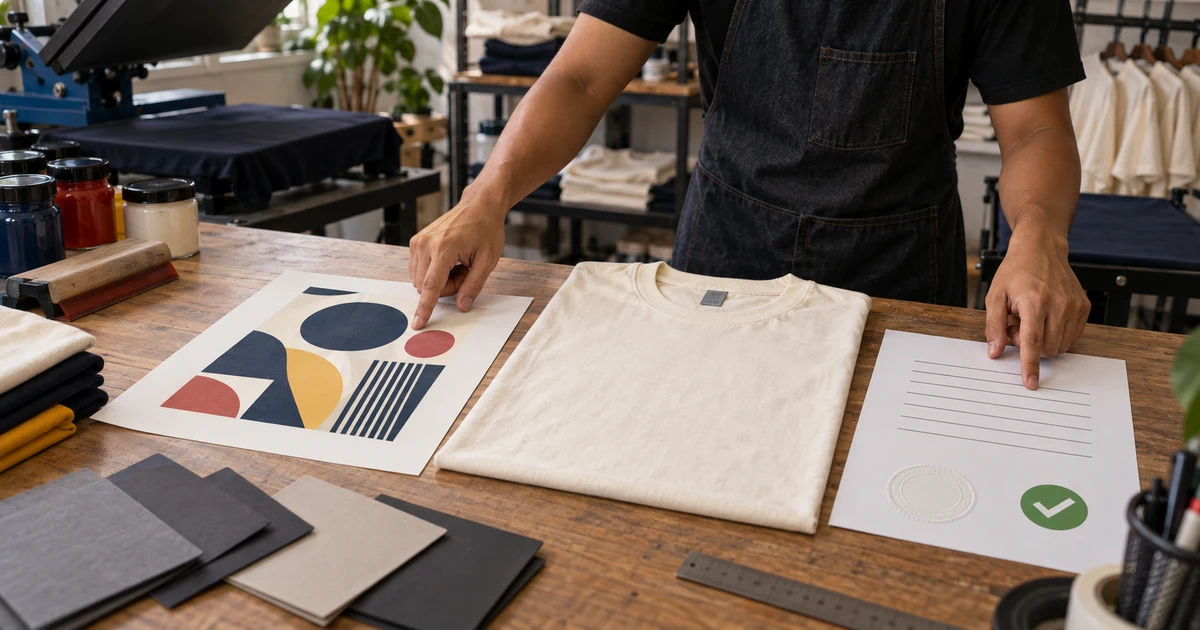
The short answer: generally, do not print a recognisable third-party logo, character, crest or illustration unless you own the relevant rights or have written permission or a licence that covers the exact T-shirt use. A small run, personal event, school activity or “not for sale” label does not automatically make the artwork safe to reproduce.
Copyright and trademark are different rights and can overlap in one design. A character illustration may be protected as an artistic work. A company logo can also function as a trademark that identifies the source of goods or services. This guide is a practical order-control checklist, not legal advice; ask a Malaysian intellectual-property professional about disputed or high-value use.
Use this first decision table
| Artwork source | Practical decision before printing |
|---|---|
| Your own original artwork | Keep source files and evidence of who created it; check any third-party elements inside it |
| Your employer’s or client’s logo | Obtain approval from an authorised representative for the exact garment use |
| Sponsor, school, club or event crest | Ask the owner or organiser for written permission and the approved master file |
| Famous character, game art, sports crest or entertainment image | Treat it as third-party protected material unless a valid licence or rights-holder permission proves otherwise |
| Stock, template or design-platform element | Read the current licence for printed products, commercial use, modifications and distribution limits |
| Image found through search or social media | Do not treat the download as permission; trace the source and rights holder |
| Public-domain or openly licensed work | Verify the status, exact version, attribution and other licence conditions before using it |
The printer’s ability to reproduce an image is not evidence that the customer has the right to reproduce it.
Why can one shirt design involve two rights?
MyIPO’s copyright FAQ explains that a copyright owner controls acts including reproduction in material form and distribution of copies to the public. Printing artwork onto a garment is therefore not just a file-format task: it creates another material copy.
The same MyIPO page defines a trademark broadly as a sign that distinguishes one undertaking’s goods or services from another’s. Signs can include words, names, devices, brands, labels, shapes, colours and combinations. A logo printed on merchandise may therefore raise trademark questions even when the artwork also attracts copyright.
You do not need to classify every right yourself before asking for permission. The safer order workflow is to identify anything you did not create or own, find the authorised owner or representative, and obtain approval broad enough for the planned production and use.
Do not assume “personal use” is a blanket exception
MyIPO lists limited fair-dealing purposes such as non-profit research, private study, review and reporting current events, with acknowledgement requirements. Those examples do not create a general rule that any personal, educational, fan, school or non-profit T-shirt is permitted.
Context matters. One shirt for a genuine legal exception is not the same as merchandise for sale, event uniforms, sponsor apparel or a public campaign. Quantity alone does not decide the issue. If the design depends on an exception rather than permission, obtain legal advice before sending it to production.
Avoid common assumptions such as:
- “It is fine because we are not making a profit.”
- “The image had no copyright symbol.”
- “Another seller already prints it.”
- “We changed the colour or redrew part of it.”
- “It is only for students, staff or family members.”
- “The printer accepted the file, so the rights must be clear.”
MyIPO describes Malaysian copyright protection as automatic rather than dependent on compulsory registration. The absence of a registration number, watermark or © notice is therefore not proof that artwork is free to copy.
A search result is research, not permission
MyIPO provides an IP Online search service for records including trademarks and copyright applications. A search can help identify an applicant, proprietor or potentially relevant record. It cannot grant a licence, confirm every unregistered right or prove that an image download is authorised.
MyIPO also notes that trademark registration is not compulsory. An empty result should never be treated as a clearance certificate. Names, images and characters can involve multiple owners, jurisdictions, versions and agreements.
Use search findings to ask better questions:
- Who appears to own or control this exact artwork or mark?
- Is the person giving approval authorised to do so?
- Does the permission cover garments, the intended audience and the planned channel?
- Does it cover Malaysia and the required production dates?
- Can the printer receive the file and make necessary production adjustments?
For material commercial campaigns, obtain a professional clearance rather than relying on a quick database search.
Ask for permission that matches the actual order
“You may use our logo” can be too vague when the order introduces shirts, public distribution and artwork changes. Ask the rights holder or authorised representative to record:
- the exact logo, character, crest or artwork version;
- who is granting permission and their authority;
- the organisation or customer receiving permission;
- the garment type and decoration positions;
- the purpose, event, campaign or staff use;
- whether sale, giveaway or internal distribution is allowed;
- quantity or other scope limit;
- territory, channel and validity dates;
- permitted resizing, colour changes or simplification;
- whether a production supplier may receive and reproduce the file; and
- any proof, sample or final-artwork approval required.
The rights holder may use a formal licence, brand portal, email approval or campaign agreement. The form matters less than whether the record is authentic, specific and sufficient for the intended use. Do not crop a message so narrowly that the authorising identity or conditions disappear.
Separate artwork ownership from file delivery
Receiving a high-resolution PNG, vector logo or brand guide does not by itself prove permission. Conversely, valid permission does not make a low-resolution screenshot suitable for printing.
Run two separate checks:
- Rights check: may this customer and supplier reproduce the artwork for this use?
- Production check: is this the correct approved file, colour version, size and placement?
Use the AI, PDF, PNG and SVG file guide for the production handoff. If the design was assembled in a template platform, the Canva T-shirt artwork guide explains why every library element still needs a licence check.
Build a sponsor and organisation approval pack
Company events, school programmes, club shirts and esports jerseys often combine several marks. One organiser’s approval may not cover every sponsor, publisher, venue or partner.
Create one simple register with:
| Item | Owner or approver | Approved file | Permitted use | Conditions | Status |
|---|---|---|---|---|---|
| Main organisation mark | Named authorised contact | File version | Staff event shirts | Approved colours only | Approved/Pending |
| Sponsor mark | Sponsor contact | File version | Named event | Minimum clear space | Approved/Pending |
| Illustration or character | Rights holder or licensee | File version | Exact quantity/channel | No modification | Approved/Pending |
Do not release production while a required item remains “Pending.” The esports jersey checklist uses a similar sponsor-approval matrix for team apparel.
Give the printer a clear acceptance record
Printers can reduce avoidable risk by applying the same rule to comparable orders. A practical artwork intake asks the customer to:
- identify whether each element is owned, licensed or authorised;
- provide the relevant approval record for third-party material;
- name the person responsible for artwork clearance;
- confirm the final approved file and proof; and
- disclose restrictions on editing, colour, quantity or distribution.
This does not turn the printer into the customer’s lawyer and does not replace the printer’s own terms or legal advice. It creates a checkable trail instead of relying on “the client said it was okay” after production.
If permission is missing, pause that element. Replace it with original artwork, request a properly licensed alternative or remove it from the design. Do not merely trace, mirror, recolour or slightly alter a recognisable protected image and assume the issue has disappeared.
Approve rights and production together
Before paying a deposit, keep one folder containing:
- original source or licence for each non-original element;
- rights-holder permission and all conditions;
- approved master artwork;
- production proof showing size, position and colour;
- garment, quantity and distribution scope;
- approval names and dates; and
- the final supplier quotation.
Reference the folder or approval version in the purchase order. The complete T-shirt printing brief helps keep the artwork, garment and approval route aligned.
Once the rights are documented and the production file is ready, you can request comparable quotations from Malaysian printers and state that third-party artwork approval is available for review.
Frequently asked questions
Can I print a famous logo or cartoon character on a T-shirt in Malaysia?
Do not proceed unless you own the relevant rights, have written permission or hold a licence that clearly covers the planned garment reproduction and use. A personal, school or small-quantity order is not automatically exempt.
Does finding an image online make it free to print?
No. Search results, social posts and marketplace listings do not prove ownership or grant a printing licence. Trace the artwork to its rights holder and retain the permission or licence terms before production.
Is a company logo protected only when it is registered as a trademark?
No. A logo may involve copyright in its artwork as well as trademark rights, and MyIPO notes that trademark registration is not compulsory. Checking a register is useful research, but it is not permission to copy or a complete legal clearance.
Can a printer rely on the customer's statement that permission exists?
A printer should set its own risk controls. For third-party logos, characters, crests and sponsor marks, a practical control is to request written authorisation that identifies the artwork, permitted use, quantity and authorising party before accepting production.
What should written artwork permission include?
It should identify the rights holder or authorised representative, exact artwork, permitted garment and use, quantity or scope, territory or channel, validity period, allowed edits and approval conditions. Keep the complete record with the final proof.
Ready to compare suitable printers?
Get 5 Free Quotes