
Why Do Prints Change Colour on Polyester Shirts? Dye Migration Explained
Learn why polyester dye can tint white or light prints, which garments are higher risk, and what to test before approving a Malaysian bulk order.
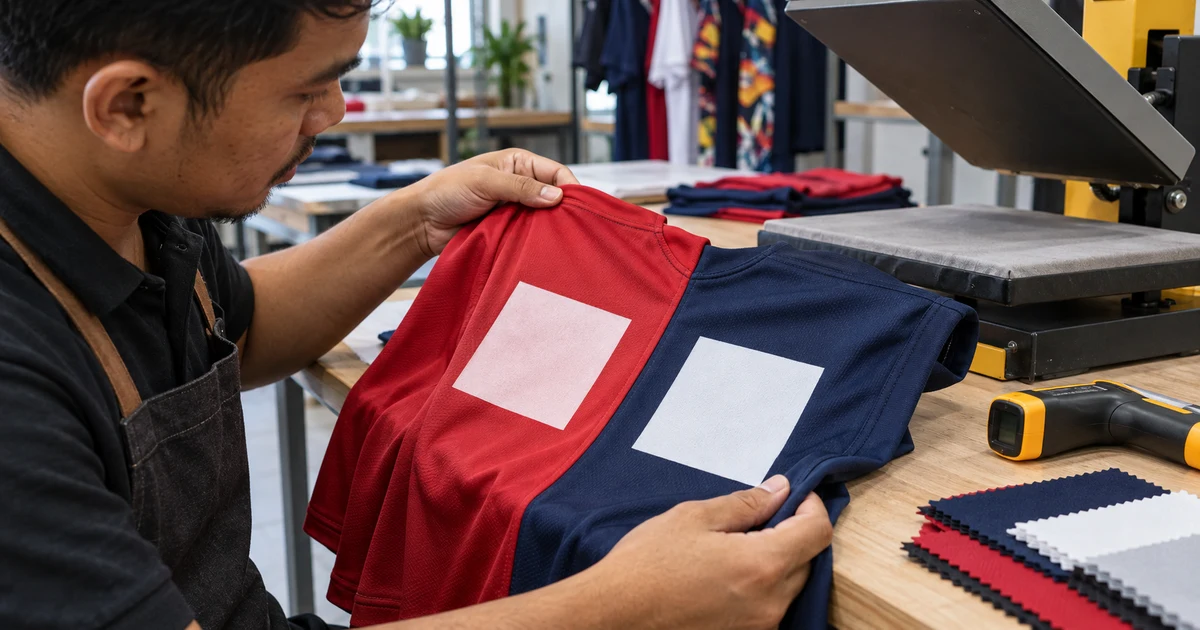
The short answer: a white or pale print can turn pink, red, blue or grey when dye from a polyester shirt moves into the print layer. Heat used for screen-print curing or transfer application can reactivate an unstable garment dye. The colour may appear immediately or only after the sample cools and rests.
This problem is called dye migration or colour bleed. It does not mean every polyester shirt is unsuitable for printing. It means the printer must test the exact garment, colour and decoration system instead of applying one standard recipe to every “quick-dry” shirt.
What dye migration looks like
The clearest warning is a light graphic that develops the shirt’s colour. A white name on a red jersey may become pale pink; a white logo on navy polyester may take on a blue-grey cast. A multicolour transfer can also look muddy where migrating dye changes its light areas.
Dye migration is not the same as these other colour problems:
| What you see | More likely issue | Useful buyer check |
|---|---|---|
| White becomes pink, blue or another shirt-related tint | Garment dye has entered the print layer | Inspect after pressing and after the sample has rested |
| Dark fabric is visible through a thin white from the start | Insufficient opacity or coverage | Compare the approved white density on the actual shirt |
| All printed colours differ from the artwork | Colour profile, ink, substrate or screen-reference difference | Approve a physical colour reference, not a phone image |
| A shiny rectangle or flattened texture surrounds the print | Heat, pressure or platen contact changed the fabric | Inspect the unprinted area around the transfer |
These symptoms can occur together. STAHLS’ current dye-migration handbook distinguishes dye entering the transfer from simple opacity and notes that migration may appear at the press or more than 72 hours later.
Why polyester dye moves into a print
Polyester is commonly coloured using dye and heat during manufacturing. When the garment is heated again for decoration, some dyes can become mobile and travel into a heat-transfer film or screen-print ink. Light print layers make the colour shift easier to see.
The risk depends on the complete combination:
- polyester percentage and fabric construction;
- whether the garment is piece-dyed, patterned or sublimated;
- shirt colour and the specific dye chemistry;
- variation between garment models and dye lots;
- ink, film, adhesive or blocker selected by the printer;
- actual heat exposure, dwell time and pressure; and
- repeated heating for several print positions.
Dark red, maroon, navy and patterned performance garments deserve careful testing because a small amount of transferred colour is obvious against white or pale artwork. However, colour alone cannot prove whether a garment will bleed. STAHLS notes that polyester behaviour can vary even from one dye lot to another.
Which shirts need extra attention?
Treat these as test triggers, not automatic rejection rules:
| Garment situation | Why it needs a test |
|---|---|
| Dark polyester quick-dry shirt | Light artwork can reveal even a modest colour shift |
| Fully sublimated jersey | The decoration process reheats a garment that already carries sublimation dye |
| High-polyester blend | The care label may show enough polyester to create migration risk |
| Unknown supplier, model or batch | A previous sample may not represent this fabric or dye lot |
| Several heat-applied positions | The garment may be heated more than once |
| Critical white or pale brand colour | A small tint can fail the visual standard even when adhesion is sound |
Read the care label, record the garment product code and keep the tested colour separate from other colourways. “Polyester”, “microfiber” and “dry-fit” are broad descriptions, not production specifications. Our Malaysian shirt-fabric guide explains what to record before comparing decoration methods.
How printers reduce migration risk
There is no single temperature, time or product that is correct for every job. A responsible printer selects a compatible system and validates it on the real garment.
Common controls include:
- A lower-temperature process within the product specification. Less unnecessary heat can reduce dye activation, but under-curing or incomplete bonding creates a different failure.
- A dye-blocking or low-bleed layer. Certain transfers and screen-print underbases are designed to resist migrating dye. They can change thickness, feel, colour or cost, so the exact construction belongs in the sample.
- Ink designed for polyester. Low-bleed screen inks and suitable blockers can improve resistance when cured correctly.
- Controlled flash and cure exposure. More heat is not automatically safer. Excessive flashing, temperature spikes or repeated oven passes can worsen discolouration.
- A production-representative test. The sample should use the actual shirt model, colour, print size, position and intended ink or transfer stack.
Avient’s official performance-wear printing guidance recommends matching bleed-resistant inks, lower flash or cure exposure and blockers rather than relying on one measure. Its polyester pre-test guidance also warns that fabric and dye behaviour can vary by manufacturer and dye lot.
For heat transfers, a supplier may propose material made for sublimated polyester. Siser’s Printable Sub Block specification is one example of a product with a blocking construction and its own application instructions. It is evidence that the transfer type matters—not an endorsement or permission to copy its settings to a different film.
What a buyer should approve
Do not approve a colour-sensitive polyester order from a digital mockup alone. Use a simple three-stage record:
1. Identify the garment
Record the brand, product code, colour name, fibre percentages, supplier and dye lot or delivery batch if available. Photograph the care label and keep one unprinted control shirt.
2. Test the intended decoration
Use the final artwork or a representative light-colour area at the intended size and position. The sample should use the same transfer, blocker, ink stack and production process planned for the order.
Check:
- print colour and white neutrality;
- opacity over the dark garment;
- surrounding fabric for shine, scorching or press marks;
- adhesion and edge quality;
- stretch and feel at the real coverage; and
- repeated-heat effects when the shirt has several positions.
The DTF problem-prevention guide gives a wider inspection list for transfers. For a high-value run, keep the approved physical sample using the sample approval checklist.
3. Allow a delayed colour check
Inspect the sample immediately, after it is fully cool and again after an agreed waiting period. For sensitive light artwork, a check at least 72 hours after production is a practical gate because manufacturer guidance notes that migration may continue to develop beyond the press.
Write the acceptance standard plainly: for example, “the white chest logo must match the approved cooled sample with no visible red tint under normal indoor light.” A vague note such as “colour nice” is difficult to enforce.
What not to assume
- A successful cotton sample does not approve a polyester version.
- One navy shirt does not approve every navy fabric or later dye lot.
- An opaque white layer does not automatically block mobile dye.
- A blocker does not excuse ignoring its application specification.
- Lower heat is not useful if the transfer fails to bond or the ink fails to cure.
- Repressing a discoloured print is not a universal remedy and may add more heat.
If a light logo is essential and the proposed system cannot pass the test, change one variable before production: garment model or colour, decoration system, print colour, artwork construction or supplier. Record the change and test again rather than accepting an unverified verbal assurance.
Brief the quotation so suppliers can compare the same risk
Send the garment code and fibre label, every colourway, quantity by size, artwork file, print dimensions, positions, required light colours, delivery postcode and deadline. Add three direct questions:
- How will you test this garment and dye lot for migration?
- What ink, transfer or blocking construction will the sample represent?
- When will the cooled and delayed colour result be ready for approval?
You can request quotations from Malaysian printers through Baju Printz using that specification. Compare the tested finished result—not just a method name or the lowest unit price.
Frequently asked questions
Why did a white print turn pink on a red polyester shirt?
The garment dye may have migrated into the light print layer after heat reactivated it. This is different from the red fabric merely showing through a thin, non-opaque print, so the printer needs to assess both dye migration and opacity.
Can dye migration appear after the shirt leaves the heat press?
Yes. Discolouration can be immediate or develop after the sample cools and rests. Inspect a production-representative sample straight away and again after an agreed waiting period before releasing a colour-sensitive bulk run.
Do all polyester shirts suffer dye migration?
No. Risk varies with the polyester content, garment dye, colour, manufacturing process, dye lot and decoration system. A result from one shirt model or colour should not be treated as proof for a different garment or batch.
Can a dye-blocking transfer guarantee the print will stay white?
No buyer should assume a universal guarantee. Dye-blocking layers, low-bleed inks and lower-temperature systems can reduce risk when used correctly, but the printer must follow the selected product specifications and test the exact garment.
What should I send a printer for a polyester team-shirt quotation?
Send the garment brand and code, fibre composition, colour, supplier or dye lot if known, artwork, print size and position, quantity, deadline and required colour standard. Ask for a sample on the actual garment and a delayed colour check before bulk approval.
Ready to compare suitable printers?
Get 5 Free Quotes