
5-Panel vs 6-Panel Caps for a Logo: What Should You Order?
Choose a custom cap by front-panel shape, structure, mesh, fit and the actual logo—not panel count alone. A practical guide for Malaysian team orders.
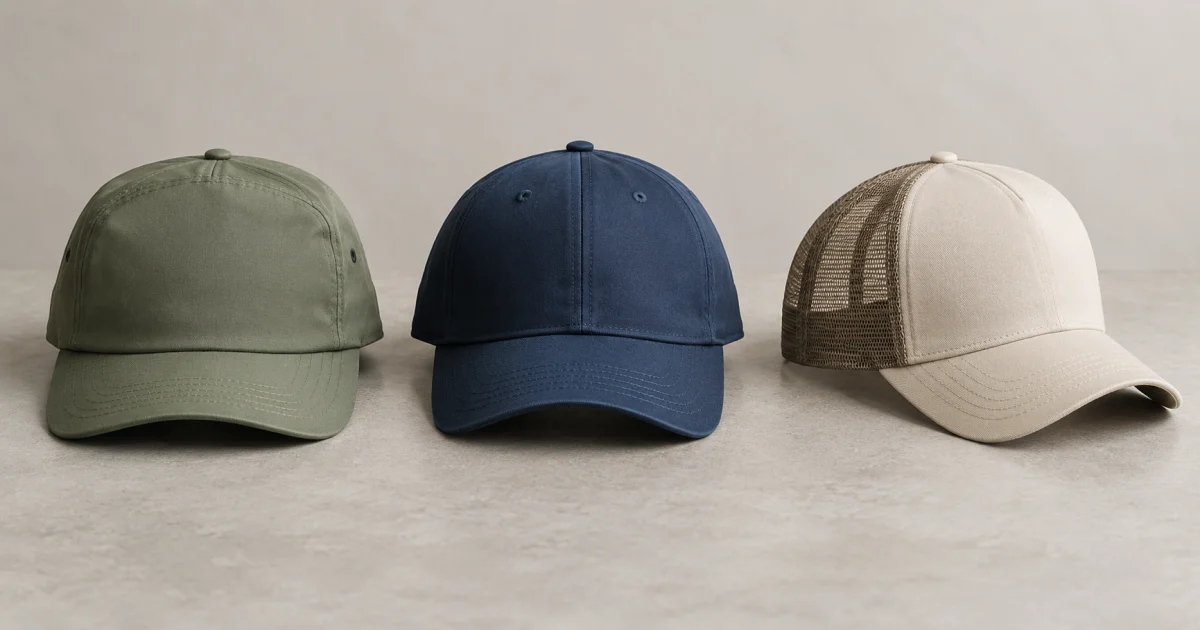
The short answer: choose a five-panel cap when your approved model offers the clean, uninterrupted front that a prominent logo needs. Choose a six-panel cap when its classic crown and fit suit your team and the logo still works across its front construction. A trucker cap is not a third panel count: it usually has mesh at the side or back and can be five- or six-panel. For a Malaysian bulk order, choose the exact cap code and approve one decorated, worn sample before production.
This guide chooses the blank cap. If you have already chosen a cap and need to decide between raised and low-profile stitching, see 3D puff vs flat embroidery for caps.
Compare three separate specifications
| Question | What it tells you | What it does not tell you |
|---|---|---|
| Five or six panels? | How the crown is assembled and whether the front of the specific model has a centre seam | Whether it is structured, mesh-backed, adjustable or comfortable |
| Structured or unstructured? | Whether the front holds a firmer shape or relaxes against the head | Panel count or the maximum logo size |
| Trucker or full-fabric? | Whether the chosen model uses mesh side/back panels | Whether it has five panels, six panels or a particular closure |
Richardson’s cap-style guide describes its five-panel styles with a seamless front and its six-panel styles as a classic baseball-cap shape. Its shape guide also lists both five- and six-panel crown profiles that differ in structure and height. These are useful construction terms, not a guarantee that every brand’s five-panel cap has the same surface or fit. Inspect the actual product.
Match the front to the finished logo
Start with the final logo width, height and placement, not a picture of a generic cap. Ask the decorator where the artwork will sit relative to the centre seam, brim, top button and side-panel joins. Check the usable front area on the curved cap; a flat artwork file does not define that area.
An uninterrupted front can make a broad wordmark easier to position and review. A six-panel front with a centre seam is not automatically unsuitable for embroidery, but the seam is a real change in the sewing surface. Ask for a sew-out on the exact model, especially if a narrow letter or critical detail lands on the seam. A soft, unstructured cap may also sit differently from a firm structured one when worn.
If the logo has tiny text, address that before buying caps. Our minimum embroidery text and line guide explains why the final physical size and sample matter. Do not assume a larger blank front will rescue artwork that is too fine to stitch.
Decide whether mesh and closure suit the wearers
Mesh changes the side/back construction and feel; it does not identify the front panel count. Flexfit currently lists a five-panel mesh-back trucker model 6506 and a six-panel mesh-back model 6511W. The first has a snap closure; the second is stretch-fitted in size bands. Those are two product examples, not universal specifications for trucker caps.
For outdoor crew or an event giveaway, check the actual fabric, mesh coverage, sweatband, brim, closure and care label. Mesh may feel more open, but do not promise that one cap will keep every wearer cool in Malaysia’s heat. Let intended staff try on a sample during the work they will perform; check that it stays secure and does not obstruct sightlines.
“One size” is a range, not proof of universal fit. Record the manufacturer’s stated head-size range and test the closure at both comfortable ends. If your group includes children, request a separate child model and fit check rather than shrinking the adult artwork in a mock-up. Oren Sport’s current Malaysian cap range lists different cotton, polyester, trucker and children’s codes—further reason to quote an exact code instead of “one cap”. Confirm availability with the selected supplier.
Approve the cap as a finished product
Give competing suppliers the same brief:
- cap brand/model code, colour, panel layout, structure, profile, material and closure;
- size range and the number needed in each model or colour;
- logo source file, final dimensions, placement and decoration method;
- whether a centre seam or other join lies under the artwork;
- a physical decorated sample and the decision-maker who will approve it; and
- packing, delivery postcode and the in-hand date.
Compare the total for the exact capped-and-decorated specification, not just the blank cap price. On the sample, inspect the front, side and worn view; check symmetry, readability, any seam distortion and comfort. Photograph the approved result with its cap code. The sample approval checklist gives a wider record format that you can adapt for caps.
If you change the cap model after approval, recheck the logo. A different crown height or front seam can change its apparent placement even when the embroidery file stays the same. For a comparable quotation, request a BajuPrintz quote with the exact cap code and sample requirement, and confirm which supplier can provide the chosen model.
Frequently asked questions
Is a five-panel cap always better for a logo?
No. An uninterrupted front can simplify some decorations, but the crown shape, support, usable area, artwork and wearer's fit still matter. Approve the logo on the exact cap model before ordering in bulk.
Can a six-panel cap be embroidered across its centre seam?
It may be possible, but the seam changes the surface beneath the stitches. Ask the embroiderer to assess the final-size design on that model and approve a physical sew-out rather than relying on a flat mock-up.
Is a trucker cap the same thing as a five-panel cap?
No. Trucker usually describes a cap with mesh side or back panels; panel count is a separate specification. Both five-panel and six-panel trucker models exist.
Does one-size-fits-all mean a cap will fit every staff member?
No. Check the maker's head-size range, closure and crown depth, then try a sample on the intended wearers. Some cap models use separate fitted size bands instead of one adjustable size.
Ready to compare suitable printers?
Get 5 Free Quotes