
Canvas vs Non-Woven Tote Bags for Events: Which Should You Print?
Choose an event tote bag by its contents, construction, print method and delivered cost—not a material label alone. A practical Malaysian buyer checklist.
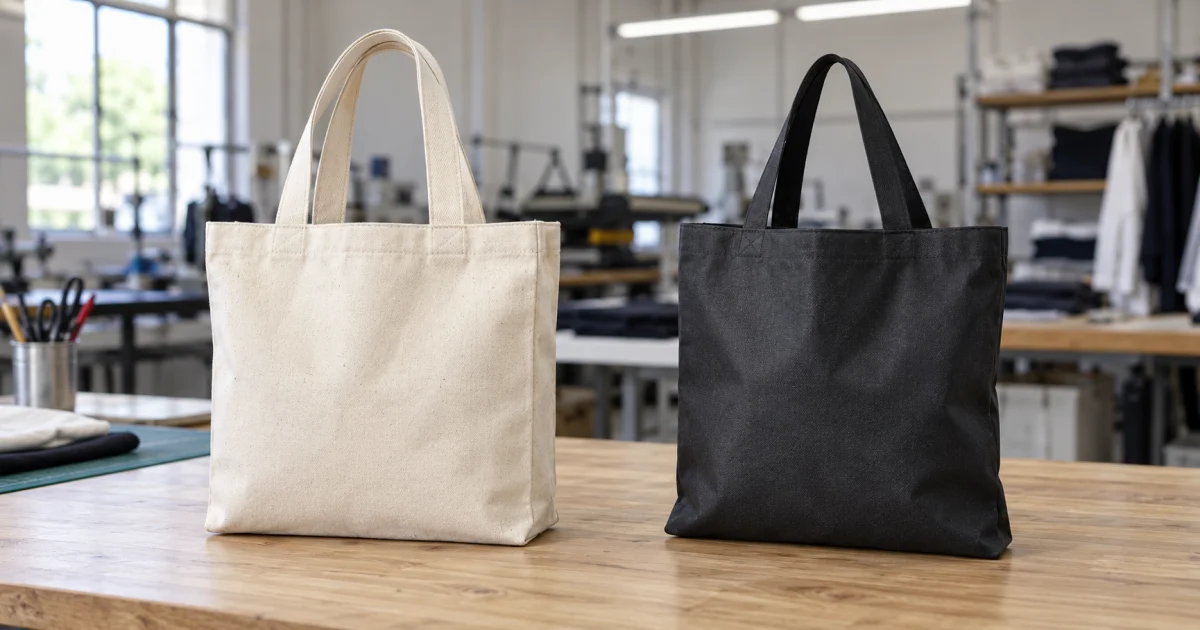
The short answer: choose non-woven only when its exact model carries your event pack safely and its finish suits the artwork; choose canvas when the intended use and approved sample justify its different construction and cost. Neither label guarantees a better print, longer use or a greener giveaway. For a Malaysian seminar or brand event, test a filled, decorated bag before ordering the full quantity.
This is a bag-selection decision, not a second guide to counting pre-orders. The event merchandise pre-order guide covers demand and stock; here the question is which physical bag to specify.
Compare the bags you can actually order
| Check | Cotton canvas tote | Non-woven tote |
|---|---|---|
| Material and feel | Woven cotton with a visible texture; weight and stiffness vary by model | Usually non-woven polypropylene; weight and seam construction vary by model |
| Carrying job | Check the actual base, handle attachment and intended contents | Check the actual base, handle attachment and intended contents |
| Decoration | Confirm the chosen method reproduces the artwork on that weave | Confirm the chosen method and any heat are compatible with that material |
| Quote | Compare one specified model, print area and delivered quantity | Compare one specified model, print area and delivered quantity |
Do not compare “one canvas bag” with “one non-woven bag” as if either were a single specification. Excard’s current canvas range lists a CT8-A3 model at 360 × 400 mm and a different gusseted CTD12-A3 model at 360 × 320 × 100 mm. Its non-woven range includes a WS-A4 model at 280 × 330 × 80 mm with 90 gsm material and ultrasonic finishing. These are examples from one supplier, not universal sizes, weights or performance ratings.
Start with the contents and handover
For a seminar pack, lay out the actual folder, booklet, bottle and other items. Measure the largest rigid item and the filled stack; then check the sample bag’s usable opening, internal width, height, gusset and handles. “Fits A4” on a listing is helpful screening, not proof your full pack will slide in or carry comfortably.
If guests will hold the bag while queuing or travelling between venues, fill a sample and carry it through a realistic handover. Check whether the base distorts, handles pull at their attachment, and printed artwork creases where the bag folds. Record the product code and approved contents, not just a photograph of an empty tote.
For event merchandise sold rather than given away, decide the offer and quantity separately; do not let a cheaper blank bag determine a product that buyers did not request.
Match the decoration to the material
Canvas can be decorated, but the weave, handles and seams affect the usable area. Transfer Express’s canvas-tote application example explains how straps can interrupt pressure in its heat-transfer workflow. That does not mean every transfer, accessory or pressing recipe works on every canvas bag.
Non-woven polypropylene needs a separate decision. Transfer Express’s polypropylene-bag guidance warns that the material is heat-sensitive and calls for a compatible low-temperature transfer and a flat application area. Do not copy a cotton-canvas press setting onto non-woven material. Silk screen or another process may be offered, but ask the actual printer to approve the bag and artwork together.
Mark the front or back print position in centimetres. Keep important text away from handle stitching, side seams, pockets and folds; the guide to printing around seams and obstructions explains the pressure issue. Use the artwork-file guide to supply a production-ready logo instead of asking a printer to enlarge a small screenshot.
Compare a complete quote, then approve the sample
Ask each supplier for the same written brief:
- exact bag code, material, dimensions, colour, handle and seam construction;
- contents to be carried and any load claim the supplier is willing to support;
- artwork file, print method, colours, dimensions and position on each side;
- quantity, sample/proof charge, packing, delivery postcode and in-hand date; and
- the rule for a bag or material substitution.
Compare the complete decorated-and-delivered total, not the blank-bag price alone. A digital mockup cannot establish handle strength, print feel or transfer compatibility. Use the sample approval checklist to record a physical pass, change or rejection before bulk production.
Avoid calling either material “eco-friendly” simply because it can be reused. That conclusion depends on actual use and end-of-life, not a promotional label. If you are also ordering shirts, browse Baju Printz printers and first confirm which suppliers can quote tote bags; keep the bag specification as a separate line from the apparel order.
Frequently asked questions
Is canvas or non-woven better for an event giveaway?
Neither is universally better. Compare the exact bag's size, handles, seams and tested carrying capacity against what guests will receive, then compare the complete decorated and delivered cost.
Can a non-woven tote bag be heat printed?
Some non-woven polypropylene bags can be decorated with a compatible low-temperature transfer, but the material is heat-sensitive. The printer must check the exact bag and transfer instructions and approve a physical test.
Does a canvas tote always give a better print?
No. Canvas has a visible weave and bags vary in weight and construction. Ask for a sample of your artwork on the exact bag, and check detail, colour, edges and placement before the full run.
What tote bag size fits A4 event documents?
Measure the actual document pack and compare it with the bag's usable internal dimensions and opening. An A4 label is only a model description; pockets, seams and gussets can change the usable space.
Is a canvas tote automatically more sustainable than a non-woven bag?
No material label alone proves a lower environmental impact. Consider whether recipients will use the bag again, its construction and care, and the disposal route available to them; avoid an unsupported environmental claim.
Ready to compare suitable printers?
Get 5 Free Quotes