
Can You Remove or Cover an Old Logo on a Uniform?
Decide whether to remove, cover or replace an old uniform logo by checking the decoration, fabric, remaining marks, sample result and total recovery cost.
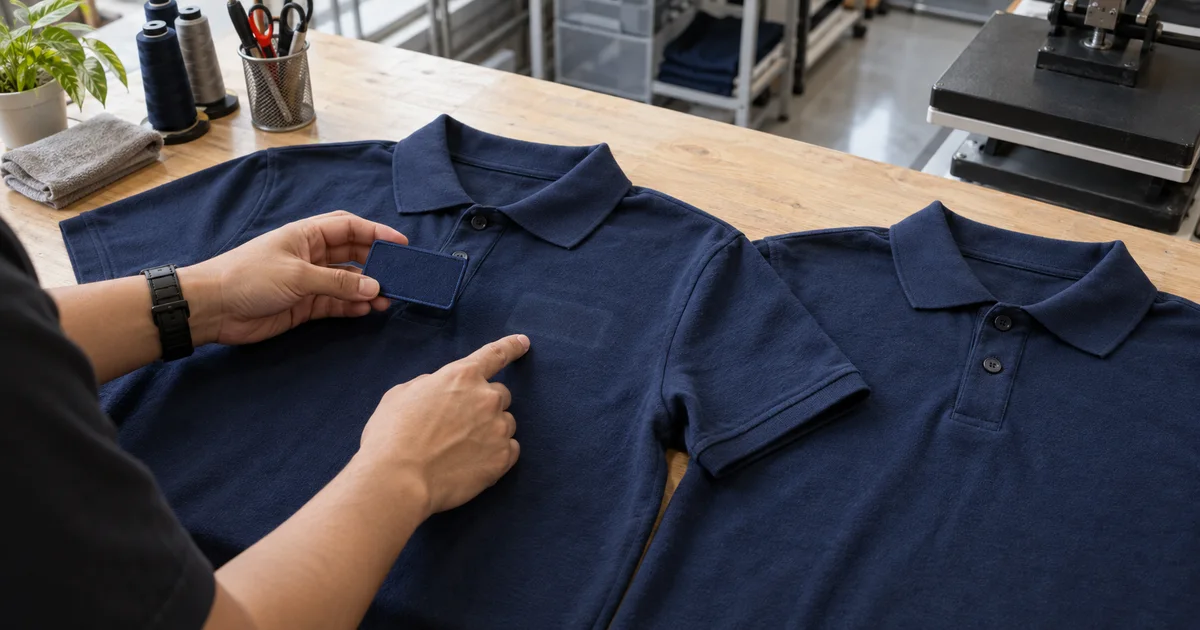
The short answer: an old uniform logo can sometimes be removed or covered, but no method returns every garment to a blank, new condition. First identify the existing decoration and fabric. Then test one expendable uniform, inspect the remaining outline or damage, and compare the complete recovery cost with replacing the garment.
Treat removal, covering and replacement as three different quotations. A supplier who can remove heat transfer vinyl may not be able to erase screen ink, embroidery needle marks or a sublimated design. A larger patch can hide an area, but it also changes the uniform’s appearance, feel and care requirements.
Use the existing decoration to choose a starting path
| Existing decoration | Practical starting options | Main uncertainty |
|---|---|---|
| Cut heat transfer vinyl (HTV) | Specialist removal trial, or a compatible larger transfer | Adhesive residue, colour difference, heat mark or fabric damage |
| DTF, plastisol transfer or screen print | Supplier assessment; a deliberate opaque cover may be tested | Added thickness, old edges showing, heat exposure and adhesion |
| Direct embroidery | Careful unpicking trial, or a larger sew-on patch | Needle holes, puckering, backing residue and a visible outline |
| Existing patch or badge | Remove the attachment and fit a larger approved patch | Stitch holes, adhesive, stiffness and the old border showing |
| Sublimation | Replace the garment or panel; test an opaque applied redesign only if necessary | The dye is within the polyester, so there is no surface layer to peel away |
This table is a triage tool, not a guarantee. Two navy polos can react differently if their fibres, dye, coating, age or previous press history differ.
Identify the garment before anyone starts removing the logo
Ask the supplier to inspect the outside and inside of the decorated area. Provide:
- garment brand, model, colour and fabric composition;
- whether it is new, worn, faded, stretched or repeatedly washed;
- the original decoration method, if known;
- the old logo’s full width, height and position;
- photographs under even light, including the inside backing or adhesive area;
- the number of affected uniforms and sizes;
- whether identical replacement garments are still available; and
- the new artwork, finished dimensions and required date.
Do not identify a method only by touching the front. A surface film might be HTV, DTF or another transfer, while an all-over polyester jersey may be sublimated. If the production record is missing, ask the original supplier before authorising a removal attempt.
The customer-supplied garment guide explains how to record condition and agree what happens if a trial changes the item.
Understand that removal is not the same as restoration
Siser’s official HTV correction guidance describes using a vinyl-lettering remover from the inside or carefully reheating the material to loosen it. That shows that some HTV errors can be corrected; it does not show that every fabric will return to its original colour and texture.
After a removal trial, inspect for:
- adhesive or ink residue;
- a glossy, flattened or scorched area;
- a darker or lighter rectangle caused by uneven fading;
- stretched fibres or surface abrasion;
- needle holes, puckering or remaining backing; and
- an outline visible from normal conversation distance.
Do not apply an unknown solvent, heat setting or scraping method across the full order. Ask the specialist to name the process, test it on one expendable piece and follow the garment and decoration manufacturers’ safety instructions.
For waterproof, high-visibility, flame-resistant or other protective workwear, do not assume that removing stitches, adding heat or covering a mark preserves the garment’s claimed performance. Obtain approval from the garment manufacturer or the person responsible for the workplace specification before altering it.
Make a cover design solve the whole old footprint
A new logo that is only slightly larger can leave corners, adhesive shadows or stitch holes exposed. Measure the complete affected footprint, not just the visible letters. Then create a deliberate patch, badge or transfer shape with enough margin to cover it consistently.
Check the proposed cover for:
- opacity over the old colour and edges;
- sufficient margin around the affected area;
- alignment with the placket, pocket, seam and opposite chest element;
- acceptable stiffness and weight while worn;
- heat compatibility with the garment;
- a clean inside finish; and
- care instructions suitable for the complete uniform.
An embroidered patch can be sewn on or attached with a compatible heat seal. Madeira’s emblem finishing guide explains both paths and notes that heat-seal bonding can add stiffness. The patch supplier must still specify the attachment and test the production garment. Use the direct embroidery versus patch guide to compare the resulting construction.
Do not turn a cover-up into an accidental solid rectangle. If the patch must be much larger than the intended identity, replacing the garment may produce a cleaner uniform.
Treat sublimation as a different problem
True sublimation does not sit on top of the shirt. Sawgrass explains that the dye turns into gas under heat and pressure and bonds directly into polyester fibres. The old design therefore cannot be peeled away like a film.
For a sublimated jersey or panel, the clean starting options are usually:
- replace the garment;
- replace a separately constructed panel when the manufacturer offers that service; or
- redesign the area with an opaque applied decoration after testing colour bleed, adhesion, flexibility and feel.
The third option is a new decoration system, not removal. A wide opaque transfer can also reduce breathability and create a noticeably different surface. Compare it against a replacement before approving the batch.
Build one recovery sample before pricing the whole batch
Choose a non-critical garment that represents the production order. If there are different fabrics, colours or decoration methods, each group needs its own decision.
Ask the supplier to record:
- the garment and old decoration identified;
- the exact removal or covering process used;
- the condition before and after treatment;
- the new decoration material, dimensions and attachment;
- the wash and care test agreed; and
- the result after the sample is worn and viewed in normal light.
Approve the complete physical sample rather than a digital mockup. The sample approval checklist helps record position, colour, feel, workmanship and care before the remaining uniforms are released.
Compare recovery and replacement as complete costs
Use two written totals:
Recovery total = inspection + removal or cover preparation + new decoration + sample + expected rejects + sorting + delivery.
Replacement total = new garment + correct decoration + size handling + delivery.
Recovery may make sense for a small number of expensive jackets, an unavailable garment model, or a planned sew-on badge system. Replacement often makes more sense for low-cost T-shirts, a large or faded old mark, unknown fabric, widespread damage or a result that still looks visibly repaired.
Also ask how rejected pieces will be counted and replaced. If 60 uniforms are required for staff, do not treat a damaged recovery sample as part of the 60 wearable units unless it is formally accepted.
Send a recovery brief that can be quoted
State the garment model, fabric, age, quantity, old decoration method, affected dimensions, new artwork, preferred removal or cover option, test piece, required finished quantity, acceptance standard and deadline. Ask for a separate replacement option using the closest available garment.
You can request comparable uniform quotations through Baju Printz after photographing the affected area and deciding which garments may be used for the recovery sample.
Frequently asked questions
Can an old logo be removed from a uniform without leaving a mark?
Sometimes, but it cannot be promised. The result depends on the decoration, adhesive or stitches, fabric, colour, wear and previous heat exposure. Test one non-critical garment first and approve the result before treating the full batch.
Can a new logo be printed over an old logo?
Only after a supplier checks the old decoration and garment. The new mark normally needs enough opacity and coverage to hide the complete old footprint, while added heat, thickness, stiffness and dye migration must remain acceptable.
Can embroidery be removed and replaced?
Stitches may be unpicked, but needle holes, puckering, backing residue, faded fabric or a visible outline can remain. A larger sew-on patch may cover the area more predictably, but the exact garment still needs a sample.
Can a sublimated logo be peeled off a polyester jersey?
No. True sublimation dyes the polyester rather than adding a peelable surface layer. Replacing the garment or panel is usually cleaner; an opaque applied decoration is a redesign that must be sampled for colour bleed, feel and durability.
Is covering an old logo cheaper than replacing the uniform?
Not always. Compare inspection, removal or covering, a recovery sample, rejected pieces, redecorating, sorting and delivery with the price of a replacement garment carrying the correct logo.
Ready to compare suitable printers?
Get 5 Free Quotes