
How Many T-Shirt Sizes Should a Class Order? Size Breakdown Guide
Calculate a class t-shirt size breakdown using an exact supplier chart, named responses, fitting checks and deliberate spare quantities.
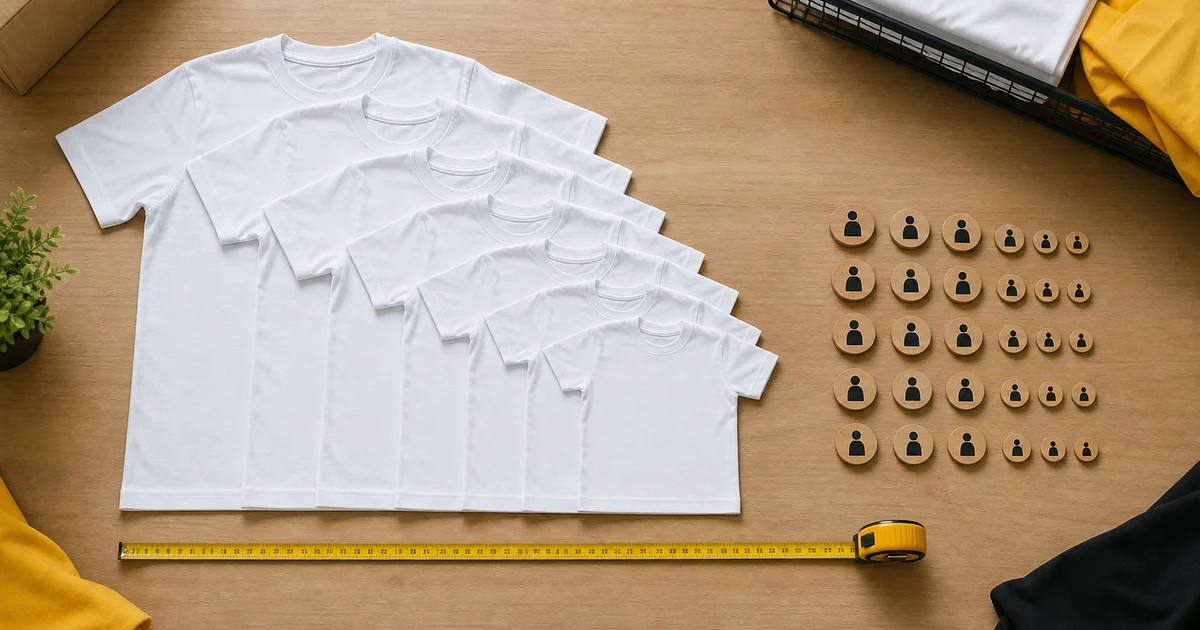
The short answer: order one confirmed size for every named student and teacher, then add only the spare shirts your class has deliberately approved. There is no reliable universal percentage for S, M, L or XL—build the quantity from the exact supplier chart and your actual roster.
This method prevents two common errors: assuming an M fits the same across every brand, and buying a generic size ratio that does not match the class.
The size calculation
Use this formula:
Total order = confirmed student shirts + teacher or adviser shirts + approved spares
Then count each product and size separately. The sum of the size breakdown must equal the total order.
Worked example
A class has 35 confirmed students and two teachers. It chooses two spare shirts after reviewing the real size list:
| Size | Named shirts | Approved spares | Order quantity |
|---|---|---|---|
| 2XS | 2 | 0 | 2 |
| XS | 6 | 0 | 6 |
| S | 12 | 1 | 13 |
| M | 10 | 1 | 11 |
| L | 5 | 0 | 5 |
| XL | 2 | 0 | 2 |
| Total | 37 | 2 | 39 |
This is an arithmetic example, not a recommended Malaysian size ratio. Another class of 37 people could have a completely different breakdown.
1. Freeze the exact shirt first
Do not ask “What is your usual t-shirt size?” before choosing the garment. Record the brand, product code, cut and fabric, then share only its chart.
Current Malaysian product catalogues illustrate the problem. Oren Sport lists some kids shirts in numbered sizes 24–32, while selected unisex products use lettered sizes across a different range. Its 2025–2026 catalogue also states that actual product measurements may vary by plus or minus 5%. Check the current product chart and stated tolerance for the exact shirt being quoted.
Another Malaysian printer, CUSTA, similarly advises buyers that an M in one product will not measure the same as an M in another and recommends measuring a well-fitting shirt against the selected product’s size chart.
These are supplier-specific examples, not a universal tolerance or scale. Your quotation and chosen product chart remain the final reference.
2. Know what the chart measures
A chart may show garment measurements or body measurements. Do not compare the two as if they were identical.
For garment measurements, lay a shirt that fits comfortably on a flat surface and compare equivalent points, commonly chest width and body length. Follow the diagram supplied with the chosen product because measurement points can differ.
Also confirm whether the shirt is:
- kids, adult or unisex;
- regular, fitted or oversized;
- short sleeve, long sleeve or Muslimah cut; and
- the same model for every size.
Never convert between these cuts using the letter on the label alone.
3. Collect one named response per wearer
Use a simple private form or sheet with these fields:
- student or teacher name;
- class or group;
- chosen product and cut, if more than one is offered;
- confirmed size;
- printed name or number, if required; and
- payment status.
Set one response deadline. Follow up directly with missing names rather than guessing their sizes. A try-on sample is the clearest option for anyone between sizes or uncertain about the cut.
The complete class t-shirt order guide covers approvals, artwork, quotations and delivery around this size list.
4. Count separate garment models separately
If the class offers a kids tee, unisex tee and Muslimah top, create one subtotal for each product before combining the purchase total. Different models may have different prices, stock ranges and printable areas.
A clean summary looks like this:
| Product code | Colour | Size range used | Quantity |
|---|---|---|---|
| Unisex tee A | Navy | XS–XL | 28 |
| Kids tee B | Navy | 28–32 | 7 |
| Long-sleeve tee C | Navy | S–L | 4 |
| Total | 39 |
The product names and figures above are illustrative. Replace them with the actual quotation.
5. Decide spares from the real risk
Spare shirts are a choice, not a hidden percentage. Ask:
- Can students still join after the deadline?
- Does the class need one display, prize or teacher unit?
- Can the printer make a small reorder later, and at what cost?
- Would a replacement be needed if a personalised spelling is wrong?
- Is the class paying for unused stock?
If spares are approved, choose their sizes from the class’s confirmed distribution and record them as “spare”, not under a student’s name. Do not add large quantities only to reach a discount tier.
6. Run a final reconciliation
Before payment, verify that:
- every named wearer appears once;
- every selected size exists for the quoted product;
- teacher units and spares are labelled separately;
- personalised names match the artwork list;
- all size subtotals equal the purchase total; and
- the printer has acknowledged the final breakdown in writing.
Save that version as the order record. Any later change should update both the named list and the size totals.
Get the exact chart before collecting sizes
The safest class order starts with a product code, not a guessed ratio. When your roster and specification are ready, browse Malaysian printers by location or send one complete brief through Baju Printz.
Frequently asked questions
Can a class estimate t-shirt sizes from students’ ages?
Age or school year is not reliable enough for a final order. Share the exact supplier chart and collect one confirmed size from every wearer because body proportions and garment cuts vary.
Should a class order more M and L shirts as spares?
Only if the class’s confirmed size list supports that choice. There is no universal class-size ratio, so spare sizes should follow the actual group rather than a generic distribution.
How many spare class t-shirts should be ordered?
There is no fixed number. Consider late joiners, replacements, teacher units, budget and whether a small reorder is possible, then record every spare separately from named shirts.
Can kids and adult sizes be combined in one class order?
Sometimes, but they may be different garment models with separate size scales, stock and prices. Ask the supplier whether both models can share the same artwork and quantity tier.
Ready to compare suitable printers?
Get 5 Free Quotes