
Can You Put a Company Logo on a High-Visibility Safety Vest?
Order branded high-visibility vests in Malaysia without guessing about logo placement, garment approval, reflective bands, printing methods or sample checks.
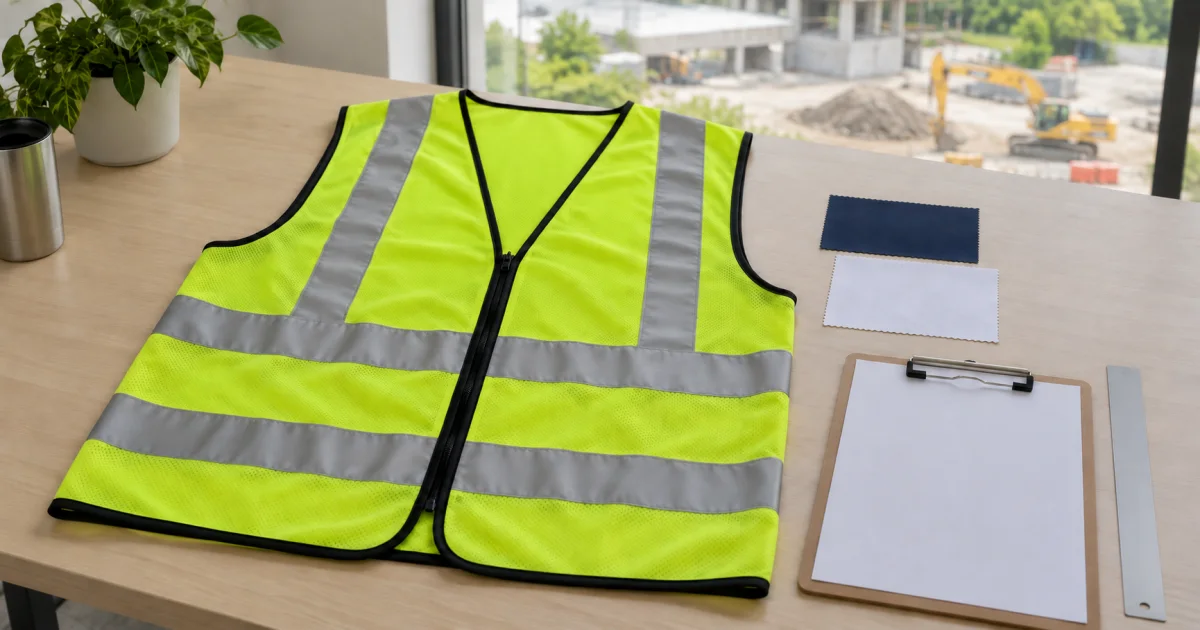
The short answer: you can add a company logo to a high-visibility vest only after the exact vest, decoration method and logo position are approved for its intended use. Start with the workplace risk and the garment specification. Ask the garment maker or authorised supplier where branding is permitted, then have the safety owner approve a decorated sample before placing the bulk order.
This is a different purchase from printing an event vest for visual identification. A bright colour, silver-looking tape or reflective logo does not by itself establish that the finished garment meets a protective clothing requirement.
Is the vest for workplace protection or event identification?
State the job before asking for a print price. A site marshal near moving vehicles, a warehouse worker in a loading zone and a volunteer directing guests may face different risks. In Malaysia, section 18B of the Occupational Safety and Health Act 1994 requires an employer, self-employed person or principal to conduct a risk assessment for people who may be affected by their undertaking and implement controls where needed.
Ask the organisation’s safety owner to specify the garment required for the assessed setting, including daytime, night-time, vehicle movement and other site rules. A printer should receive that approved specification; it should not be expected to decide the protection level from a logo file.
| Intended use | First buying decision | Branding decision |
|---|---|---|
| Assessed work near traffic or machinery | Select the approved protective garment and required performance | Use only a decoration approved for that exact garment |
| Event identification where no protective clothing is specified | Choose a suitable visibility garment for the event plan | Specify logo size, position, comfort and care without making unsupported safety claims |
The same garment appearance can be sold under different specifications. Request documents for the exact model and size range being quoted, rather than relying on a catalogue photograph.
What does a high-visibility clothing specification control?
The published ISO 20471:2013 standard covers colour and retroreflection, including minimum material areas and placement in protective clothing. The ISO page lists the published edition as current while a replacement draft is under development. That makes the full garment construction relevant to any proposed logo, especially on small sizes where available visible area is tighter.
ISO 20471 is not a universal statement that every Malaysian event vest must meet that standard. Use the standard and any other applicable requirement selected by the safety owner for the particular work. Request the model’s performance evidence through the organisation’s normal procurement process.
Do not assume that a badge, printed letter or extra reflective patch upgrades an ordinary vest to the specified performance. The selected garment must meet the required specification as a complete wearable item.
Where can the logo go without disrupting the vest?
Mark the vest’s front and back at actual scale. Identify reflective bands, fluorescent panels, seams, closure, pockets and labels before placing any artwork. A location that looks empty in a flat photo may be covered when the vest is zipped, worn over a jacket or viewed from behind.
Ask the garment maker or authorised supplier for its permitted decoration zone and maximum dimensions. Give that information to the printer as a constraint, not a suggestion. Do not move the logo onto a band or enlarge it after sample approval without another review.
For each proposed position, check:
- whether the mark covers or interrupts required material;
- whether it remains visible on the smallest and largest ordered sizes;
- whether a strap, radio, lanyard or outer layer hides it;
- whether the print sits across a zip, pocket or seam; and
- whether the garment can still be inspected and cared for as instructed.
A small chest mark may be easier to position than a large back graphic, but there is no universal safe logo size. Approval belongs to the exact vest design and specified performance.
Which decoration method should you quote?
Ask the supplier to name the method it allows on that garment. Screen printing, a transfer, embroidery or a sewn-on identifier may affect fabric, tape, seams and wash care differently. A technique that works on a normal polyester T-shirt is not automatically suitable for a protective vest.
Compare the proposed method on three points: whether it is permitted by the garment maker, whether the printer can apply it without covering required areas, and whether the finished sample survives the intended care routine. Dense embroidery may pull lightweight mesh; a large transfer may stiffen the panel or need heat the vest cannot tolerate. These are sample checks, not claims that every vest will fail.
Use the uniform embroidery-versus-printing guide for the general method trade-offs. For a protective vest, the garment’s approved instructions decide the allowable process.
What evidence should the quotation include?
Send one controlled brief to each supplier:
- exact garment maker, model, colour and size range;
- safety owner’s required performance specification and supporting evidence request;
- approved decoration zone, maximum dimensions and application method;
- final artwork file with finished dimensions and colour references;
- quantity by size, including spare and replacement stock;
- required decorated sample and approval date;
- washing, storage and inspection instructions; and
- delivery postcode and required receipt date.
Request an itemised price for the garment, logo setup, decoration per vest, sample, packing and delivery. If a supplier proposes another vest or print process, require a new written approval for that combination. The quotation comparison guide helps keep production lines comparable; do not group unlike vest models into one assumed price tier.
Approve the worn sample before the bulk run
Photograph the sample flat and worn from the front, back and sides. Inspect it closed and layered as it will be used. Compare logo position on a small and a large size, then check the reflective bands and fluorescent areas remain as specified by the garment maker and safety owner. Follow the stated wash and care method before approval.
Record the garment code, size chart version, artwork version, logo dimensions, print process and signed sample together. The sample approval checklist covers general visual and production checks; add the safety owner’s garment-specific acceptance record for this job.
Request comparable quotations through Baju Printz when the approved vest model and decoration rules are ready. Ask each supplier to quote the same garment and a physical sample so the choice rests on a reviewed finished vest.
Frequently asked questions
Can a company logo be added to a high-visibility safety vest?
It may be possible, but first select the vest for the assessed work risk and get the manufacturer or authorised supplier and workplace safety owner to approve the exact decoration and position. A blank area on a vest is not automatic permission to print there.
Can a logo cover a reflective strip on a safety vest?
Do not approve artwork that covers a reflective band or required fluorescent area without a competent review of the complete garment. High-visibility specifications assess material area and placement, so a decorated vest needs to be checked as a whole.
Does a reflective logo make an ordinary vest safety compliant?
No. A reflective logo alone does not establish the colour, retroreflection, material area, placement or evidence required for a specified high-visibility garment. Select the protective garment first, then consider branding.
Is heat transfer printing suitable for a safety vest?
Only when the garment maker or authorised supplier accepts that transfer and application process for the exact vest. Heat, adhesive, washing and the decorated area may affect the garment, so approve a production sample and its care instructions.
What should a buyer request before ordering branded safety vests?
Request the exact vest model and size range, applicable performance specification and evidence, approved decoration zone and method, final-size artwork, a decorated sample, care instructions, quantity by size and written sign-off from the workplace safety owner.
Ready to compare suitable printers?
Get 5 Free Quotes