
Laminated Card or Synthetic Paper for Restaurant Menus in Malaysia?
Choose a restaurant menu material by comparing handling, spills, cleaning, price changes and the complete Malaysian print quotation.
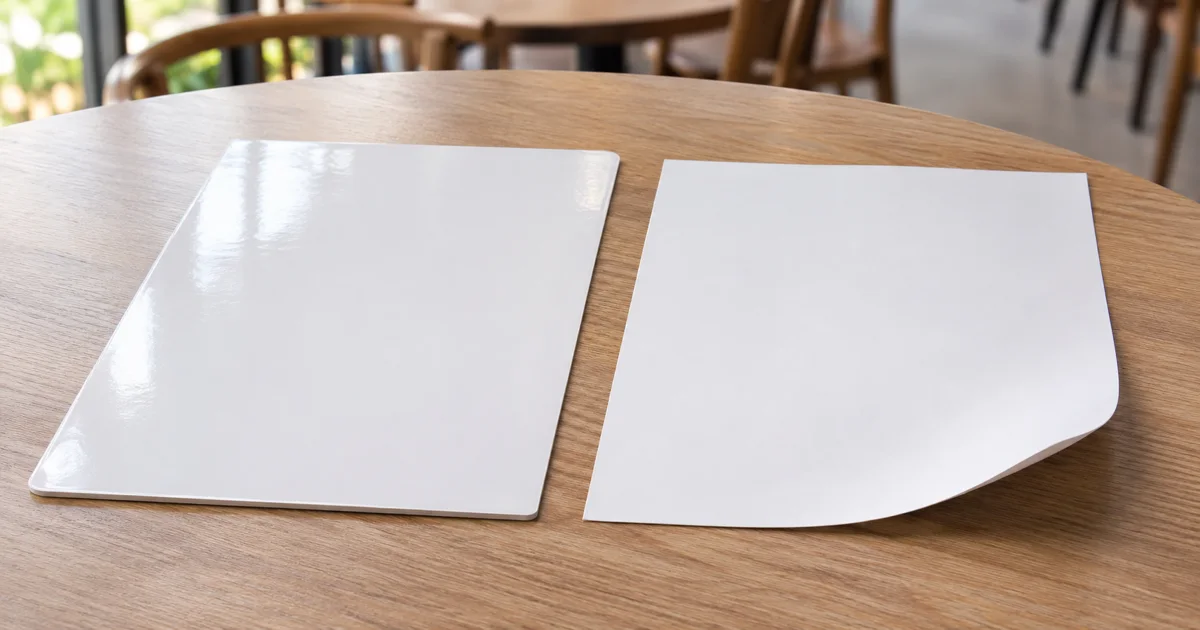
The short answer: choose a laminated card menu when a familiar rigid sheet and straightforward reprints suit your service; compare synthetic paper when repeated handling and spills make the sheet material itself important. Neither label proves that the finished menu will survive your cleaning routine. Request samples on the proposed stock, print and finish, and test them in the restaurant before approving a full run.
This guide is about a menu handed to diners, not a table tent that stands on the counter or a takeaway flyer. Malaysian printer Printlab lists art card, ivory card and waterproof synthetic paper for one express menu-card product. Gogoprint lists several paper/card weights and optional matte or gloss lamination for its menus. These are supplier-specific ranges, not a standard menu specification or a promise about BajuPrintz printers.
Compare the finished menu, not just the material name
| Buyer check | Laminated paper or card | Synthetic paper |
|---|---|---|
| Feel at the table | Check stiffness, thickness, corner shape and glare under dining lights | Check flexibility, thickness, grip and whether it lies flat |
| Spills and wiping | Inspect cut edges and any folds after a real wiping test | Test the printed surface, edges and any added finish with the same routine |
| Menu changes | Price the next reprint at the quantity you will actually need | Include replacement of outdated sheets in the comparison |
| Format | Confirm whether the chosen card and film can be folded or bound as specified | Confirm the printer can make the required folds, holes or binding on that exact stock |
Printlab’s waterproof menu listing describes synthetic paper and laminated art card as different material routes, with options such as folding, rounded corners and multi-page binding. That does not mean every combination is available for every quantity or finish. Ask for a finished sample of the exact construction rather than borrowing a generic swatch.
How often will dishes and prices change?
A menu that lasts longer can still be the wrong purchase if prices, dishes or seasonal offers change before the material wears out. Count how many menus sit on tables, how many are held in reserve, and how many versions are needed across branches. Compare the cost and timing of a partial reprint, not only the first batch’s unit price. For frequently changing content, ask whether a reusable holder with replaceable inserts would be easier to maintain than a fully printed durable sheet.
Keep one approved master list for names, prices, descriptions and dietary notes. Mark the version date on the production file, not necessarily on the customer-facing design, and confirm who signs off changes. If the menu has a QR code, test the final-size printed code and its destination; a digital page does not correct a wrong printed price.
What should you test before ordering the full run?
Read a finished-size proof at the table under normal lighting. Look for small prices disappearing into reflections and for type near cuts, folds or binding. Wipe a sample using the restaurant’s actual cloth and cleaning method; inspect the ink, surface and edges after it dries. Do not infer compatibility with a chemical cleaner from a generic “waterproof” claim. Check that the menu does not curl, slide or feel awkward to pass between diners.
Use the selected printer’s artwork template for safe margins and files; the artwork-file guide helps you prepare the handoff. If a folded format is needed, compare it with the folded-brochure panel guide but follow the menu printer’s own dieline.
Request quotes for the same complete menu
Specify finished size, number of pages or faces, print sides, stock and thickness, lamination or other finish, corners, folds or binding, quantity per version, proof and sample, packing by outlet, delivery postcode and required in-hand date. Ask for the substrate and finishing method separately; “waterproof menu” alone is not enough to compare quotes. Confirm production and delivery dates for the chosen specification rather than applying an express listing’s timeline to every job.
You can request a BajuPrintz quote with this brief and check which menu materials and finishing options the responding printers actually offer.
Frequently asked questions
Is a laminated paper menu the same as a synthetic-paper menu?
No. Lamination is a film applied to a printed paper or card; synthetic paper is the sheet material itself. Ask the printer to identify both the substrate and any added finish.
Which menu material is better for a café with frequent price changes?
Compare the cost of replacing the full menu whenever prices change. A shorter-run card menu or a reusable holder with replaceable inserts may be more practical than a durable sheet with outdated prices.
Can all waterproof menus be wiped with the same cleaner?
No cleaning compatibility should be assumed from the word waterproof alone. Test the finished printed sample with the café's actual wiping method and ask the printer about the ink, finish and edge construction.
What should a restaurant menu print proof include?
Check every item name, price, dietary note, printed side and page order against the approved master list, then inspect a finished-size sample for legibility and handling.
Ready to compare suitable printers?
Get 5 Free Quotes